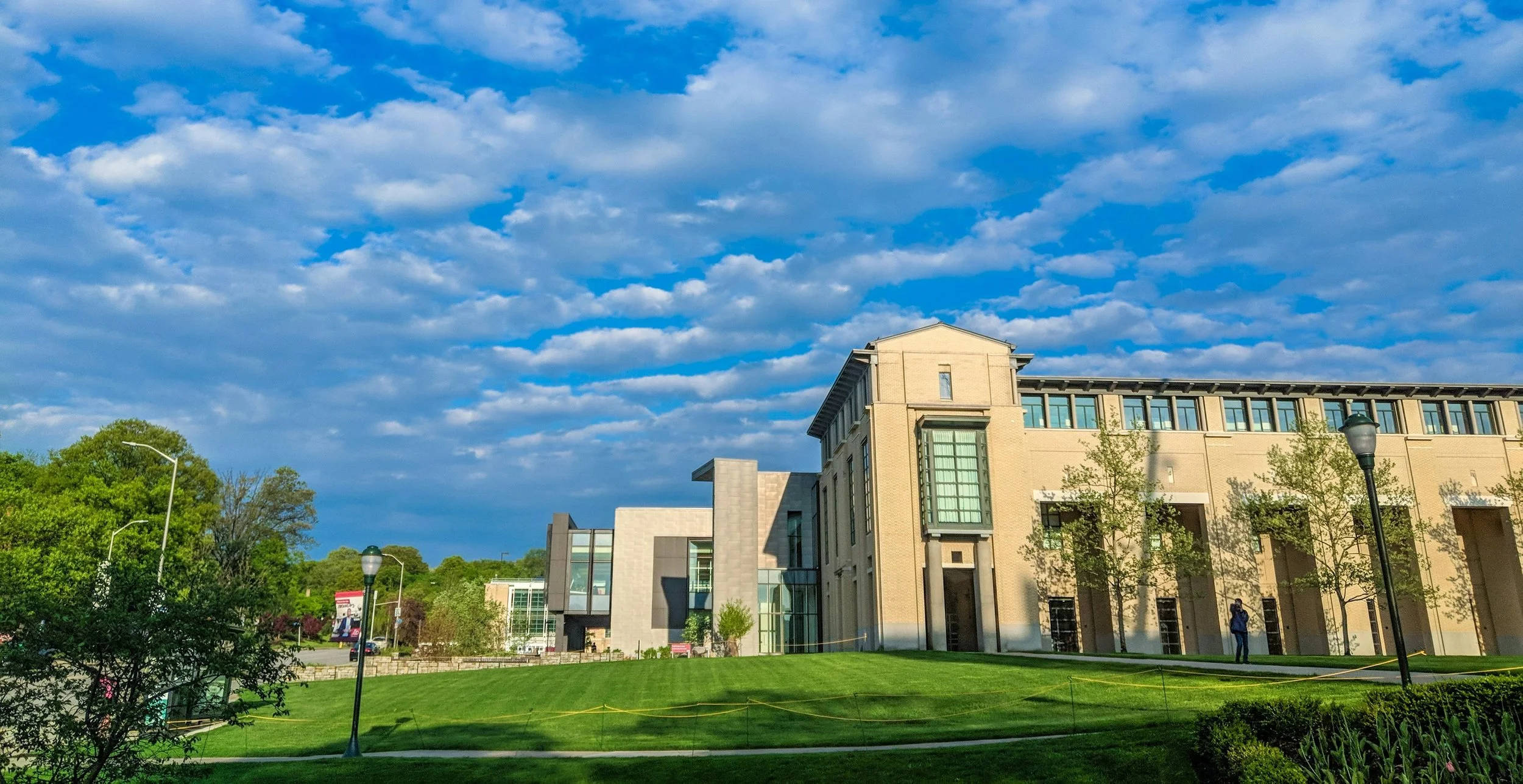
Webinar Transcript: Live Q&A with Carnegie Mellon University Senior Assistant Director of Admissions
Anna Lu
(This is a transcript of a webinar from August 2025, a recording of which you can find on our YouTube channel.)
Anthony Su (he/him): All right, we're rolling. Elton, Andrew, I'll catch you at the Q&A.
Elton Lin: All right, I am going to organize the screen a little bit... Alrighty, as people are filing in… it's been a while since we've had our admission officer series where we interview different people from across the United States, across universities up and down the West and East Coast, Midwest… with the hopes of really just trying to provide some space for our students and parents to really just understand—perhaps demystify—the admissions process.
Super excited to have Andrew McMillen from Carnegie Mellon University come on with us! He told me he's super honest—too honest, so we wanna test that theory and see what he might be able to share—but all in all, super excited to have him on.
Would you mind going on to our chat, and go ahead and tell us where you are coming from? Had all sorts of people from everywhere join in from us. I know that we have students and parents from our audience who have come in. We also have independent counselors from across the United States, so I've certainly met a lot of colleagues from across the United States and the world, so if you don't mind, go ahead and just let us know where you're coming in [from].
Connecticut, North Carolina… Cherry Hill, New Jersey… some Bay Area people, as we've always enjoyed—lots of Bay Area people. Keep rolling in where you are calling in from. And always excited—I think oftentimes we get some people from international locations… Europe—it's a little late for your people right now, but sometimes we get Asia-based people coming in as well.
But just wanna let you know: go ahead and, at the bottom, go ahead and post your questions all throughout our conversation. Andrew and I are probably going to chat for maybe… 30 to 35 minutes. And then we'll open up some time for all of you to ask questions.
We will ask them all at the end. My trusty partner, Anthony, will come back in at the end and make sure that all your questions are answered, and we'll have a good time getting to know CMU and Andrew.
So, thanks so much, Andrew, for coming on. I just want to give you an opportunity to share a little bit about yourself and introduce your role at CMU, and perhaps… it looks like you've also had a circuitous journey back to CMU. So, tell us a little bit about yourself, Andrew.
Andrew McMillen: Yeah, for sure. My name's Andrew McMillen; I'm a Senior Associate Director of Admission at Carnegie Mellon University. I got my first start in admission back in 2010 at CMU in the Undergraduate Admissions office, and I was there for five years, then went on to Allegheny College—it's a small liberal arts school a little bit north, in between Pittsburgh and Erie—and then went on to the high school side. So I was actually a high school counselor, for a little bit, and done a little bit of independent counseling, as well.
So, you know, made my way back to the admissions side at CMU, and certainly very excited to be chatting with you all today… and like Elton said, you know, hopefully demystify some things, provide some great insight, and some tidbits and things for you to be able to use in your own process.
Elton Lin: Awesome, awesome, fantastic.
So, maybe [the] first question for you is that, like, it's 2025—just to check, just make sure everyone's on the same page. But a lot has happened since 2020, and there's been some ebb and flow with regards to the admissions process and requirements. What's most changed within CMU admissions since 2020?
Andrew McMillen: Yeah, so I think the biggest thing for us has been twofold. Number one is, of course, being a school that had always required test scores for the longest time, getting to COVID, being test-optional.
And now we are back to a hybrid model, where we are going to require some type of test, but it doesn't necessarily have to be the SAT or the ACT. So students can submit AP scores from AP exams, IB scores, as well as Cambridge or French baccalaureate scores, in lieu of the SAT or the ACT.
For our School of Computer Science, you will have to submit an SAT or ACT, but all of the other academic programs will be test-flexible, is how we describe it. And then our College of Fine Arts will still be test-optional. If students would like to submit it, they can, but they don't have to.
And then the second is that we had our longtime Dean of Admission, who was there for over 50 years—he was a student at CMU back when it was Carnegie Tech, and then changed to Carnegie Mellon, and then, you know, was the Director of Admission and then Dean of Admission—his name's Mike Steidel.
He retired, back in 2023, and so… we went to a brand new leadership structure within enrollment management, as opposed to the Dean model, and ended up having a much more cohesive and fluid relationship with a lot of the other groups within our enrollment management process, like financial aid, the Hub, a lot of additional groups (like the Registrar's Office), which is hopefully making things a little bit easier for families, so where it's not a firm cutoff, right, if they do end up admitted and decide to come. There's a little bit of a gradual shift and change for that.
Elton Lin: Got it, got it. So maybe, harkening back to the first thing you mentioned about testing.
Andrew McMillen: Mm-hmm.
Elton Lin: There's certainly been… a fair amount of schools that have been going back to test-required. You—CMU apparently is also test-required for [the] School of Computer Science—and there certainly have been admission leaders who have gone on to say that having a test score is really a benefit in really understanding a student's, you know, maybe longer-term trajectory, or the viability for them to really make it all the way through school.
And it's also putting pressure, perhaps, on us, maybe students and families, where they feel like they need to have a test score in order to apply. How would you respond to that in light of that?
Andrew McMillen: Yeah. Great question, and I think the biggest thing is to prepare to take it.
At this point in time, you don't know how things are going to change. So do your best, prepare as if you're going to have to submit it to every single school. And then if you don't, then that's just an option that you're going to be able to have, if you end up not performing as well as what you might like, but you've at least done everything that you possibly can in order to have that score, in case you need it.
Besides that, though, I do think that the schools that are now indicating: here [are] our policies, we've taken a look at all the things from institutional research, and been able to track since 2020, in some of those opportunities for students who graduated, et cetera makes a big difference.
So, when we say we are test-flexible and an AP score is completely fine, we mean that, right? If you're not applying to the School of Computer Science, please, you know, feel like you can submit any of those other tests as part of the requirement.
For any of the other schools, I think that's obviously a much different kind of scenario where if you don't feel like you have a quality of enough score, how much time do you put into, you know, applying to some of the great major state schools, like a Georgia Tech, for example, where Georgia went to requiring tests scores again? And that's, I think, again, completely an understandable toss-up for students that don't feel like they're going to be in that middle 50% range.
I also highly recommend: reach out to those admissions offices. We now, in our transition period, have told as many of the high school students as possible that if you're not sure what to do, we will try to help you as best as we possibly can. So if somebody's like: “Here’s my ACT test scores, and here's what I scored on my AP exams; what's best to be able to provide or submit?” We're fine with helping students out. We can't do that necessarily once you've applied, and once we start reviewing—but in the period before that: yes, we're happy to be able to provide some insight into [that], and I think most other programs are willing to do that, too.
Elton Lin: Yeah, I mean, that's… I appreciate that, because I feel like—if I hear you correctly—if I'm a student, and I've got a… you know, a host of different test scores, some that I'm not as proud of… but I can call you and say, “Andrew, this is what I got.” You're not gonna write it down and hold it against me… you're going to even think about how I might present those scores in such a way that may aid the process for myself and the admissions process, is that correct?
Andrew McMillen: Exactly, exactly.
Now, that is a little bit different from actually putting it on your application itself, right? So anything that you do put in the application, we do indicate we will review and take a look at. So I would say don't do that, where you just submit everything and let us decide. Only do that for the schools that literally have a policy in place where they essentially say, you know, “do no harm, we will decide what your best, and most advantageous, scenario is,” and then only review that as part of it. I can't remember which schools are doing that. There are a handful—but we are not in that position, just yet.
Elton Lin: Hmm. Okay, so you're saying very specifically, don't just share all your scores, and it's actually important to really take the freedom of self-reporting. Take it… and then report the scores that really help you in the process.
Andrew McMillen: Exactly.
Elton Lin: Okay, I just want to make sure I understand correctly. Let's go through a scenario. This is not on our question list, but since you brought it up, let's get in there.
But… I mean, if I were to come in and—certainly, you know, it's easy for a student to come and say, “I got a 1550 on the SAT,” I mean, there's nothing mysterious about that—but if… for whatever reason, a lot of students have test anxiety, they just had a bad day, for whatever the case, maybe the SAT or ACT score is not… as solid as they would like it to be, and they come back in and say, “but perhaps I have a good number of 4s and 5s on a range of AP subjects that are both STEM and social sciences.
How does that compare? Like, does that… properly supplement for the lack of a strong SAT score? How do you read that?
Andrew McMillen: Yeah, no, great question. And yes, typically I would say, you know, you're in a good position.
Most of the time, or how I've… talked about it with students, is that a great thing to use is our guidelines for which AP exam scores are going to actually come in and count as credit or placement at CMU. So, all the time, it has to be a 4 or 5. If you've gotten a 3 or below, usually we won't take it. So if you're achieving that, that's gonna end up being good enough for the university to say, “yes, you're gonna place out of something, or you're gonna get credit for something.” So that, for sure, is going to be something that you can list down.
The very small percentage of students that get fives over fours—obviously fives are definitely going to be better; if you can submit some 5s, that's great. If you can do it in areas that make a lot of sense, you know, engineering-wise: STEM, math, physics, biochem, et cetera—if you can show those 5s or 4s in those areas, that's great. Not that we don't want to see it in an AP English, for sure, but it's certainly going to impress a little bit more whenever you're doing it in an arena more targeted to what you're going to be studying for your four years.
Elton Lin: Got it, got it. So… you are—I mean, as originally Carnegie Tech, and now Carnegie Mellon University—you are really looking for students who… really have the foundations to really pursue the STEM pathway with a lot of success. Do I understand that correctly?
Andrew McMillen: Correct—except for, again, the programs that don't have that… So if you're applying to our Dietrich College in one of the humanities areas, then no, we're not expecting, you know, a 4 or 5 on Calc BC. We definitely could be looking at, you know, an AP Psych or, you know, different tests that could end up making a lot more sense for the student there. So it definitely depends on which program a student is applying to for us.
Elton Lin: Okay, okay. So let's… maybe let's take a few steps back and… give you a little bit more of a broad entry point, like: I know, certainly… there's gonna be students on the call who are thinking about, like, “is CMU a really good fit?”
Can you paint a picture of the student who really thrives at CMU? [Someone who is] super happy finding their place. What does that student look like?
Andrew McMillen: Sure. I think, in general, to start, it's somebody that usually does know what their main passion is, or the first and foremost academic or artistic area they're hoping to pursue… but then is also open and willing to kind of explore all the different aspects that, you know, CMU has to offer.
When a lot of times people say, what makes CMU unique? I always talk about… very rarely can any institution in the world say that they’re peers of both MIT as well as Juilliard, and CMU can; and that's because of our amazing artistic and amazing performing arts programs like drama and music, and of course, CS, engineering, IS, et cetera for it.
So, even though we're very segmented and siloed in the way that we admit students into programs, once you're here, you can go and take courses in any of the different colleges. You can pursue a minor in any of the other areas outside of your major, and the students that do and explore those areas tend to be the ones that get the most out of their four years, once they're there.
So, you know, knowing what you want to do is important, because it can—students can't just immediately come in and then internally transfer to another program. There's no guarantees for that. But if they have a passion for, you know, biology, but they also really kind of want to do something within, you know, philosophy or policy-related items within Dietrich, they can minor in that extremely easily. So I think that's really important.
Elton Lin: So just to make sure we're clear on this… I think what I hear you saying is that there is a lot of latitude for students to really explore different disciplines. I know there's a lot of interesting interdisciplinary programs at CMU, including the IDA program, the BXA… For sure. Degree structures that are going on at CMU. And it is a pretty fascinating place to be if you want to study different disciplines.
There's also certainly… maybe, a reputation that it's not super easy to change majors. Certainly, specifically, perhaps in the School of Computer Science.
Andrew McMillen: Correct, yeah.
Elton Lin: So perhaps maybe you can clear up this aspect of, like… this aspect of changing majors, certainly… and then for a student, and if you're in, say, engineering… How readily accessible is it to, say, minor in… the School of Fine Arts, or in Dietrich, or anything like that? It just seems like it's a huge amount of courses… practically, how might it work, and is it possible?
Andrew McMillen: Yeah, no, great question. So, about… 20% of our students do double major. That includes some second major-only options, which essentially are for engineering students to take a second engineering discipline, as well with their first. So really, only about 1 in 10 students does an actual double major, and it's outside of whatever, you know, their home college is.
Internally transferring is definitely never a guarantee. We always tell students that, you know, we're going to try as best as we possibly can. If there's space available in those programs, of course we're going to try to make sure that we can provide some opportunity. The reality is, IS, ECE, and Mech-E, as well as computer science, tend to be over-prescribed as it is, and so very rarely are students able to switch majors or double major into them.
The good news, though, is that all of the minors are extremely accessible. We have anywhere from 55% to 60% of students that graduate with a minor. Many of those are outside of their degree programs, so it is extremely accessible to be able to do that. And a lot of times, what our advisors are telling students anyways is: your high school students' desires to double major sometimes don't make sense… and I don't mean that in a patronizing way to all of you who are there and hoping to double major.
Elton Lin: Tell the truth, Andrew, tell the truth.
Andrew McMillen: Yes, yes.
But a lot of times it comes down to: what do you want to do? Like, what are your goals? And then they work backwards to see, does a double major make sense? And in some cases, it certainly does. But there's a lot of cases where a minor, or even taking certain and specific classes, provide you with exactly what you need in order to achieve your goals, or be effective whenever you're interviewing for specific jobs or in certain disciplines, without having to go through a double major.
So we will always work with the students, and we always want to make sure that we're providing the students with enough opportunities, but a lot of times, I think everybody just, you know, hears, “oh, I'm going to double major, I'm gonna triple major, or I'm gonna do all of these different things,” when in reality, you don't need to do that, and you can take all of the really cool special classes that you're hoping to do, learn about all of the disciplines that you're hoping [to learn], without having to double or triple major.
Elton Lin: So, what I hear you saying is that, actually, the aspect of either taking a few classes [and] really understanding your goals, but taking a few classes and doing a minor, may indeed fulfill those goals in a more effective way, save you time, save you money. I think that's also a big thing.
Andrew McMillen: Sure.
Elton Lin: And then … but what I also hear you saying is that actually double majoring in the really high-impacted majors, like computer science on IS, Mechie… If I hear you correctly, you're saying that it's not even just, like, unlikely—it’s impossible.
Andrew McMillen: Yeah. I wouldn't say totally impossible, but at some point… I think it was about 3 or 4 years ago, when I first came back… students were taking the minor within computer science, and, wow… essentially, they had achieved almost everything—all A's, except for maybe one class, so they've done everything that they could in order to show, “I am highly capable in CS.”
I could come into CS, and there were only four of those students that actually got in, right? Because there were only four spots available. So, the good news is all of those other students proved and showed that they had the highest level of CS knowledge, and they have a minor in CS now, but they just won't be able to double major. So they're achieving a lot, but it's just, again, no guarantee.
And it's based off of a seat model, and essentially an individual student could take up more than one seat, depending on which programs they're in. Again, there's just… too many stipulations from class sizes, graduation sizes, things like that, that we just can't go over for, so… we do try our best, but yes, it is… it is limited, for sure.
Elton Lin: Okay, alright, got it, got it.
Let's come back to another popular topic for 2025, which is AI, right? So I think: not only is our conversation about students using AI to help them craft their college essays, but [also]… There's more and more and more admission offices that are also discussing use of AI in the admissions process.
Certainly CMU has—you know, an understatement that it's a tech-forward university, but—are you able to share a little bit about how the admissions office at CMU is approaching AI for students, and also what sort of things they're doing in order to implement in their own process?
Andrew McMillen: Yes. Absolutely, and I say this having… we just hired our new vice provost for Enrollment Management yesterday, so she could have a very different opinion than what we've been operating in the past few years on, but—we look at AI as, you know, the tool that it is, right? And so a lot of times, when we think back about big changes that happened in education and how it impacted or what people's reactions for it in general, some people were just way too late to adopt, than what we think, you know, should happen.
And we use, like, the calculator for an example. You know, you could not use a calculator on math tests. You had to do all of it in your head, and then as you know now, everybody can use a calculator for almost everything. We carry one around, you know, in our pockets, whenever we need to, and it's super accessible. AI can be that exact same thing. We need to use it appropriately, though.
So, if you use prompts in order to help generate ideas for essays, there's nothing wrong with that. If you try to completely plagiarize your essays, or just put in the prompts until you get something that you think is perfect, or what we want to hear, then yes, that's not in the spirit of what anybody is hoping that you're doing with your applications.
I think, again, it can be a very great tool to be able to synthesize information, to be able to get… ideas down on paper, to begin to create, you know, essays and different pieces to kind of show who you are, but at the end of the day, you need to be the one that is editing through, that is making it in your own voice, that is ensuring that it actually is a representation of yourself. And if you don't do that, then don't be surprised if any colleges or universities do not look favorably on your application… if you are doing that, then again, I think it's going to be pretty tough.
In all of the case studies and things that I've done over the past few years, I have guessed correctly which was the essay that was AI-generated every time. Now, not everybody can do that, but I was able to.
But I did ask the… I tried to test myself. I was like, “okay, do that same thing, but then actually, read through it and edit it just so that it sounds a little bit… different,” and then see… and nobody could get it. None of us on, you know, admission counselors, because, again, they changed it into their own voice after having all of those points down.
So, again, use it as a tool. Do not use it to essentially do everything.
Elton Lin: Got it. So, what I hear you saying is that, I mean… you recognize it as a tool. Is it safe to say that CMU… I mean, there's no sort of, like, internal kind of AI detector engine that's happening behind the scenes.
Andrew McMillen: Yeah. No, I can guarantee that we have not used that at any point, and even if we did, it would not be to, again, penalize or harm a student in the admission process.
Again, I think, in some cases, it's certainly going to be interesting to see how AI develops and whether or not it gets sophisticated enough that, you know, you can't tell the difference between somebody that just gave a couple prompts and writes a great letter versus somebody who painstakingly, you know, puts dozens of hours into it.
But for right now, no, we have no intention for it.
Elton Lin: Mm-hmm. And is CMU implementing AI on the admissions side with regards to actually reviewing essays, reviewing applications, in order to kind of filter out, perhaps, applicants that may not be the best fit?
Andrew McMillen: Yeah, great question, and no, we have not. There's no doubt that there have been discussions, right? I think every single admission office in the country, probably the world, has talked about it. We do not have any plans right now.
I, for one, am a big proponent of, again, being able to use it as a tool, but we are a holistic review process, so… in no way would we ever, you know, run any one individual process and say, “okay, this is going to eliminate a student from being possibly selected to be admitted.” So even if we were to, at some point in the future, use it, it would again be as one part of the entire process, and there would still be a very human element that would be making the decisions on the finality of it.
Elton Lin: Got it, got it.
Let's shift over to campus culture, and maybe when Anthony comes on—because Anthony's also a CMU grad, and perhaps has some of his own input to say, when he comes back on during Q&A, but—certainly Carnegie Mellon's renowned for school, computer science, academic rigor, which is a major draw.
However, students online have often discussed a stress culture at CMU. And… we certainly have had a lot of students who've gone to CMU who've really enjoyed their time at CMU, but who've all validated that it is a stressful culture.
Andrew McMillen: Yeah.
Elton Lin: So, I mean, what are your thoughts on that? How do you respond to that? And is CMU doing anything to help alleviate that, to really provide support for students? What are your thoughts?
Andrew McMillen: For sure. So I'm gonna give the Carnegie Mellon answer first.
Elton Lin: Haha, please. I like it.
Andrew McMillen: And then I'm gonna give the Andrew McMillen answer, which is a little bit… a little bit separate, and I'll… I'll hopefully be able to show it.
So, the CMU answer is: yes, there's no doubt that, you know, it can be an extremely stressful place, it's high academic rigor. Students are expecting a lot; we are expecting a lot from our students.
We've also tried to implement a number of different things where it's a lot more group-work related, and so students shouldn't feel like they're only going to be assessed on their individual ability to do things. This actually coincides with a lot of the feedback we've gotten from industry partners who are hiring interns and, you know, people for their full-time positions, that they just didn't have the proper skills across the board.
It wasn't just at CMU, but, you know, younger generations, for working together in teams and trying to get a better overall product by the sum of the parts, rather than individual people being able to produce at a higher level. So we made it a part of every single one of our undergraduate programs, so you're going to have to work together in teams. You're going to have to be able to communicate effectively, and hopefully, you know, that ability to interact with other people and be able to solve a lot of the aspects of the academic rigor together will make it a little bit less of an individual struggle for students from a stress standpoint.
Having said that: I, myself, went to the University of Pennsylvania. My oldest brother, Ryan, did go to Carnegie Mellon. Now, it was way long ago—his was ‘99 to 2003—and we talk about a lot of different things. I really have a hard time whenever I hear students talk about how much harder they had it at CMU than many of the other individuals that I went to school with at UPenn, in various programs.
Is it going to be difficult and hard? For sure. You're going to a Top 25 institution. It's known for its academic excellence. If you're going to any Top 50, Top 100 school in the country, it's probably going to be pretty rigorous, and you're probably—unless you're just the highest level of intellectual—you're gonna be working pretty hard, and you're probably going to have to put in a lot in order to achieve a lot from it.
So… I think that's my biggest regret whenever I see all of that online, and I think, you know, it's a part of the ethos of a student to talk about it as a CMU grad or a current CMU student about how much more you're working or doing versus other, again, Top 25, Top 50 programs. If you're going to any of them, you're going to be working very hard, you're going to be doing a lot, so that's my personal opinion. But even with that, all schools should be trying to make it so that, again, it's not as stress-inducing, and it is about the academics and the outcomes, so we've always tried to do that as well.
Elton Lin: Got it, got it. I think it makes sense, and I appreciate your sharing.
So maybe last two questions before we go to Q&A. If you've got a question you're thinking about, go ahead and post it. Anthony's gonna come back on, and we're just going to go through all of our different questions.
But, maybe, yeah, two more questions: maybe, specifically, since it's end of August, students are working on their college essays, getting their applications ready to submit. The “Why Us?” essay for CMU is famously important. Certainly, a lot of schools… whatever school that really has that prompt is really wanting to understand whether students really thought through their decision to apply, and whether CMU is the right fit.
Let me ask you, what makes a good “Why CMU?” essay truly stand out for you? And certainly, maybe… I don't mind if it perhaps might go beyond just making references to specific programs or specific CMU things—but for you, what really stands out for a good “Why CMU?” essay?
Andrew McMillen: Yeah. So this is gonna seem like a cop-out, and I promise it is not, but authenticity is… easily the thing that I enjoy the most. I can usually tell when it's somebody that is trying to say things that they think we want to hear, versus what their actual answer is.
And it can be extremely basic. You can say, you know, something very generic, but if that is the real reason—and usually you can sense that in what they're talking about, or how they're describing it—it definitely comes through, right?
You can, of course, name drop, or you can talk about specific professors you want to work with, and, you know, none of that is wrong, and none of those are going to be an answer that would negatively impact your admission decision in any way. But I do think that, you know, the students that kind of just sit down, think about it for a little bit, and write—of course, edit, always edit. Your counselors and teachers that might be on. Yes, please edit—but doing it that way is certainly, I think, a great potential strategy to have. Again, when you're thinking too much about what you think we want to hear, versus what you want to tell us, that's usually where sometimes students will go wrong.
Elton Lin: Fantastic. I lied. I got two more questions.
So, one, before we get to the very last question, maybe to harken back to the more interdisciplinary study that is able to be had at CMU, but… I think, classically, if I'm a CS or an engineering major—I mean, certainly CMU comes very quickly as far as schools that I would be interested in applying to. But if I'm a humanities student, if I'm… studying anything outside of those disciplines, what makes CMU a school I should consider?
Andrew McMillen: Yeah. So I do think the fact that we leverage and do things in a… slightly different way than what traditional humanities might do, or what you would get at a traditional liberal arts college, is what makes us very unique, and certainly would provide opportunities for students to showcase their individuality in the eventual—your job search process, as well.
The fact that our philosophy department talks about the use of AI, and not just in, like, the philosophical “should we or shouldn't we,” but no, in the actual process of doing the work that they're doing, and incorporating it into degree components, is extremely unique. The fact that we have a set of, again, engineering degrees that also are collaborative… the fine arts program that we have, within engineering, or for the policy degree as well, that works a lot with various aspects of our CMIS program in humanities… I think that is really a great selling point for students.
And yeah, I think it is… you're going to get a very different type of an experience being at a non-traditional humanities or a non-traditional liberal arts school, but learning those items, with still amazing outcomes, when it comes to career search, and opportunities after graduation.
Elton Lin: Awesome, thanks, Andrew.
Alright, this is the last question, I promise, before we get to Q&A… There's been a lot of talk in the news about universities getting pressure from the Trump administration with regards to funding and the type of… adjustments universities perhaps are thinking that they need to make in anticipation of that pressure, and that pressure of perhaps losing that funding.
How is CMU experiencing that pressure? And perhaps, maybe CMU is… it's not at the top of the headlines right now—UCLA actually, perhaps, is really at the top of the headlines right now, but—how is CMU experiencing that? And how might that impact their forthcoming freshman class? That might be a plug-in.
Andrew McMillen: For sure. So we did end up pivoting a little bit this year, and so we are coming in with one of the larger classes that we've had in quite some time, and so it would not surprise me if we, again, will try to have a little bit of a larger incoming class. I know a lot of people out there are not going to be too disappointed hearing that, meaning that there are going to be more admits going around for students.
But yeah, there is just a lot of uncertainty, and so trying to plan when you're not 100% sure if your models and metrics are going to hold up is certainly… is certainly there.
We're very fortunate at CMU that from a financial standpoint, we're still very strong. Again, on the undergraduate side, we have not seen a big impact in the way that some of the graduate programs potentially have, and I feel like with the graduate-level funding and research, that's where a lot of Tier 1 research institutions are, at this point in time… where it's impacting things at the professor, PhD, [and] graduate level a lot more, necessarily, than the undergraduate programs.
But we just know that we need to be flexible, and we need to be nimble, and we need to be very open to making updates and changes as needed in order to, again, make sure that we have an amazing and unique set of incoming first-year students for Fall ‘26, and then also making sure that we're constantly looking at, how their experience, regardless of what challenges come up, are going to be the exact same as any student who has come into CMU over the past 100 years.
Elton Lin: Got it, got it. Alright, thanks so much, Andrew. I'm gonna invite Anthony to come back on—CMU alum 2019, if I'm not mistaken?
Anthony Su: Yes, 2019.
Elton Lin: 2019, alright. So, Anthony, if you don't mind leading us off with some of the questions that our friends online have posted.
Andrew McMillen: It's good that Anthony didn't immediately come in and tell me that I'm wrong.
[Everyone laughs.]
Elton Lin: Give Anthony time. I mean, he might—give him an opportunity.
Anthony Su: [laughs] Yeah, sure, sure.
Just for folks in Q&A: I'm gonna try to organize things by topics we have not discussed yet, and then we'll come back to things that we have discussed.
So, one topic I saw… a couple of people wanted to know about the Career Center services and kind of how the support is at CMU for internships and things like that. Could you talk a little bit about that, Andrew?
Andrew McMillen: Yeah, of course, our group is fantastic.
Of course, they will provide a ton of individualized help, but what I think is extremely unique about our group is: we do split it out based off of the colleges and the programs. So we have individual advisors that are going to be experts in the industries, where students are most likely to end up as part of that group, and so we do try to specialize a lot in that respect.
I think what's also unique about our career services is: from day one, when they step on campus, even if they've never built a resume before, they can get in with Career Services and start at the very beginning in trying to build up their skills and show things on their resume, go through mock interviews. Of course, they do a ton of work trying to actually recruit companies to interview for internships on campus, but then as well, you know, as full-time employment.
But a very unique aspect, which we just learned this year in our office, is that CMU does not have a cap on any of the career services. So most institutions out there indicate, five, possibly ten years, and then, unfortunately, you're not going to be able to utilize a lot of the services. CMU Career Services is going to be available to anyone. We had somebody, alum in their 50s, in terms of age range, ended up coming in and talking about how they wanted to make a complete pivot, and how best to go about that. And so, our Career Services group worked with them in order to be able to realize those changes. Something very unique. So it doesn't matter if it's, again, two years after graduation; if there's something that might be a little bit of a different setback, or, again, a complete change in career path, later on, CMU is willing to work with students and alums.
Anthony Su: Good for me to know.
[Everyone laughs.]
Elton Lin: Hey, Anthony, don't be looking for jobs yet!
Anthony Su: A follow-up question [is] that people wanted to know about how students are balancing their lives on campus, so whether it's clubs and if they're doing internship searches and things like that, what does the student life look like?
Andrew McMillen: Yeah, so I actually—I wish I could just throw it back to you and be like, “what do you think,” right? Because I, again, I did not attend, so it's always going to be a little bit different when you talk about it from, you know, hearing student stories versus actually experiencing it.
But I do think the students that are more involved with aspects that they deeply appreciate and enjoy usually end up being able to manage time more effectively. I know whenever I was doing varsity sports in college, when I was in season, that was my best GPA semester, right? Because I had a very strict schedule, I knew exactly what I needed to be doing, when I needed to study. When I had a little bit more free time on my hands? That's whenever I didn't have as great of habits to do.
So the students that are really involved tend to indicate that they end up doing extremely well. We have over 350 different clubs and organizations, so students are going to participate a lot in various groups, but I do think it depends on where they want to spend their time.
If there is somebody that's potentially doing Booth and Buggy, that takes up an extreme amount of time, potentially, as part of their overall, you know, co-curricular, extracurricular activities, versus maybe being involved in a group where, you're helping with just a couple service-oriented aspects a semester. So, you know, you're giving some time, but it's in a very small dose scenario. But again, you're doing it to a cause that you love and are able to get immense pride and joy from it.
So, any and all in between… of course, we have students doing undergraduate research. We have students that are, again, doing internships. Most of our advisors in academic groups are going to say, please don't do internships during the school year, but we know it happens, and students can manage it, but I think that is definitely, at times, whenever some students are doing a little bit too much, or burning the candle at both ends in that respect.
Anthony Su: Yeah, I remember, I think one of the first things [in] orientation was asking a CMU student for, sometimes, asking for an arm and a leg… so yeah, making sure you have that balance of [those] time commitments.
Andrew McMillen: For sure.
Anthony Su: There's a question about how the evaluations… I think you were talking about, like, [the fact that] career services were segmented towards particular industries. The question here was regarding, how does the admissions process look at it from a… like, are there admission readers for the School of Drama specific for the drama applicants, compared to architecture and things like that?
Andrew McMillen: Correct—and yes, absolutely, we have various teams. I actually coordinate the reading and the review process for us at the undergraduate level, and yes, we do read it based off of the different colleges or programs, so that the readers and reviewers can be as in tune to the academic needs and what the colleges are looking for based on all of those programs.
CFA [College of Fine Arts] is a little bit more unique, though, because that is the only set of programs where it is not entirely an undergraduate admission decision: it is a combination of the portfolio or audition that is reviewed by the faculty in the College of Fine Arts, as well as then our review. I would say in certain programs, like drama, it is 90% of the decision, based off of your audition, or potentially your portfolio, review… and in those cases, we're really looking just for overall admissibility, not necessarily selectivity, and the drama school is what is looking for the selectivity, at that point in time.
But for all of the other programs: yes, we do have readers that are going to be reviewing specifically and trying to find fit for the programs that students are applying to.
Anthony Su: And yeah, there was a follow-up question about portfolios and how those are evaluated. I guess if you can go into, again… hearing that, like, “hey, it might be up to 90% of the decision,” I guess that's an important thing to get right.
Andrew McMillen: Yes, and so what's great is we do have our counterparts in the different schools: School of Arts, School of Architecture, Design, Drama, and Music that are… the Director of Recruitment and Engagement, so they work directly with students and are happy to go through and provide some help.
I am not… I love the arts. I am not talented in any way. I would think every single student that auditions should be admitted, so it's good that I'm not giving you pointers on what to do or which combination of dance and monologue you should do, but we do have people that are going to be willing and able to help with that.
Thankfully, all of those criteria and what we're looking for are also on the schools’ (within the College of Fine Arts) websites as well. So, very specific. We use Accepted for drama and music, and we use SlideRoom for the visual arts.
Elton Lin: Actually, as a quick follow-up… for a student who's not applying into the fine arts schools, do you… would you look at a fine arts portfolio or a performing arts portfolio? Does it matter?
Andrew McMillen: Yeah, great question. We care about what a student has done, but we're not going to look at a portfolio because we will not, again, indicate that a student is going to be more impressive because they were able to do XYZ performance piece versus another. But if a student is able to list on their activities list, you know, that they helped perform within the Youth Boston Symphony, then yes, of course, that's gonna be something that will be highlighted on their application. But no, we're not going to then go and take a look and listen to the pieces that you're playing, or anything along those lines.
So yes, we care, but we're not going to be reviewing any of the external materials.
Anthony Su: Let's see… there's a lot of questions—I think people had some more questions surrounding, since you have a flexible test policy… CMU being a particularly competitive school for things like engineering, CS. They also wanted to know what other factors would be important for admissions when thinking about that beyond just the testing.
Andrew McMillen: Yeah, yeah! Again, we are holistic, so we're going to look at—all of the things that we require, we promise that we will look at when we're evaluating.
So of course, your academics: what is available at your high school, how well you're taking advantage of that curriculum, is extremely important.
What you're doing with your time—and I won't say necessarily clubs and activities, because there's a lot of really important things that you might be doing that are not just a club or activity in that space—we want to know about that, right? And it certainly tells the overall narrative of who you are as a person.
What goals you have, how you want to, approach your undergraduate academic career, and again, how well we might be a good fit for what you're hoping for.
And ultimately, that's always what we're looking at. We look for admissibility first, and so naturally, the majority of that is going to end up being context, in a number of different ways; resources; how well a student is doing; their preparation for the type of curriculum that CMU has; and then also being involved with the selectivity.
So, once we know that a student is admissible, then, we're looking at all of the factors, every single piece: the recommendation letters; your essays; how much you've been able to provide some insight as to who you are as a person… those kinds of things all then go into whether or not you're selected.
Anthony Su: And then there was a question also about courses outside of typical high school courses… so whether, like, UC Scout, community college, how does that get factored into [admissions]?
Andrew McMillen: Yeah, and so I think we'll always look at, first and foremost, what a student at your high school has offered. So, if it's a part of a dual enrollment program that's super easy for you to be involved with, then that's fantastic: we're certainly going to count those as typical. If it's an additional course that not all students would necessarily be able to take, or it would take financial resources in order to be able to do that, we're certainly going to give students credit for it, but we're not going to artificially elevate any students who are doing things like that over other types of activities.
I think the key potential area that definitely changes is when a student is going to a high school that might not have the same resources when it comes to academic preparation, and then they're trying to supplement it in some other way.
We've talked with some students who, you know, go to schools where they have a calculus class, but it's only offered every other year, and so they're going and trying to supplement it in some other way that's not a part of their high school curriculum. That's usually something that we're going to take into consideration a little bit more, than, again, the student that was able to, again, go to a summer pre-college program, for example, and take some classes that way.
Anthony Su: And then there was a question about early decision, I think. This person in particular was wondering about, kind of, the admit rate in comparison, particularly saying, it seems like there is not as much of a change in comparison to other schools, where there might be a substantial, like, two or three [times] compared to… I guess I just wanted to kind of give you space to kind of comment on that, or about early decision versus regular decision at CMU.
Andrew McMillen: Yep, absolutely, and what that person has seen is correct.
However, last year was a little bit different. So, prior to last year, we did have Early Decision 1 as well as Early Decision 2. Last year, we moved to only Early Decision, which meant that ED2 was gone. I don't think a lot of people knew that, necessarily, and so our ED total applications shrunk significantly, so the total apps that we got were pretty much… I don't know if it was a full, you know, 33%, but it was… it was a lot.
Naturally, we were still looking, and admitting, about the same number of students. So last year alone, it looks like our ED admit rate jumped a super high amount in comparison to what we usually were doing, but we still only admitted the same number of students that we typically admit in the 500 to 600 range or so. So, you can usually expect that we're going to have 65–70% of our incoming class… under regular decision, and still, you know, again… [about] 35% under early decision, as of right now.
So: is there a bump? Sure, right? But it's definitely not going to be that same amount that you see at a lot of other places, for sure.
Anthony Su: There's a question about athletics, so just… wanted to hear about the athletics at CMU.
Andrew McMillen: Yeah, we just had a great conversation with all of our athletics department and our coaches for the varsity teams.
Some really cool opportunities that have happened in recent years. We've won a few national championships: two team, and a couple individual, as well. We're a part of the University Athletic Association, UAA, and they've done a great job of kind of raising the level of competition for CMU at the Division III level.
Athletics is a fantastic thing for us. There is no scholarship aspect to it, because it is at the Division III level and not D2 or D1, but I think a lot of the students indicate, if they're a part of the varsity teams or club sport teams, that they get a lot of enjoyment, a lot of camaraderie, a lot of support in their entire academic journey, as well as being able to do that at the co-curricular level and compete for four more years in a sport that they love.
Anthony Su: Let's see… trying to go through these last few ones, they're still… Let's see this one. There's a question about Pittsburgh, and how does that shape CMU and the experience of a student going to CMU?
Andrew McMillen: Yeah, so, Pittsburgh—I grew up here, so I'm a little partial to the area, but it has changed dramatically in my lifetime, and certainly whenever we think about whenever Pittsburgh was first created… it was created by Andrew Carnegie for the sons and daughters of steelworkers, and was kind of like the original entry point as a first-gen higher-ed landscape. So literally, it was not meant for people who had degrees or families that had already had a high level of stepping stone when it comes to social mobility.
And we've just kind of continued to have that hopeful experience of being a little bit of an underdog in some ways—we're obviously the youngest of any top 25 institution in the country—but also trying to consistently be at the forefront of innovation and change, and trying to provide opportunities.
And then, obviously, when the steel mills—did not completely go away, but—a lot of the jobs went away. The 60s and 70s were some really tough times for the region. And thankfully, Pittsburgh kind of reinvented itself in three different ways.
First, higher education. So we're actually one of the top three to five undergraduate college towns in the United States. We have some ninety-some thousand undergraduate students in Pittsburgh, so even though CMU's a medium-sized college, we're gonna be about 6,500–7,000 undergraduate students; there's gonna be a lot of 18–22 year olds in the city of Pittsburgh to be able to interact with. So higher ed, certainly, at the highest level.
Healthcare, which is great. So, obviously UPMC (University of Pittsburgh Medical Center), Highmark Allegheny Health Network—some major, major players in healthcare are in our region, and, you know, people fly all over the world to come to Pittsburgh and get certain types of healthcare, and so… again, another big, big support.
And then, last but not least, we have the most amount of entrepreneurship per capita compared to most major cities in the country. A lot of the small tech hubs, et cetera, that are here in the region with regional offices, like for Google… Duolingo is here, and many, many others.
So, those three big areas—and of course, CMU being a pretty large part of all of them—have certainly made a big impact for it.
We are, again, much more of a smaller city than most others in the country, so I do think you're gonna still get a very urban environment, but maybe in a surprisingly suburban-type setting. Anthony, I think you could probably talk about that a little bit more, but, you know, whenever I'm on one of the sides of campus, and it's the biggest city park in Pittsburgh—feels very different than when I'm standing on Forbes and staring at the Cathedral of Learning in downtown Oakland, right? It's two very, very weird and different stances.
Anthony Su: I try to describe to students and families, like: if you have a car, Pittsburgh's small.
Andrew McMillen: Yeah.
Anthony Su: If you don't have a car, if you're taking the bus, it might take you, you know… if you don't have a car, it's, like, 20 minutes to drive anywhere in Pittsburgh, really. And then, yeah, if you're taking a bus, you're gonna take a little bit longer.
I remember going to… There's an Asian grocery store on the Strip that took 40 minutes on the bus, 20 minutes on the car, so, you know.
Elton Lin: It made you appreciate those groceries, Anthony.
Anthony Su: It did. And then they opened a grocery store in a closer neighborhood to CMU next year, so…
Andrew McMillen: I always talk about the cityscape of Pittsburgh being a photographer's dream: being able to be on, like, where Mount Washington is, where, you know—Fort Pitt, et cetera… but for a city planner, it's a nightmare. You have the three rivers, you can't do the wheel and spoke, you can't do city grid, it's… there's no doubt that it is not the easiest city to get around in. We are very self-reflective on that. But we do try to make sure that we have busing and different things for students to be able to get around a little bit easier.
Anthony Su: Let's leave… let's do this question as the last one, because it sounds… you know, it's a fun question. Out of curiosity, how does the admissions department get to know the student body, in terms of clubs, events, yeah.
Andrew McMillen: Oh, yeah, great.
Yeah, so we try to be as involved as we can, so if there's activities that are going on, and we are invited—of course, we're not gonna just barge our way in—but if we're invited to them and can participate, we can… I did, for the video game club, I went and played Mario Kart Tournament on one of the Friday nights, which was a ton of fun. Myself and a couple others in our office are big gamers, as well.
Of course, you know, going to some of the service-oriented groups trying to help with fundraising.
One thing that the entire institution does, which is really great, is: during midterms and finals, we actually do pancake… did you ever go to the midnight pancake breakfast celebrations?
Anthony Su: Yeah! Yeah, yeah.
Andrew McMillen: Yeah, and so, faculty and staff will go and actually make pancakes and breakfast at midnight while you all are studying and working so hard, and trying to show our support and solidarity. We were there once, right, at some point, and trying to help out.
But I think—yeah, just being involved in the community in some way has been awesome. Again, I talk about my brother being involved, so I actually got my first experience of CMU when I was a middle schooler, and so I saw the Kiltie Band as an 8th grader for the first time: full Scottish regalia, kilts, doing all types of crazy prep band stuff, or pet band stuff, and then, you know, all of these amazing… hype-type, you know, aspects for the football game on a Saturday.
So, I was pretty easily hooked once I saw a lot of that, and just trying to be as involved as we can in the campus community.
Elton Lin: How capable are professors at making pancakes?
Andrew McMillen: They are much better at teaching than they are at making pancakes, but… I think they were pretty good pancakes, still.
Anthony Su: I think… I think a lot of college students, [with] free pancakes, they're not gonna think too much about it.
Andrew McMillen: Yeah, if you put enough butter and syrup on anything, it's gonna be great.
Elton Lin: Alright… do we have any straggler questions that you feel like we need to answer, Anthony?
Anthony Su: Yeah, I'm trying to look through… I'm not gonna lie, a lot of the… I mean, Andrew, you have your email [mcmillen@cmu.edu] in the background. If you can put it in the chat, I'm sure folks would be more than happy to ask questions if they had any other straggler ones. A lot of these are also just Google-able, to be honest, so…
Andrew McMillen: Yeah, we're always happy to, and actually, you know what, I'm also going to do… just in case, because again, if I do get dozens and dozens of emails, there's no doubt it might take me a little bit of time to respond, so if you need to, you could also always go to admission@andrew[.cmu.edu], and either myself or any of my colleagues—we monitor the general email account and can answer questions. But yes, I'm happy to answer anything and everything that I can.
Elton Lin: Awesome, awesome. Hey, Andrew, thank you so much for coming on to our show together, and I appreciate your time, and appreciate your honesty! Appreciate your insight. And hopefully it was helpful to everybody online today.
We have… Not to compare anything… We have Northeastern next week, so…
Andrew McMillen: Hmm…!
Elton Lin: So if you're looking to learn a little bit about Northeastern, the email will go out very soon, so please sign up for that.
But all in all, thank you so much, Andrew. Appreciate your time, and hope we get another chance to connect in the near future.
Andrew McMillen: I'm happy to do it—and yeah, again, I hope everybody that was here this evening got a lot out of the time, and I always enjoy getting to share a lot about CMU and higher ed in general.
Elton Lin: Thanks so much, Andrew. Take care, everybody. Alright, bye.