
Webinar Transcript: 2025 Admissions Trends: What’s Changed?
Anna Lu
(This is a transcript of a webinar from April 2025, a recording of which you can find on our YouTube channel.)
Anthony Su (he/him): All right, we're live. Elton, I'll see you in Q&A at the end.
Elton Lin: All right, all right. Hi, everybody! Good to see you virtually… Before we get started, would you mind going on to the chat and let[ting] us know where you're calling in from? I've been doing this specific presentation for a couple years, and [I’m] always encouraged by having people come in from all over the world.
U.S.—and of course, number one is Hong Kong, fantastic. So good to have everybody. Where are you calling in from? Of course, Bay Area. Fantastic… Lots of Bay Area. Some Southern California, fantastic. We've always, in the past, have had, you know, North Carolina, different parts of the United States… all sorts of different places. Glad to have the Californians and Hong Kong… I'm happy to have everybody here. I have a fair amount of content for tonight, and certainly a lot of things to share.
But before we get into that, let me maybe share a little bit of a lay of the land for tonight… and I also want to thank everybody for joining me during prime cooking time… yes, happy to have an NYC person join in with us tonight, thank you. And yeah! Thank you so much for jumping in with me during prime dinner prep time. So I apologize for that, but glad that you can be with us.
I'm going to share some things that we're learning as it relates to college admissions, trends, and what's happening in a landscape; and we'll do some deep dives into some different trends, and share a little bit more about how you might respond to some of those trends. Happy to take some Q&A at the end, so feel free to post your questions at any time in the Q&A box.
Anthony is on—has his camera turned off, but he's very present, so feel free to post on Q&A, and we will address most or all those questions during the Q&A time at the end. But at any time, go ahead and post your questions.
You know, when I applied to college back in 1991—which you know, certainly dates me a bit—but when I applied to college in 1991, I submitted 2 applications. I submitted a UC application—I'm from Fresno, California—I submitted a UC app, and then I also submitted an application to Fresno State. On my UC app, I applied to most of the UC campuses, and then I had Fresno State as my backup, because, of course, I'm from Fresno. Then, when I got the results, I was admitted to UC Davis, UC Irvine, and Fresno State, and that's it.
And remarkably, at the time, when I was going through the college admissions process myself, I was feeling an enormous degree of stress and felt like it was complex, and felt an immeasurable amount of confusion. As I was going through the process, my parents did not know how to advise me. They did not attend undergraduate university in the United States, and it was really all on me. And as I look back on this process—and now, really being a college admissions expert—the reality is that it is certainly immeasurably more complex and stressful now than it was back when I applied in 1991.
And so what I'd love to do is… to kind of go through some of these trends, and do my best to bring some clarity, and perhaps give you a little bit more confidence on how you can navigate this. But there are some realities to the admissions landscape that [are] important for everyone to know about.
I have a lot of content and a lot of data science, so I'm going to kind of get through [it all], and it may be a little fast, but let me encourage you: if something comes up as a question, go ahead and post it in Q&A, and then [I] would love to address it in greater detail once we get to that point.
Elton Lin
CEO/Founder of ILUMIN Education
15+ years in college counseling
300+ students/year, 2,000 apps/year
Students admitted to all 50+ Ivy
3-7x the national average
Elton Lin: So let me do a short introduction of myself. My name is Elton Lin. I'm CEO and founder of ILUMIN Education. I've been doing private college counseling for 15+ years. Our team at ILUMIN works with actually almost 350 students a year. Our students submit two thousand apps a year. We read three to four thousand essays a year. Our students have been admitted to every Top 50 university, including every Ivy League, multiple times over. And our internal admit rates to top universities—and I realized that last line got cut off, perhaps, on the previous presentation—but our internal admin rate to Top 15 schools is anywhere between three to seven times the national average. So, for example, the Stanford [average admit rate] is 4%, and our internal admin rate of Stanford is 15.5%. And then, when you get to schools like Johns Hopkins and Duke, our internal admit rate is anywhere between 30 to 35, even 40% depending on the school. So we do our best to leverage our years of experience to help our students put their best foot forward—certainly we can't promise that anyone can get anywhere, but we certainly do our best.
Topics for tonight
Most critical trends for 2025-26
How to respond to trends
Student examples
Questions
Elton Lin: So, as mentioned, I'm going to talk about some critical trends for 2025-26, [and] how to respond to those trends. I'll share a student example, and then we'll get to some questions.
What are the current trends in college admissions?
Elton Lin: So what are the current trends in college admissions? Let me give you the first one—
Trend #1: Applications are UP ↑
Elton Lin: —it's no surprise that application numbers are up.
Applications UP - Admit Rates DOWN
- Almost 35% increase since 2020
- +10% increase in public schools
- +5% increase in private schools
- 81% came from target/safety schools
Elton Lin: There's [been] almost a 35% increase since 2020. And I mean, if you think about this last year, there were 150,000 applications to UCLA, and then, 10 years ago, there [were] almost 70,000 applications. UCLA. So you can imagine that just the amount of applications coming in is already making the admissions process more strained inherently. The admit rate has to come down. And it's just making it also more difficult on the admissions side to ascertain who might be a good fit for their school.
Applications UP - Admit Rates DOWN
| Schools | Admit Rate 2020 | Admit Rate 2024 |
|---|---|---|
| Harvard | 4.92% | 3.59% |
| Yale | 6.53% | 3.73% |
| MIT | 7.41% | 4.52% |
| Dartmouth | 8.80% | 5.32% |
| Rice | 7.70% | 7.51% |
| NYU | 15.30% | 8.00% |
| UCLA | 14.00% | 8.25% |
| USC | 15.83% | 9.20% |
| UT Austin | 32% | 11% (non-auto admit) |
| Univ of Washington | 51% | 39% (2% OOS-CS apps) |
Elton Lin: So to give you, maybe, a little bit of data. Here is the admit rate, as compared [between] 2020 to 2024. I think the Harvard, Yale, MIT… I mean, 4.92% to 3.59%. Frankly, neither here nor there. It's still hard to get in, no matter what.
But perhaps the schools that are notable are universities that, maybe, in the past, we thought were target schools, like an NYU, a UCLA, and USC—now down to single digits. You're talking about a UT Austin, which—you know, the specification here for… there's a within-state-of-Texas auto-admit for top 9% students—but if you're not within that bracket—and it includes all out-of-state students: it's an 11% admit rate to UT Austin. For University of Washington, it's 39%, but if you're an out-of-state student applying into computer science, it's 2%, right?
So the schools that many of us, even when we were in college, considered as target or safety are becoming more difficult to get into…
Applications UP - WHY?
- 1 in 5 students applied to 10+ schools
- Harder to get in! I'll submit more!"
- Most growth towards in-state publics
- Rise of college post-pandemic
- Let’s take a look at the UC’s
Elton Lin: And you can imagine that if the feeling for students is that it's harder to get into school, then I'm just going to submit more applications. And certainly that is a natural response. So 1-in-5 students are applying to 10+ schools… so submitting, in many respects, could be nine, ten—I mean, our students are oftentimes submitting 10 to 13 applications (with one of those applications being UC), which means that they're getting 18, 19, 20 results.
So students are submitting more apps. The applicant pool is bloating, and it's becoming more difficult for students to get in. It's also becoming more difficult for admissions officers to filter through the applicant pool.
But let's take a quick look at some UC stats, since we're based in the Bay Area—and I understand that not everybody here is maybe as interested in the UC system, but there's a lot of Californians. So I can imagine the Californians are interested in UCs.
Palo Alto HS - UC Admit Rates
| School | 2020 | 2021 | 2022 | 2023 | 2024 |
|---|---|---|---|---|---|
| Berkeley | 13% | 14% | 12% | 13% | 18% |
| LA | 13% | 12% | 9% | 8% | 9% |
| SD | 29% | 22% | 15% | 12% | 14% |
| Davis | 38% | 43% | 32% | 27% | 20% |
| SB | 48% | 33% | 22% | 24% | 27% |
| Irvine | 30% | 20% | 9% | 14% | 17% |
| SC | 73% | 50% | 42% | 64% | 53% |
| Riverside | 87% | 69% | 69% | 65% | 79% |
| Merced | 84% | 87% | 94% | 85% | 98% |
Elton Lin: Let me kind of dig into some data, and—certainly not everybody is familiar with every high school, but I've picked three high schools here just to take a look at some of their data.
So Palo Alto High School… and let me just say, generally speaking, [it’s a] public school… If I can describe Palo Alto High school, public school, and you know, generally speaking, a slightly upper income neighborhood, just to provide some quick demographics. But Palo Alto High School, if you look at the 2020 admit rate for UCs, the 2024 admit rate in comparison… I wouldn't worry about the UC Irvine 9% in 2022… and when you see some of the other high schools, there's some anomalies with UC Irvine—Irvine has had an enrollment issue in 2021, 2022, so they had to make some adjustments in their admission rubric for forthcoming years, so don't worry about the 2021, 2022 anomaly for UC Irvine—but perhaps, just observe how the admit rates are moving along over the course of 2020 to 2024.
San Diego was 29%. Now, 14%. Davis was a 39%. Now, 20%: basically cut in half. Santa Barbara: almost cut in half as well. Irvine cut in half as well. So over just the course of 3 or 4 years, admit rate has come down pretty substantially for some schools that many of us considered as target schools.
Milpitas HS - UC Admit Rates
| School | 2020 | 2021 | 2022 | 2023 | 2024 |
|---|---|---|---|---|---|
| Berkeley | 16% | 14% | 10% | 11% | 11% |
| LA | 12% | 8% | 8% | 8% | 8% |
| SD | 23% | 18% | 14% | 12% | 12% |
| Davis | 38% | 36% | 28% | 30% | 29% |
| SB | 28% | 17% | 14% | 21% | 21% |
| Irvine | 25% | 7% | 8% | 10% | 10% |
| SC | 74% | 44% | 40% | 54% | 53% |
| Riverside | 82% | 63% | 72% | 69% | 69% |
| Merced | 88% | 87% | 96% | 94% | 94% |
Elton Lin: And just so that we're comparing apples to apples: this is Milpitas High School. Just as a quick demographic description, I would say Milpitas High School: public high school and, generally speaking, a very middle income neighborhood. And you're seeing the same drop, but the behavior is a little bit different. So maybe a San Diego is still a pretty substantial drop from 23 to 12%. UC Davis, 38 to 29%—not a significant drop. Santa Barbara, 20 to 21%—again, not as significant, but a drop nonetheless. Irvine from a 25 to 10%, a substantial drop.
Valley Christian HS - UC Admit Rates
| School | 2020 | 2021 | 2022 | 2023 | 2024 |
|---|---|---|---|---|---|
| Berkeley | 17% | 12% | 11% | 15% | 15% |
| LA | 20% | 11% | 12% | 10% | 11% |
| SD | 34% | 19% | 15% | 18% | 18% |
| Davis | 45% | 42% | 29% | 37% | 37% |
| SB | 39% | 28% | 22% | 28% | 28% |
| Irvine | 27% | 7% | 14% | 19% | 19% |
| SC | 77% | 67% | 56% | 72% | 72% |
| Riverside | 80% | 81% | 79% | 73% | 73% |
| Merced | 97% | 97% | 97% | 96% | 96% |
Elton Lin: And then let me also share with you: Valley Christian. Again, just so that we're kind of understanding the context, Valley Christian: private high school here in San Jose. And you can see, again, some of the drops, 34 to 18%, still very significant. But for Davis, Santa Barbara—again, the drop is there, but the drop is not as significant as it might be for something like a Palo Alto High School.
UC Yield Rates for 2024
| School | PAHS Yield | Milpitas Yield | VCHS Yield |
|---|---|---|---|
| Berkeley | 67% | 52% | 33% |
| LA | 38% | 60% | 41% |
| SD | 7% | 24% | 25% |
| Davis | 9% | 33% | 13% |
| SB | 10% | 15% | 15% |
| Irvine | 9% | 29% | 21% |
| SC | 7% | 12% | 4% |
| Riverside | 4% | 16% | 5% |
| Merced | 0% | 7% | 0% |
Elton Lin: So I want to kind of come to this, and this is—if you're perhaps paying attention to some of the conversation around this term, “yield” means what percentage of the admitted students actually enroll at the particular school. For 2024, I've listed Palo Alto High School, Milpitas, and Valley Christian in comparison to the previous slides that I just shared, and if you look at the yield for Palo Alto High School for, say, San Diego and Davis, the yield is only… for UC Davis, the yield is only 9%. So [of] the students UC Davis admits from Palo Alto High School, only 9% end up [going], whereas if you compare from Milpitas High School, it's 33%, and if you compare from Valley Christian, it's 13%.
So the reality is that, if you look at a Santa Barbara, a San Diego… if you’re UC Davis, there is more confidence that if I admit a student from Milpitas High School, then that student is more likely to come. And so there are these factors that are impacting how admit rates are—how the admission process is behaving… and I share all this to just provide some context, to provide a little bit of color, about what's happening behind the scenes, and to also remind students and families that it is… there's a lot of factors that are out of your control.
And certainly, what I don’t share here, too, is that there are certainly some advantages to being at a school like Palo Alto High School, where private school admit rates are going to be stronger than what Milpitas High School students admit rates in the private schools might be. So there are pros and cons at every high school… I mean, that is a reality.
As admin rates—as the whole process becomes a little bit more difficult and complex and a little more stringent… it’s important to be mindful that there's just a lot of factors. It is not personal… Universities need to build their class properly, and they need to make sure that they hit their numbers at the end of the year, and it's really not personal. Oftentimes—there's always this feeling, like: “my student, of this particular GPA and test score and resume… how come that student from that other school got in, and my student didn't get in?” And it's never quite that straightforward, never quite that clean.
All this to say that it is relatively complex, and there are different factors happening, and to do your best to not take it personally.
Applications UP - WHY?
- 1 in 5 students applied to 10+ schools
- "Harder to get in! I'll submit more!"
- Most growth towards in-state publics
- Rise of college post-pandemic
- BUT… there are still GREAT schools!
Elton Lin: But I do want to say that with all that is happening, it forces all of us to look beyond the most common schools, and be reminded that there are amazing universities in the United States—including in California.
Many Good Colleges Out There!
- Santa Clara University
47% Admit Rate
Ranked 7th for
“Highest Mid-Career Salary”
**Behind Stanford, in front of Dartmouth, Harvard
Elton Lin: And so let's take a look at a couple schools: Santa Clara University, I mean, we're here in the Bay Area, but Santa Clara University, 47% admit rate, which certainly is significantly higher than some of the single digit schools I mentioned, ranks 7th for highest mid-career salary—again, behind Stanford, but in front of Dartmouth and Harvard, if you can imagine. Highest mid-career salaries, ranked 7th: Santa Clara University.
Many Good Colleges Out There!
- Arizona State University
89% Admit Rate
Ranked 14th for
““Highest Employability””
**Ahead of Cornell and UCLA
Elton Lin: Let me share with you another one: Arizona State, 89% admit rate, ranked 14th for highest employability, ahead of Cornell and UCLA. So I mean, just based on the numbers, you can surmise that an Arizona State grad is more hireable, or is able to find themselves into the workforce more readily than somebody from Cornell and UCLA. I mean, I don't know if it seems kind of ludicrous, but that is the data! So: ranked 14th for highest employability.
Many Good Colleges Out There!
- Pepperdine University
50% Admit Rate
Ranked 14th for
90% ADMITTED to medical* school
* Medical including all health grad schools
** 54% UC Berkeley, 47% UCSB
Elton Lin: And then let me share with you one more: Pepperdine, 50% admit rate. They have a higher than 90%—90% of their students who applied to med school and other health grad schools were admitted into a med school or their health grad school. And to me it's remarkable, because UC Berkeley's matriculation rate to med school is 54%, UC Santa Barbara's matriculation rate to med school is 47%... Pepperdine's matriculation rate into med school and health grad schools is 90%, because they have—when we did an interview with the Pepperdine admissions director—they have one lady who counsels every student who applies to med school, reviews their applications, reviews their essays, make sure that they're applying to the right schools, and does everything in her power to help position those students to get admitted into the med school of their choice.
And so, if you're looking at wanting to go to med school, and you realize that Pepperdine has this 90% matriculation rate… I mean, it's hard to avoid. I mean, I have a student who was admitted to Berkeley, [UC]LA, San Diego… was admitted to Pepperdine with around a $25,000 to $30,000 per year scholarship, which brings down the total cost—it's still higher than UC, but brings it closer to what a total cost UC expense would be, and since that student's desire was to go to med school, he opted to go to Pepperdine over Berkeley and LA, if you can imagine that.
And so the reality is that there are really a lot of good schools out there. And even though, certainly, it's getting more difficult to get into a lot of schools that you're thinking about, there are still outstanding schools out there.
What do I do?
- Do your research! There are GOOD colleges out there!
- Apply to BOTH public and private schools! Privates can provide more scholarships!
- Apply to MORE safety schools
Elton Lin: So what do I do? Do your research! There are good colleges out there. Apply to both public and private schools. Private schools—as I hinted, and we didn't dig into this as much—but private schools can provide more scholarships. And it’s important to apply to more safety schools to make sure that there are good options nonetheless.
Trend #2: College Major Matters
Elton Lin: All right. College major matters. That's the second trend.
Bachelor Degrees Conferred 2022
| Agriculture and natural resources | 40,675 | Health professions | 263,765 |
| Architecture and related services | 9,462 | Homeland security, law enforcement | 56,901 |
| Area, ethnic, cultural studies | 6,658 | Legal professions and studies | 4,444 |
| Biological and biomedical sciences | 131,462 | Mathematics and statistics | 26,212 |
| Business | 375,418 | Parks/rec, leisure, fitness, kinesiology | 52,776 |
| Communication, journalism | 86,043 | Philosophy and religious studies | 11,230 |
| Computer and information sciences | 108,503 | Physical sciences | 28,301 |
| Education | 89,410 | Psychology | 129,609 |
| Engineering | 123,017 | Public administration/social services | 33,429 |
| English language and literature | 33,429 | Social sciences and history | 151,109 |
| Family, consumer, human sciences | 20,630 | Theology and religious vocations | 6,394 |
| Foreign languages | 13,912 | Visual and performing arts | 90,241 |
Source: Dept of Education, National Center for Statistics
Elton Lin: Let me share with you here some data from the Department of Education. This is “Degrees Conferred in 2022”, maybe just highlighting a few of these numbers: if you look at just bio-side, business, computer science, engineering…
Bachelor Degrees 2012 vs 2022
| 2012 | 2022 | Difference | |
|---|---|---|---|
| Biological and biomedical sciences | 100,397 | 131,462 | +40% |
| Business | 360,887 | 375,418 | +5% |
| Computer and information sciences | 50,961 | 108,503 | +113% |
| Engineering | 85,987 | 123,017 | +43% |
| Health professions | 180,437 | 263,765 | +46% |
| Psychology | 114,446 | 129,609 | +13% |
| Social sciences and history | 177,767 | 151,109 | -15% |
| English language and literature | 52,401 | 33,429 | -36% |
| Foreign languages | 21,647 | 13,912 | -36% |
Source: Dept of Education, National Center for Statistics
Elton Lin: But maybe to go to this slide, which I think compares it a little bit more succinctly. If you compare 2012 to 2022 number of bachelor degrees conferred, there's a huge difference—as everyone could probably imagine, we have a lot of Silicon Valley people here on the call—but the difference between… it's certainly more than double from 2012 to 2022 for computer science, 43% increase for engineering, 40% increase for bio-... and health professions, 46%.
And then you're also seeing significant declines in the humanities broadly, so social sciences, English, foreign language—and all of it matters, there's no question.
Case Study - UC Santa Barbara
Overall acceptance rate: 26%
90 majors
~125,000 applicants (2022)
~10,000 (8%) applied to Computer Science
~8,000 of those 10,000 had 4.0 or higher UC GPA
~800 were accepted
Computer Science acceptance rate: 6.4%
Elton Lin: We interviewed the UC Santa Barbara Admissions Director maybe almost 2 years ago, and she was sharing some of this data: UC Santa Barbara, 90 majors… back then, it was 125,000 applicants… 10,000 of the 125,000 applicants applied to computer science… 8,000 of the 10,000 had a 4.0 or higher UC GPA, and then 800 of the 8,000 were accepted, which yielded a 6.4% admit rate to computer science for UC Santa Barbara. So I mean, this is where… I mean, if you're admitted to UC Santa Barbara for computer science, it's essentially like being admitted to an Ivy League. I mean, that's—as sort of ridiculous as that sounds—the major that you post on your college app certainly matters.
Major Admit Rates - UCLA
2024
Life Science - 12%
Computer Science - 3%
Business/Econ - 8%
Public Admin - 13%
Social Sciences - 10%
Nursing - 1%
Engineering - 6%
Elton Lin: Maybe some specific admit rates for UCLA, just for reference: computer science at 3% for UCLA… nursing is actually still the most competitive program at UCLA at 1%! But you can kind of see the relative admit rates based on major, and even within the engineering school, there are different admit rates for different sub-engineering disciplines, including chemical, engineering—material, material science, engineering, as I highlighted here—and computer science is still still low. But even within the engineering schools, engineering departments, there are different admit rates.
What does this mean?
In-demand majors are more selective
Strong grades with many AP’s is not enough
Resumes must support your interest in higher demand majors
Elton Lin: So what does this mean? … The in-demand majors are certainly going to be more selective. There’s no question there. There's certainly a shift towards a certain type of major, as—probably as understood from where the job market has been for the last 10 years. But we'll talk about where the job market is going for the next 10 years in a moment.
But in-demand majors are more selective. Strong grades with APs is unfortunately not enough, especially for the more selective majors. And then resumes must support your interest in higher demand majors. A couple years ago, the UC sent out a bulletin to counselors, telling them that if the student is not very decisively wanting to study computer science and has not been involved in computer science activities for at least a couple years, that they suggest that they [the student] consider other majors. And so the CS applicant… certainly needs to demonstrate their interest in CS.
Student Case Study
Student A: Computer Science
1 award winning science fair project
1 internship
2 research summer programs
Results
UCB, UCLA, UCD, UCSD, UCSB, UCI, UCSC, UW, UM, BU, Purdue
Student B: Environmental Science
No relevant awards
1 internship
1 research summer program
Results
UCB, UCLA, UCD, UCSD, UCSB, UCI, UCSC, UW, UM, BU
Elton Lin: So let me share a couple of student scenarios real quickly.
This was a couple years ago, a student of ours: 3.85 unweighted, 1500 in SAT, 11 total APs, president of the coding club, had won a regional science fair award (which was great), coding internship, two research summer programs, applied to those schools.
So just to kind of decipher some of the acronyms… on the top line, it's most of the UCs, and then for the bottom line, it's University of Washington, University of Michigan, Boston University, and Purdue.
And then for Student B: an environmental science major, 3.75 [unweighted GPA], 1480 [SAT], 7 APs, a sustainability club officer, no relevant awards—but a pretty interesting internship, and one research summer program.
What do you think these two students’ results were like?
And I will go ahead and share those here…
Student Case Study
Student A: Computer Science
1 award winning science fair project
1 internship
2 research summer programs
Results
UCB, UCLA, UCD, UCSD, UCSB, UCI, UCSC, UW, UM, BU, Purdue
Attending: Purdue
Admitted | Waitlisted | Denied
Student B: Environmental Science
No relevant awards
1 internship
1 research summer program
Results
UCB, UCLA, UCD, UCSD, UCSB, UCI, UCSC, UW, UM, BU
Attending: UC Berkeley
Elton Lin: So, yeah, Student A with computer science as a major: largely waitlisted and denied at most of the UCs, was admitted to UC Santa Cruz, was admitted to Purdue. I do want to say: Purdue [has] an outstanding CS program; I consider it a Top 5 undergraduate CS school, so certainly the student is not losing out by studying CS at Purdue. But certainly his results were probably not as strong as he would have liked them to be.
Student B, 3.75 [unweighted GPA]—I also [want to] give this student some credit… this student’s freshman and sophomore grades were not as strong, but junior grades were super strong. 4 APs junior year, got straight As both semesters, and really finished out strong, so there is a positive in that student’s transcript story.
But even with a 3.75, fewer APs, this student was surprisingly admitted to UC Berkeley, UC Irvine, UC Santa Cruz, University of Washington, BU… and is currently attending UC Berkeley.
In this case, I think what is very clear is that the major does matter.
What do I do?
Consider other majors (that are still true to you)
Apply to more target and safety schools
Build a resume that clearly communicates the student’s interest in major
Elton Lin: So what do I do? You might consider other majors, I mean, to be honest with you—that are still true to you, so you can't just randomly choose a major. But are there other majors that still fit your goals and your story, and what you're interested in?
Apply to more targeted safety schools, as mentioned… and build a resume that clearly communicates a student's interest in that major.
Alternative majors
| Computer Science: | Biology: |
|
|
| Business: | Engineering: |
|
|
Elton Lin: Maybe a couple of alternative majors to consider… for computer science, there’s a few of these—honestly, these majors are also getting over-applied for because, I think, the overflow of computer science students are going into these majors, especially computational biology and applied math. So I think a lot of these students are sort of moving that direction. Data sciences is becoming a little bit more over-applied for as well, but for biology, engineering, business, maybe [these are] some other less high-demand majors that still may help those students to reach their goals.
Alternative majors
- More colleges offering a CS x "other major" program
- Most notable example: University of Illinois
Computer Science Programs
Computer Science: 7.5%
Computer Science + X Programs: 19.6%
Elton Lin: Maybe to share with you—if you're still very interested in computer science—there's more universities that are doing hybrid programs… what we call “CS plus other major” programs. So University of Illinois, Urbana-Champaign is the most kind of noteworthy example of this. They are doing… computer science plus econ, computer science plus linguistics, and computer science plus other majors… and on there, if you apply into the computer science program in their engineering school, it's a 7.5% admit rate. But if you apply into the computer science plus programs, it is a 19.6% admit rate. So it's important to kind of understand what's happening, and if you—again—still need to do computer science, then there are some other other ways to kind of go about it.
Alternative Majors
CS X Majors at UIUC
College of Agricultural, Consumer and Environmental Sciences
Computer Science + Animal Sciences
Computer Science + Crop Sciences
College of Education
Computer Science + Education
The Grainger College of Engineering
Computer Science + Bioengineering
Computer Science + Physics
College of Fine and Applied Arts
Computer Science + Music
College of Liberal Arts and Sciences
Computer Science + Anthropology
Computer Science + Astronomy
Computer Science + Chemistry
Computer Science + Economics
Computer Science + Geography & Geographic Information Science
Computer Science + Linguistics
Computer Science + Philosophy
College of Media
Computer Science + Advertising
Elton Lin: So here are some examples of what the computer science plus majors at UIUC look like.
Advice for 11th and 12th Graders
- Don't randomly choose - admissions can detect majors that don't match
- Your activities should support your major
- You can MINOR or DOUBLE MAJOR in college
- Major in psychology + minor in computer science = artificial intelligence
Elton Lin: So some advice for 11th and 12th graders: don't randomly choose admissions.
Admissions can detect when majors don't match—and I can certainly share a story later to give an example of that—but they definitely know. So you still need to be true to yourself. But are there other majors that might be a good fit?
Your activities should support your major.
And I also want, you know, just so that you don't—students and families don't feel like this major choice is the end-all… but you know, students can go in as one major, and they can certainly add a double major or minor in another program, and still find ways to reach their goals.
So, for example, if you major in psychology, and then even minor in computer science, that may provide enough technical background to apply into roles that may be more related to artificial intelligence. So the reality is that there are more ways to kind of piece together your academic curriculum once you're in college to reach your goals, without having to figure out to the nth degree what your future will be and then choose your major perfectly. So you can change.
Most Popular Majors 2023
Most In-Demand Majors
Nursing
Computer science
Business
Accounting
Physical therapy
Math and statistics
Information science
Finance
Software engineering
Marketing
**Source: Indeed
Top Majors Based on Salary
Computer science
Electrical engineering
Mechanical engineering
Chemical engineering
Industrial engineering
Information technology
Civil engineering
Statistics
Nursing
Management Info Systems
**Source: Glass Door
Elton Lin: I want to kind of go into these next couple slides and talk a little bit about where some of the major/professional trends are going. So I want to post this one—most popular majors in 2023—and go ahead and take a look at both lists. And if you don't mind going on the chat and… tell me what you think. Tell me what you observe for 2023.
Anybody. What do you observe?
Engineering? Certainly. Yeah.
The liberal arts are down. That is certainly an observation for 2023.
Anything else that you're seeing? Artificial intelligence? Biology is not a demand. Yeah, certainly.
So these are some trends for 2023. I'm gonna flip over to 2024, and you can tell me what you see from there.
Most Popular Majors 2024
Most In-Demand Majors
Physical therapy
Occupational therapy
Computer Science
Mathematics
Nursing
Business
Finance
Accounting
Economics
Software Engineering
**Source: Indeed
Top Majors Based on Salary
Business
Computer science
Psychology
Accounting
Finance
Nursing
Economics
Healthcare Administration
Logistics
Marketing
**Source: Research.com + Glass Door
Elton Lin: So what's the difference for 2024? What do you all think?
Yeah, there's certainly a movement away from engineering. What else do you see? I’ll flip back—2023, 2024. Business is number one… 2023, 2024.
Healthcare increased demand. It's interesting—I did a similar presentation a couple weeks ago, there was a nurse in the audience, and she was remiss that nursing had, I think, had come down a little bit, I'll tell you. Nursing is not going anywhere, that's for sure. Healthcare delivery is certainly not going anywhere.
But certainly, what you see… the difference that you see between 2023 and 2024 is honestly a real-time adjustment based on the impact of AI in the job and industry landscape. And the reality is that what you're seeing in 2024 are majors that are leading towards careers that are less able to [be] replaced by AI.
And to me, it's like—I didn't show like the last 10 years prior to 2023. But if you look at the most popular majors for 2023, like the 10 years prior to 2023, it looks exactly the same. Maybe there's like, you know, mechanical engineering maybe down two, civil engineering may be up one, but largely the list for 2012 all the way up in 2023: it looks exactly the same. And then you're seeing a massive change in 2024. And the reality is that—again, unfortunately, what we’re seeing is that… we're seeing a massive shift in the job market and how industries are sourcing different people from different majors.
I want to share one quick story: I just had dinner with a family that I worked with. Their daughter was admitted to NYU Early Decision, they were super happy. We went out to dinner a couple weeks ago. The father is the CEO and founder of an autonomous driving software startup, he's been at it for 10 or 11 years, and he mentioned to me that his engineering team was actually pretty massive—and justifiably massive—for the last 10 years, but over the last 18 months, he has been reducing his engineering staffing by around 20%.
And then his last three hires… his last three hires were English majors. Now these were English majors with a little bit of data science background, but they were, they were primarily English majors.
Why do you think his last three hires were English majors? What are your thoughts?
Maybe English is good for prompt engineering. The trend is that we're getting rid of coding. The reality is that he hired three English majors because they were better with prompt engineering. There's no question they were. They were better with crafting more detailed and thorough prompts to effectively draw better results from AI, from the language learning models that he was working with.
So the reality is that… I always feel like, this is like a real time shift towards students who are both studying the humanities, who are studying majors that are teaching them how to think… and we're seeing this real time shift in demand for students who have a different skill set than what was of higher demand in the previous 10 years. It's remarkable.
Advice for 8th, 9th, and 10th graders
- Explore Your Interests - start early, get involved!
- Try + Drop + Commit - find what you love and go for it!
- Find Ways to HELP People
- Focus on the things that MOTIVATE and bring JOY
- Even if it's English Literature =)
Elton Lin: And I've always been telling students even the last two or three years that as you approach your college education, it's actually really best to consider pairing a technical and non-technical major, and really coming out of college with a broader skill set.
So if you're a computer science major—I've often told my CS students, you guys should consider double majoring or minoring in political science, in philosophy, in history, in economics. And then I often tell my humanities students, it's really a good idea to consider, say, minoring in data science or statistics or something technical that will help complement whatever skill sets you have.
I think we're going into a job landscape that is going to be remarkably dynamic. And what is expected of grads in 5 years [will be] maybe even drastically different than what's expected in 10 years. And so, if students can go into college and really diversify their skill set and really come in with as much exposure to as many different fields and industries as possible, I think they're going to be in better shape.
But I do want to say for those students who are interested in the humanities, I feel like this is your time, you know? I feel like there's always—I've always felt this pressure from families that their kids need to study computer science, especially in the last 10 years—but this is really the time for those students who are interested in humanities: stick with it. Keep your interests.
So, if I may, for advice for 8th, 9th, and 10th graders: explore your interests, start early, really figure out what areas of interest are really true to you. Find what you love and go for it. And again, whatever it might be, really figure out what it is that you have a passion for, and have some capacity to do and stick with it. Find ways to help people with whatever that skill you might have may [be], and do your best to help people, and focus on things that motivate and bring you joy—even if it's English literature.
Trend #3: Colleges Admitted More via Early Decision
Elton Lin: Let me get in through this early decision section, and then try to reserve as much time for Q&A [as possible], because I sense there’s probably going to be some questions.
But colleges are admitting more students via early decision. That's also a trend.
What is Early Decision?
- Students apply to only ONE college on "Early Decision"
- Deadlines: ED November; ED 2 January
- Potential results:
- Accepted: student MUST attend based on ED agreement
- Deferred: student moved to regular deadline and released from ED agreement. Student may apply to another college on ED2.
- Rejected: student may not re-apply on the regular deadline. Student may apply to another college's ED 2 program.
Elton Lin: If you're not familiar with early decision, essentially, if you apply to a university that has an early decision program, and you're admitted on their early decision program, then you must attend that university. You can only apply to one college on early decision. The deadlines are generally around November and January, and if you apply, then you have to go.
Pros + Cons of Early Decision
Detriments
Can’t improve grades
Can’t compare Fin-Aid
Less time to finish app
Locked into ED choice (if admitted)
Benefits
Find out results early
Reduced stress
Access to housing
Improved chances of admission
Elton Lin: The pros and cons of early decision are: you find out early, which is great—I have students who were—that student who was admitted to NYU on ED, she found out on December 15th and her winter break was just glorious. She was stress-free, excited, no worries, so—reduced stress. Sometimes you have early access to housing, which is good, and then certainly, there are improved chances of getting into that particular school, as long as you're within the academic bracket of the students who are being admitted at school.
The detriments are… you don't have any time to improve your grades, so if you need first semester senior year to improve your overall transcript, then you won't have that, because the deadline is early, and you won't have your first semester completed yet. You can't compare all the financial aid offers, because you won't know them. Schools are actually kind of working with that a little bit to try to get the financial aid package out earlier, but you won't have the opportunity to compare all your financial aid offers. Certainly less time to finish the app. And then again, if you're admitted, then you're locked into your ED choice.
Why Do Colleges Like ED?
- Yield
- Colleges don't like guess work!
- Fit
- Colleges want to accept students who want to attend!
- ED is the ultimate form of demonstrated interest
- Competition
- Colleges want applicants who will meet their institutional priorities (e.g. first gen, rural, low income, underrepresented, majors with fewer applicants).
Elton Lin: Why do colleges like early decision?
Colleges don't like guesswork, and colleges want to accept students who want to attend. Early decision is what we consider the ultimate form of demonstrated interest, meaning that you are demonstrating your interest at school, and it's clear to them that you really want to go there. That, as you can imagine, does improve the yield for that school.
And then also colleges want applicants who will meet their institutional priorities, so oftentimes schools will admit a lot of their, again, institutional priorities, i.e. first generation students, students from rural neighborhoods, lower income, underrepresented [applicants] at the early round to make sure that their class is what they want it to be.
Admitting Higher % via ED (2023)
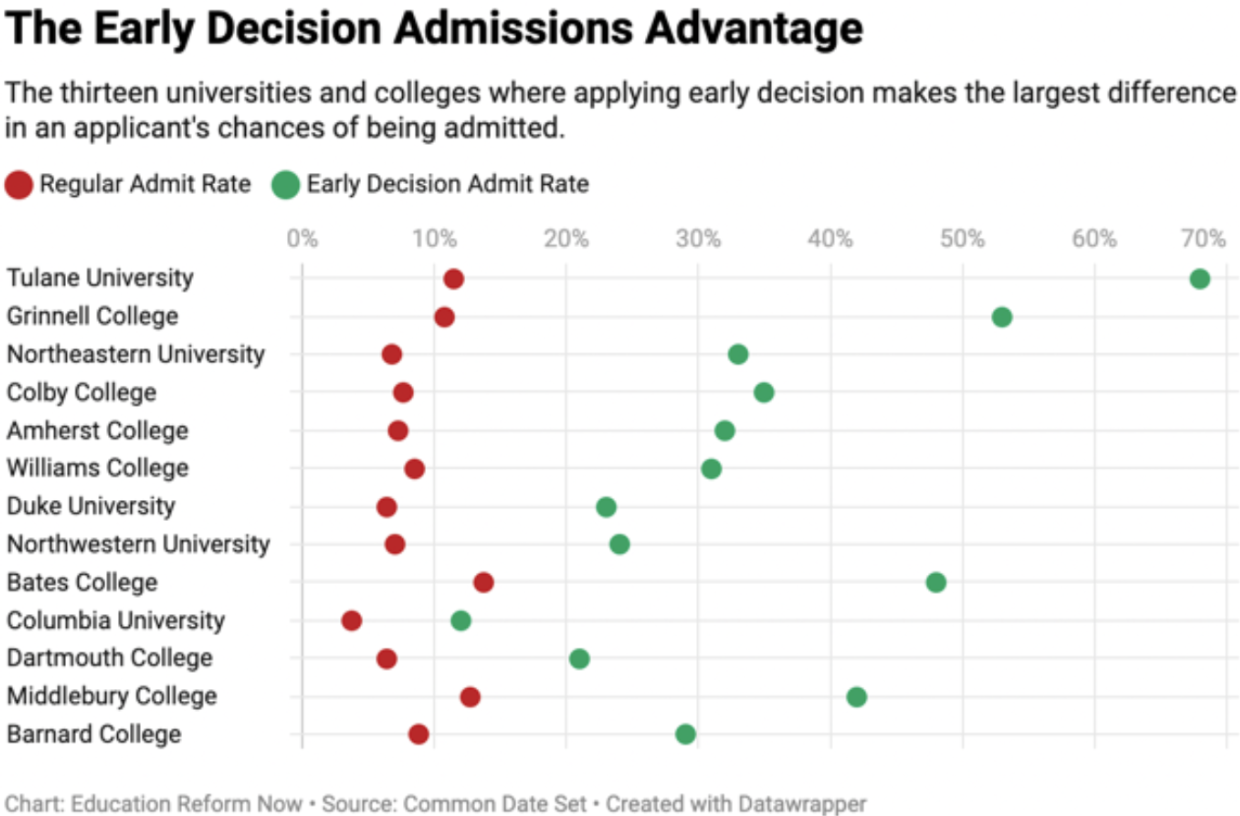
Source: Slate
Elton Lin: A quick overview of admit rates… regular admit rate as compared to early decision admin rate—if you look at this, this is from 2023. There's some drastic numbers on here like a Tulane—the ED admit rate for Tulane is 70% as opposed to around 11 or 12% [regular admit rate]. They've fixed that, so that's not as drastic as it used to be. But, generally speaking, if you apply early decision—and again, you're within the academic bracket of the type of students that they admit—then it does improve your chances.
Admitting Higher % via ED (2022)
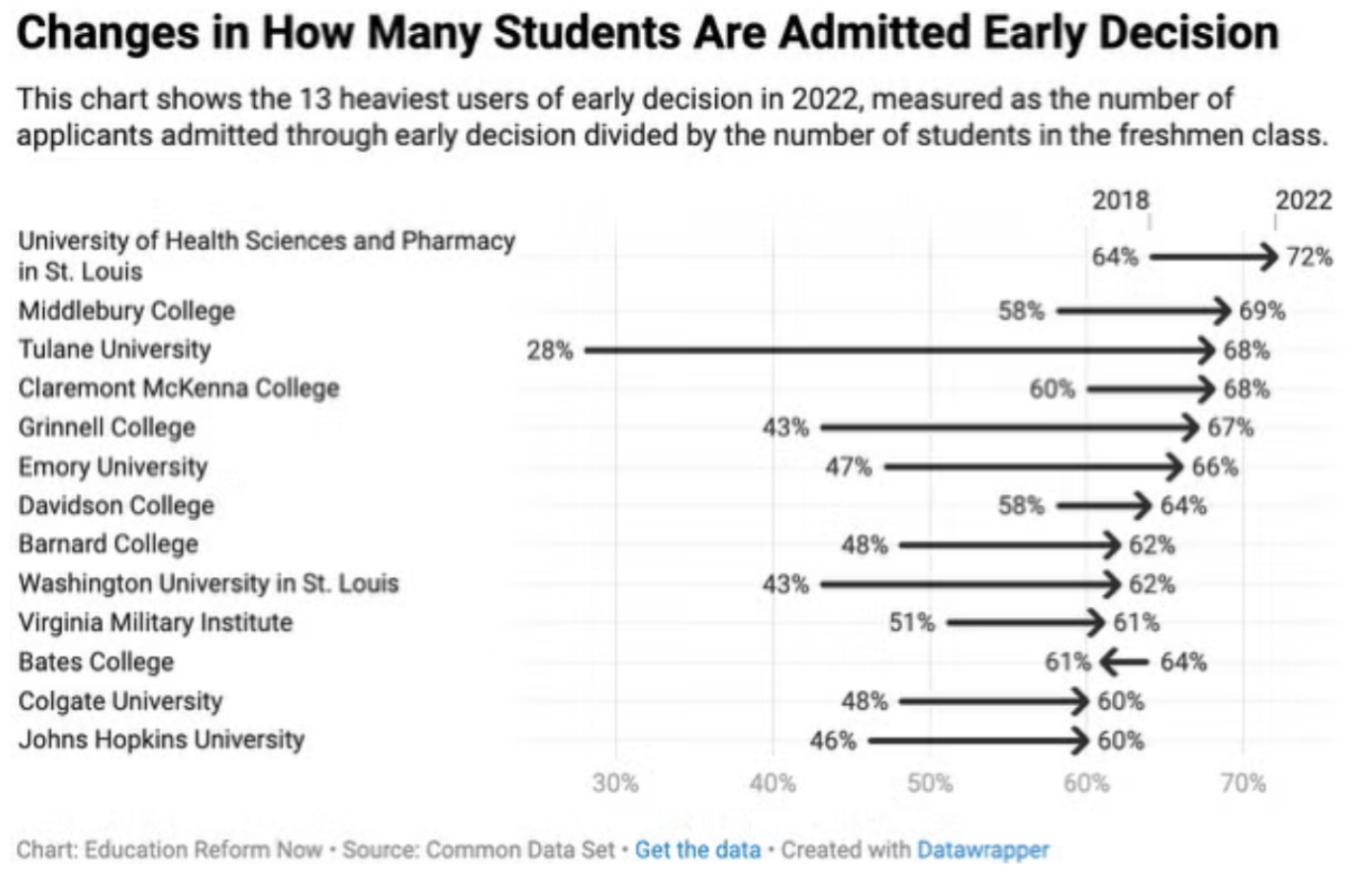
Source: Slate
Elton Lin: But I think this is actually the more important data point, which is the percent of students, percent of their freshman class, that they fill on the early round.
And so if you look at some of these schools… Claremont McKenna, back in 2018, they filled 60% of their class on early decision, and now it's 68%—maybe not that big of a deal.
But say, in Emory, at 47% in 2018. Now, they're filling 66% of their freshman class on early decision, which I think is significant—and then I did check the 2024 rates: they're actually kind of about the same.
And universities are filling more of their class on the early round, which inherently makes the admit rate at the regular round even more narrow, right? So this is where seeing this move [by colleges] towards trying to fill their class [with ED applicants] makes considering whether you should apply to ED maybe a little bit more important.
Who Should Apply ED?
- Are done with standardized testing!
- Are in a financial position to use the ED option
- Have a first choice college (no regrets)
- Are at or above the 75th percentile for admits to the college
- The early pool has the strongest applicants; students with less competitive profiles will likely not benefit from ED
Elton Lin: For 11th, 12th grade students, who should apply early decision?
If you're done with your standardized testing (as in you have the score that you want), then perhaps you should consider it, maybe.
Secondly, are you in a financial position to use the ED option, to where maybe you don't need to consider all the financial aid packages before you decide?
Maybe, thirdly, if you have a first choice college, meaning you have no regrets—you know, you really want to go to that school.
And then, lastly, are you at or above the 75th percentile for admits to the college from your high school? So you need to look at your high school's data. A lot of high schools use either a Naviance or Scoir or some platform to manage their internal college admissions data, and if you're a student at that high school, you have access to that data.
So what you can do is that you can go into your particular high school's platform and see: what is the average GPA and test score of the student who was admitted to Cornell? And then compare yourself to where you are. If you're well above that average, then you might want to consider it. If you're below the average, then honestly, the chances of them either rejecting you or just deferring you is pretty high.
If you're at or above the 75th percentile, then it may be a good opportunity to use ED.
For 9th and 10th Graders:
- Don't worry about ED!
- Consider visiting colleges during 10th grade (just to see what being on campus is like)
- Focus on school, activities, and helping people!
Elton Lin: For 9th and 10th graders: don't worry about ED. That's the main thing. Don't worry about it. Focus on school activities and helping people.
Bonus Trend #4: Testing is Coming Back
Elton Lin: I got a bonus trend number 4 that I want to share with you before we get into Q&A, but: testing is coming back. That may be fortunate or unfortunate, but it's becoming more important.
Colleges Requiring SAT or ACT
MIT
Purdue
Dartmouth
Brown
Yale
UT Austin
Harvard
CalTech
Cornell
Stanford
JHU
Miami
Penn
Ohio St
Tennessee
Georgetown
Georgia
More?
Elton Lin: There are more colleges requiring SAT or ACT. As you probably may remember, when the pandemic hit, almost every university in the United States largely went test-optional. Now, there’s a trend coming back to where more schools are requiring the SAT or the ACT.
Percent Admitted Submitting Tests
| School | % Submitting SAT | % Submitting ACT | % Submitting Tests |
|---|---|---|---|
| Emory | 42% | 19% | 61% |
| Penn | 51% | 19% | 70% |
| Michigan | 52% | 18% | 70% |
| UChicago | 46% | 30% | 76% |
| UNC | 34% | 47% | 81% |
| Princeton | 57% | 20% | 77% |
Elton Lin: But I think probably the more important data point here is what percent of admitted students submitted test scores with their application.
If you just look at the right column for this sampling of schools: Emory at 61%, Penn at 70%, Michigan 70%, Princeton 77%.
… 70% of Penn's admitted students submitted test scores. And I think that already tells a story, right? So I think, if you consider, you know, who are the other 30%? Honestly, probably students from very underrepresented communities—or maybe, you know, maybe institutional priority regions that they really want to admit more students from. But if you're not from one of those regions, it almost behooves you not to submit a test score or not to want to work hard, to get a good SAT/ACT score to submit with your application.
So in my opinion, the trend is moving towards… fortunately or unfortunately, the trend is moving towards a higher value for the SAT or the ACT.
Quote from MIT:
“Our research has shown that, in most cases, we cannot reliably predict students will do well at MIT unless we consider standardized test results alongside grades, coursework, and other factors.” — Stuart Schmill, MIT Dean of Admissions
Elton Lin: And the MIT Dean of Admissions is on record saying… “Our research has shown that, in most cases, we cannot reliably predict students will do well at MIT unless we consider standardized test results alongside grades…”
Quote from Emory:
“We’re not as trusting, frankly, of GPA these days… Grades are definitely inflated and not as connected to true class performance as they used to be. Emory will be weighing ‘external assessment’ more heavily than GPA, with a particular focus on AP scores.” — John Latting, Emory Dean of Admissions
Elton Lin: And I think that probably the most specific quote—and this is from Emory—is that “we’re not as trusting, frankly, of GPA these days… Grades are definitely inflated and not as connected to true class performance as they used to be. Emory will be weighing ‘external assessment’”—which is really SAT scores, and he specifically pointed out, AP scores—“more heavily than GPA, with a particular focus on AP scores.”
And so what the Dean of Emory is saying is that it seems like there is this trend across the United States where GPAs are inflated in high schools. I do feel like that is largely coming out of the pandemic… there was a lot of inconsistency with how things were being graded, and oftentimes administration—high school administrations oftentimes gave students the benefit of doubt… There just seems to be an inflation in grades. And so Emory is acknowledging that we want to see some outside external assessment to really see how the students really match up and really fare.
Trends for 2025:
Applications are UP ↑
College Majors Matter
Colleges Using Early Decision More
Elton Lin: Trends for 2025: applications are up; your college major matters, certainly; colleges are using early decision more; and, as mentioned, testing is making a comeback.
Don't forget!
There are good schools out there!
Build a major-focused resume
Consider ED if it’s right for you
Do the things you love 🧡
Elton Lin: Don't forget: there are good schools out there; it’s important to build a major-focused resume; consider ED if it's right for you; and do the things you love, even if it's in the humanities… whatever it might be, do the things you love, and then really consider complementing that education once once you get into college.
Final Word
Remind them (often) that you love them regardless of how the results turn out. 🧡
Elton Lin: I have one last thing I want to share with you… is that we work with a lot of students, a lot of students coming from probably a lot of high schools that that you were all from, certainly.
And I do feel like there's… a great degree of stress that our students are bearing at an unprecedented level, and some of that is certainly maybe coming from the family. But a lot of it is just coming from their peers, the environment—they're hearing it constantly from almost every direction that they're going.
And I often… I just want to remind families to remind your kids that you love them, regardless of how the results turn out. I feel like students know they know what's at stake. They feel it. They know what's happening, they hear it from their peers, and oftentimes what they need from us the most is that we love them and are still proud of them, no matter how these results turn out.
So, if I may, let me encourage you to remind your kids that you love them, no matter what.
Questions!
Elton Lin: Let's get into questions. I'm going to invite Anthony back on.
Are there any questions?
Anthony Su (he/him): There are tons of questions.
Elton Lin: There are tons of questions!
Anthony Su: Feel free, everyone—yeah, you can use the Q&A, and you can use the chat.
Thank you!
Elton Lin
CEO, ILUMIN Educationinfo@ilumineducation.com
www.ilumineducation.comClick here for a free consultation!
Anthony Su: Let's go back to... since we spent a lot of time talking about the kind of AI discussion, there was a question about the role of arts and design as well within as, you know, AI becomes more popular.
And I actually recently had a family asking about… Do we think that arts or design will be a “safe major” as, you know, AI is only likely to get better.
Elton Lin: It's interesting because my wife is a graphic designer and now a fine artist, which—I’ve often said that—my wife is a ceramicist now, and she's kind of like every parent's nightmare with regards to the fine arts. But yeah, I do. I do feel like art and design will—AI will have some impact on design, and specifically traditional graphic arts, which I think are also going to be largely AI-generated.
And we're already seeing—I didn't talk about specifically graphic design, and some of the applied arts like photography, and some of those industries are actually pretty impacted by AI.
But actually, fine arts—the value of fine arts, you can imagine, the value of something that is very much human generated is going to go up. But I still would recommend design and art students to combine their education with some technical training. But I do feel like there is some resilience with some design and the arts.
Anthony Su: I can add—I actually caught up with a friend of mine that I met through Carnegie Mellon who went and studied design. She told me that the first year—all the first years in the design program cannot use a computer. Everything is… you have to do it by hand, and there's a way of thinking where, she kind of admitted to me, where it's just kind of a pain to do everything by hand and manually, but that it instills a way of thinking that you have to go through, and you can't use technology as a shortcut.
But I wonder how they change the curriculum with this adjustment now.
A question about the 2026 demographic cliff. Elton, do you want to speculate on what that might bring in the coming few years?
Elton Lin: Yeah, I mean, the demographic cliff is in response to the reduction of high school graduates that’s happening in the United States. And it’s actually pretty severe to the effect that there are—I don’t want to throw out a random percentage, but it’s a fairly significant reduction in the number of high school grads.
But the reality is that it's not impacting applicant pools to Top 50 to 75, or even Top 100 universities. It’s going to dramatically impact… there’s also 4,000 other higher education institutions in the United States, and it's going to impact substantially those small liberal arts colleges in different places around the United States that are not, maybe, [in] as high demand, and that have admit rates that are even 80, 90, to almost 100%.
And so the demographic cliff will impact those universities… and [for] a lot of the students that are not graduating, there's gonna be an increased demand in trade school and an increased demand in other forms of professional preparation for other types of careers.
But for applicants into Top 50 to Top 75 universities, we only see, actually, demand going up, or the applicant pool going up. So now, [as for] total number of students, how that's changing? That's kind of gone up and down a little bit. But total number of applications is going up.
Anthony Su: And then a couple of questions about test scores. There was this one family who was saying that their high school doesn't provide Naviance, or a similar platform. I know of Naviance and Scoir, are there any other platforms you're aware of, in case…
Elton Lin: Yeah. Naviance, Scoir…
Anthony Su: Yeah, their main question was just like, if they don't have this information, how can they make a list of target schools or get an idea of what's comparable for their high school?
Elton Lin: Yeah! What I do is I go to the high school counselor, and most high schools will prepare a list of schools that their students have matriculated to. So I would build your list around those schools…
I mean, you know, I've had students where—there's been no admits to Harvard for the last 10 years. And honestly, you can't take it personally, like Harvard is not admitting students from that particular high school.
So you want to build your list around the schools that your high school students are getting admitted to. And then my sense is, hopefully, the high school counselor will have kept some data—which I hope they would. And then you can get some input on average GPA and test scores, and on who's being admitted where.
Anthony Su: And another question related to the test scores, saying… if test scores are becoming required, are colleges still using the holistic method to review applications?
Elton Lin: They're always going to say they're using the holistic method, you know, and I think—but I think the Emory quote is probably the most, in some sense, damning a little bit on on what traditionally has been considered the most important factor in a review process, which is your transcript.
And so certainly they're considering everything, there's no question—so it's not like it’s flipping to—like, if you're a 1550 on the SAT and you have a 2.5 GPA, you're still not getting into MIT, right? I mean, that would be ridiculous, right?
But the reality is that in the process, they will want to look at the SAT or the ACT, and they will want to factor external validations… or other parts of your profile. And those external validations are going to be standardized testing.
Anthony Su: A question—I think this is from another college counselor—but the question is, “Can you comment on the value of going to a liberal arts college during a time of economic uncertainty? I love liberal arts schools, as I have students in Amherst and Williams, but have not been able to sell this idea to anyone.”
Elton Lin: (laughs) I mean, the other—I love all my college counselor colleagues on the call, too.
No, there's no question. I think liberal arts college provides a very unique opportunity for a lot of students, especially better access to research opportunities—you know, like a Williams and Amherst, or even a Wesleyan or a Vassar, or other really great liberal arts colleges may not have the total research budget as like a Johns Hopkins, but all the research money is for undergrads [in a liberal arts college]. Really, all the resources are really to enable undergrads to pursue whatever interests they might have, and so studying the sciences at a liberal arts college would be great.
And then you also have closer relationships with your professors. If you're going to med school, those recommendations are going to be more personal, have greater depth, and will likely improve your chances of getting into med school or grad school, or whatever it might be—so liberal arts colleges are fantastic. I agree! I agree with whoever brought that up.
Anthony Su: A question about gender trends at universities, and saying, “Is it advantageous if it's a predominantly male school to be a female applicant?” And I think the general trend is also, there are going to be more female applicants for higher education, so—any comments or thoughts on that, Elton?
Elton Lin: Yeah, I mean, I think that the comment pretty much says that there is a trend. The trend is towards more female applicants. And so in that sense—I mean, we've seen some anecdotal experiences where some male applicants applying early decision to some top schools—I was kind of surprised by the results. And I think there's some efforts by universities to want to secure enough male students in the freshman class early enough in the process to make sure that the class is balanced.
So yeah, I think it matters. I think there is certainly [a] leaning towards likely admitting more male students broadly, and then in schools that are a little bit more male, I mean… maybe a Caltech might be an example. But Caltech is actually working very hard to try to make sure that their student body is also very even, as even as possible, right? But yeah, the higher female count overall does matter. There's no question.
Anthony Su: There was one question about special interest groups, but I don't know what this is referring to.
The question says, “Which majors are included in special interest group applications?” I sent a message to try to clarify.
Elton Lin: Yeah, I mean… I understand the SIG in context of other other things. But I think if the… you know, certainly there are some targeted audiences in the applicant pool, there's no question. And even with the Supreme Court ruling sort of against affirmative action, universities want to diversify their class, and they will find other ways. I mean the State of California has ruled against affirmative action for more than 20 years, and the UC System is more diverse now than it was 20 years ago. So if the universities want to diversify their class, they will find a way… either adjusting prompts, or sending more recruitment teams out to high schools—whatever it might be, they will do what they need to do.
Anthony Su: I got a clarification. It says specifically for art majors, so it must be referring to under-applied-to majors compared to so-called impacted majors and things like that.
Elton Lin: Yeah, no, there's no question that applying to a less-applied-for major does make a difference, and it's mainly because there's been such a… the forthcoming two or three years, I think, are going to be interesting, but up until last year—I mean, the CS applicant pool was so bloated. And it's drawing students away from, largely, the humanities. And so I mean, if—yeah, you're a French major… it's a good time to be a French major, right? But no, there's no question that it matters.
You also have to think that universities have… some universities have expansive English and history and classics departments with tenured professors, and those budgets need to be maintained… I don’t want to spend like fifteen minutes on that, but there's some interest to make sure that the budget balances.
Anthony Su: I'll call this one the final question, but: “Do you advise us applying multiple majors to multiple schools?”—and the example being computer science for one school, engineering to another, like, what does that type of strategy look like? … And I guess, based on prior students, does that work or not?
Elton Lin: I think computer science and engineering… I mean, if you're talking about computer science and computer engineering at different schools, that's kind of, you know, neither here nor there. I think you could probably justify that.
But I think the difference is, say, computer science, and then something as drastic as, like, political science, you know, at another school. And the reality is that… the student's profile needs to support the student's interest in that particular major.
And the hard part—now, let's kind of get into specific things like the UC application, where there are four essays to support your application into all the UC campuses, and then one or two of your essays should include reference to why you want to study that particular major.
So if you're saying on UC Berkeley, it's computer science, but UC Santa Cruz, it's English, there's going to be some conflict in your set of essays to which you're submitting for all those campuses. So that's a practical aspect, where it's not going to work to apply to drastically different majors on the UC app.
Now, if you apply to other universities that don't share the app platform, you can certainly apply to different majors. But again, I'll come back to: the student’s profile needs to support those majors.
And then, secondly, you almost double the amount of essay work that you need to do by declaring two different majors at two different schools that are drastically different. So it's a lot more work for students, and even on our end, it's a lot of work, too. That's something to consider before you consider applying to a wide range of majors.
Anthony Su: We got through all the questions.
Elton Lin: All right. Sounds good, sounds good. Hey, thank you so much, everybody; appreciate everybody coming on. Thanks to Anthony as well.
Anthony will send a follow-up with some other information, and hopefully, a video link if you want to share with friends, but—hope this was helpful!
If you can do me one last thing: if you can go onto the chat and tell me what was most helpful to you about today's presentation. That's helpful to us, so that we can then make whatever revisions, or understand what's most helpful to you, and then maybe focusing on those areas. So if you don't mind going on chat right now, and then tell me what was most helpful about today's presentation, that would be great.
All right, data trends, most helpful.
Anthony Su: Also, anticipation on topics you would like to hear about; I think that's always something interesting that we wanna get from the audience as well.
Elton Lin: So data trends, trend shift, change in majors regarding AI for sure, data trends… Ulysses, and then info on other great schools.
Yeah, I can do a whole presentation on other great schools! I think there are so many good schools out there. I’ll plug in the liberal arts—
Anthony Su: The different schools, I think, for some families who are like, I want to stay in California but, you know, what else to look at besides UCs… I think that'd be a good [topic].
Elton Lin: Oh, yeah… absolutely. We can talk about all the interesting schools.
Anthony Su: It's like, almost automatic, right? But yeah, definitely, so you get a different perspective.
Elton Lin: For sure. All right. Super different schools topic, yes… Statistics, ED class percentages… All right, thank you so much!
Yeah, keep throwing it out there, and then I'll have Anthony do some copying and pasting, but—thank you so much to everybody for joining in with us on a 6 to 7pm—and then on an East Coast 9pm, and on a Hong Kong time... I'm not sure. Tomorrow morning, whatever it might be. But thank you all so much. Appreciate you, appreciate your interaction. Hopefully this was helpful, and we'll want to do our best to provide as much helpful information as we can.
So thank you, everybody, and look forward to seeing you soon. Thanks!
Anthony Su: Thanks, everyone. Take care! Bye.