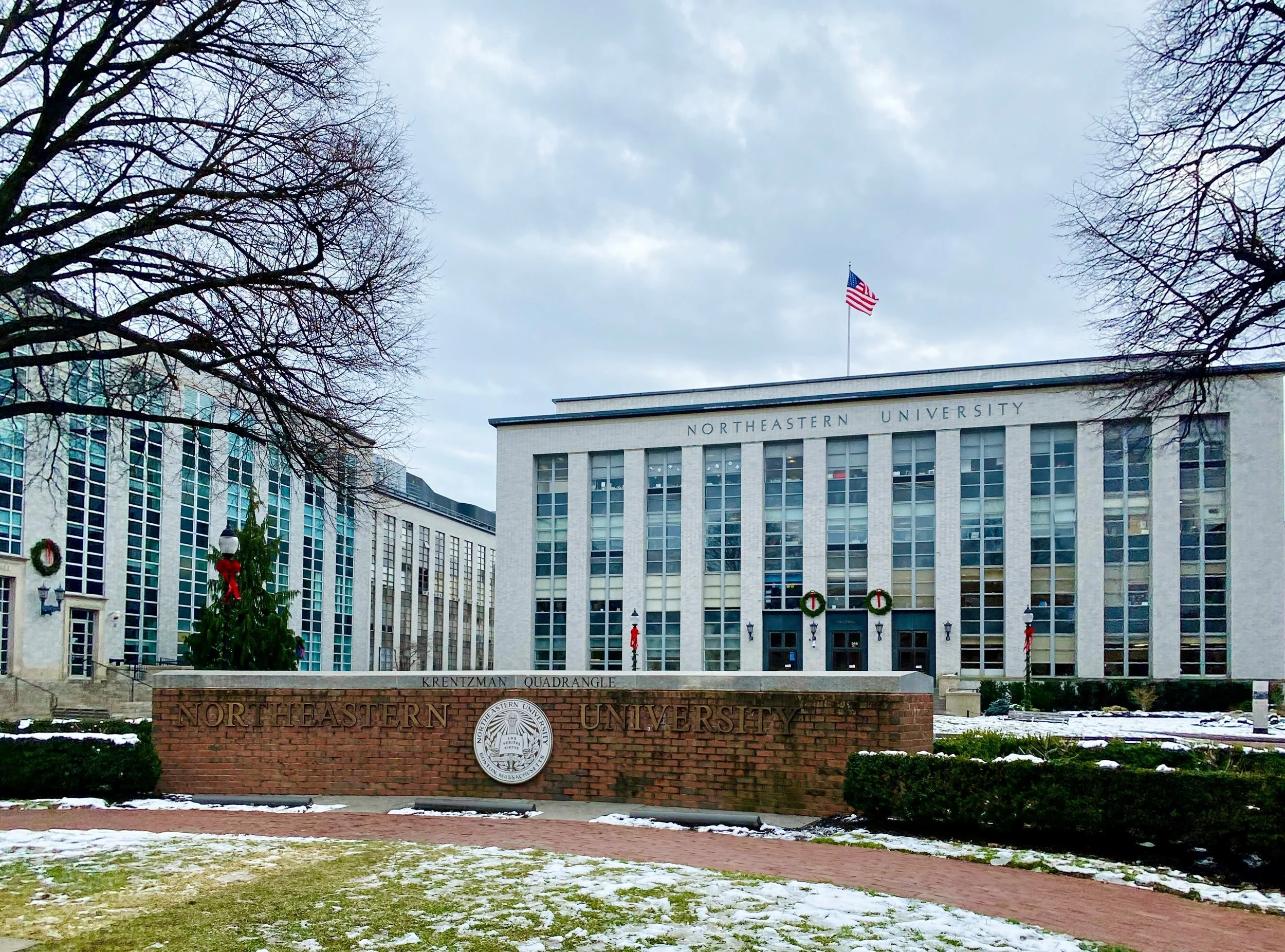
Webinar Transcript: Live Q&A with Northeastern University Director of Admissions Engagement
Anna Lu
(This is a transcript of a webinar from August 2025, a recording of which you can find on our YouTube channel.)
Anthony Su: Alright, we are live. Trey, Elton, I’ll see you at the Q&A section.
Elton Lin: Fantastic. Alright, let me organize my screen a little bit, but… hey, good evening! Welcome. Excited to have Trey Moore from Northeastern come on with us tonight—tonight, if you're on the East Coast, and also tonight, if you're on the West Coast, so… so glad to have everybody on. And, once again, we have a Q&A box at the bottom, so go ahead and post whatever questions you'd like at any point in our conversation.
If you're familiar with our interviews, my trusted colleague Anthony will come back on a little bit later to go through all of our questions and make sure Trey has the opportunity to answer everything for everybody as much as we can… but—excited to have Trey on.
And… would you please go to the chat and let us know where you are calling in from? We've always had—again—we've always had, people, students, parents, even counselors who've been calling in from all over the United States—many from different parts of the world—so if you can go ahead and go into the chat and just post real quick where you're calling in from. This way Trey knows, clearly… what part of the world he's speaking to. And if nobody comments, then Trey, you're just speaking to me.
Trey Moore: [laughs] Speaking to somebody.
Elton Lin: Indeed, indeed. Alright, fantastic.
So, Trey, let me give you an opportunity to introduce yourself… if you don't mind, please tell us a little bit more about your role at Northeastern, perhaps a little bit about your history of admissions, because you are an admissions… a bit of an admissions lifer. I don't know if that's a bad thing or a good thing, but tell us a little bit about your story, Trey.
Trey Moore: No problem. Now, I think it's a good thing. [laughs]
Good evening, everybody. Pleased to speak to you all. My name is Trey Moore, and I currently serve as the Director of Admissions Engagement at the University of Northeastern here in Boston, Massachusetts.
What that typically means is I handle all front-facing aspects of the admissions office, so: the visitor center, our events, our tour guides, our tours… I handle all of that, as well as our engagements with counselors and CBOs and things of that nature.
So that is the main purview that I have, plus my recruitment territories. I recruit Central, Massachusetts, and then out on the West Coast, the South Bay area—so San Mateo and Santa Clara County, the City of San Jose—and I help out with our team in Oakland with some recruitment in the Oakland area as well.
Regarding my journey: yes, I am an admissions lifer. I like to tell people: I got the start—I got the itch—as an undergraduate. So I started off at the University of Oklahoma—I'm from the great state of Oklahoma, I'm not a native New Englander. And so as an undergrad, I worked in our admissions office. I was a student intern for our multicultural recruitment program, and so I worked there throughout my time as an undergrad, and then after I graduated, I decided to get my master's in adult higher education. Right before I graduated, I got a job at the recruitment office at the University of Oklahoma, and so I was there for about 14 years! And through that time, I had worked in a myriad of offices on our Tulsa campus, as well as Norman.
And then, after 14 years there, I decided to make a change, so I went out to California, moved out to Oakland, and I worked at UC Berkeley for about 4 years. So I was out there, and thoroughly enjoyed my time at Oakland. It was the first time I ever lived outside the state of Oklahoma, so that's why I truly say that that's where I truly, truly grew up. But, after… from my time there, I stayed there, and then from there, I came out here to Massachusetts. So I worked at a small engineering college here in Worcester before coming to Northeastern, so it'll be a year at Northeastern this October.
So, yeah: thoroughly, thoroughly enjoyed my time in admissions. I love admissions work. I love working with students. I've been in admissions so long, some of the students I first recruited have PhDs and multiple degrees, and things like that, so it's always fun and cool to see them and catch up with them, and just see all the good things you get to do as an admissions counselor, and see all the lives you get to change, and the families' trajectories you get to change, and things like that. So that's the main reason why I'm still here.
Elton Lin: That's awesome, Trey, thank you so much. And the counselors on this call will know WPI, for sure, so…
But, as it relates to… I mean, normally, I've been beginning with this question for a lot of our interviews, but what [have] been some of the biggest changes that have been happening? And I think, you know, even though you’ve only been at Northeastern for a year, certainly I think you can probably get a sense of the progression of changes that have happened at Northeastern in admissions.
I think 2020 certainly was a big change. There are some changes with testing. Certainly 2022, 2023, not the same as 2025. So, if you were to say what makes 2025 different than, let's say, 2020, what are some of the biggest things that you would point out?
Trey Moore: It's a good question.
So, first of all, like you said, start off with, you said, with testing—coming on the hills of the pandemic, like most universities, Northeastern adopted a test-optional policy. So students that were applying to Northeastern, they had the option to submit their ACT or SAT scores, or they didn't have to. So, since the end of the pandemic, I know some universities have gone back to requiring tests, but Northeastern is going to be test-optional for the foreseeable future, so we have decided that that would be, you know, our mandate for things like that.
And then one of the biggest things about Northeastern is sort of the expansion. In 2020, we didn't have an Oakland campus, and so… I believe, in early 2021, we purchased what used to be Mills College in Oakland (for all my folks in the Bay Area in Oakland that have a history in Oakland). We purchased Mills College, and so now it's Northeastern's campus in Oakland.
And so that was a really big change for us, and we've changed it around, but it's the ethos of Mills College, you know, that dedication to the community, and to education, and community justice and things like that. You'll see that everywhere on our Oakland campus. And we've really jumped in and had a partnership with OUSD and the Oakland area and things like that, with our Oakland Opportunity Scholarships for graduates from OUSD and the Oakland area and things like that.
Also, we've expanded in New York City! So we partnered with Marymount Manhattan College… so we have a group of students every year that start in New York City. So this is the first cohort of what we like to call our New York City Scholars, and so these are students that start their first year in New York City studying and living and learning in New York City before coming to Boston for their second year.
We've also expanded our London offerings; students can have the opportunity to be a part of our London Scholars Program and be in London for a full year before coming back to Northeastern. And now, we also offer a fully-realized UK degree, so students can actually apply to our London school through the UCAS application system, and actually stay in London for all three years and get a UK degree. So, that's another change that's happened since 2020.
So, you know, the big things that have happened at Northeastern in just these five years is the testing policy and the expansion of the offerings we offer undergraduate students.
Elton Lin: Those are two big things. I want to break those down, and we're gonna come to all the expansion ones. I've got a question later.
Let's break that one… let's break the second part down a little bit later in this call, and let's talk about the first one with testing. Because I feel like… you know, truth be told, I think the reality… the impact of testing on admissions decisions has evolved, even over the course of the last five years. I think when 2020 hit, and most colleges went test-optional, I think it was really very test-optional. I think there was a lot of, you know, a very fair consideration with where students are coming from.
But certainly in the past year, there's been a fair amount of very notable schools, including Ivy Leagues, that have come out and said that they really believe that the test score is a determining factor, and it's a very notable piece in the admissions review process.
So let me ask you: what is Northeastern's approach to reviewing the test score? And has it changed since, say, 2020 or even 2023, which I also think is probably a little bit different. You know, what are your thoughts on that?
Trey Moore: That's a good question.
So, my thoughts, and the way we look at it is: if the student is… the test score is just one piece of who the student is and what they offer and things like that. Not all students test well, not all students do well on that particular day when it comes to tests. So we don't think how a student performs on one test one day is an accurate description of the academic picture of the student.
So if a student decides they don't want to submit their test, that's quite all right. We won't look at their test. We will look over their application, and it'll go from there. If a student decides to send us their test, then great! That's just one more data point that we have to review when we are reviewing their application. So it's truly up to the student if they want to submit their test [or] not.
And more important than that, through looking at the data, since we've been test-optional, we've seen [that] the academic records of—the academic prowess of our incoming students has not changed. It hasn't faltered since we've gone test-optional. It's actually increased. It's gone up since 2020, so that's one of the main reasons why we're going to be test-optional for the foreseeable future.
Elton Lin: Got it, got it. So, what I hear you saying is that your own internal metrics have shown that there hasn't been a substantial difference in students who are coming in, and so far, so good with regards to their own, say, graduation rates, long-term viability, those kinds of things.
And… I certainly bring this up because I think there are other schools that have been public… I mean, we interviewed Carnegie Mellon last week, and he certainly did say students should plan on taking the test, and this is where… short of saying that it's required, but at least trying to encourage students to really consider it, plan on it, and do the best that they can, right?
So I think, certainly every school's gonna be different, but from what I hear you saying is that [for[ Northeastern: really, if you have it, and it's an asset to you, then it's great. But you're saying that it has not… it's not an overwhelming factor in the review process?
Trey Moore: That is correct.
Elton Lin: All right, fantastic.
Let's transition over to a more exciting question about artificial intelligence, Trey. And so, you can imagine that students out there are generating content, maybe essays even, if you will, sometimes using AI generators.
And I think a question for you is… what is the admissions office purview on students using these kinds of tools? And then let me ask you: there's also been other admissions offices that have been forthright about saying that the admissions offices are using AI technology to also help [as] part of the review process.
Can you shed a little bit of light on—maybe on the student side, but also on the admissions side—how is the university's… what's the university's perspective on AI and how it's being used on campus?
Trey Moore: That is a good question.
Northeastern, being the type of university that it is—where it is in Boston, one of the technological hubs in the Northeastern United States—we've sort of embraced AI. I mean, we're one of the first universities to offer graduate degrees in artificial intelligence and things like that, and professors use AI, and we realize students use AI to assist them with, you know, doing their papers and things like that, so…
We take the sense that AI is a tool, but it shouldn't be the only tool in a student's repertoire. So, you know, it would be silly of us to think that students aren't using AI to help them with their essays and things like that. And so, when it comes to the way we review the application and things like that, we don't expect a student to just fully copy and paste an essay from ChatGPT or Claude.ai or things like that, so… and you can normally tell when a student has done that, and that application… [we don’t] look too favorably upon [that], if I do say so myself.
But we encourage students—if you're comfortable using AI, we understand that [for] students, it's built into the fabric of who these students are. They grew up on the internet and using things like YouTube and things like that to help them, with their academic lesson plan and things like that, so it would only be natural that they use AI to help them with their work when it comes to school and when it comes to applying to colleges and things like that.
So we look at it as it being a tool, but we don't expect the student to just fully rely on AI when they're completing their application and things like that.
Elton Lin: When you say something like, you know, if it looks like a student has used AI for an essay, and you don't look too favorably on that, are you saying that from an admissions reader's perspective? There's a sense where it's sort of automatically written off, or it's just… it automatically sort of taints the review. Can you give a little bit of color about what that means?
Trey Moore: Sure, sure.
So, if, you know… when it comes to the application, when it comes to a holistic application process, we're looking… Everything that the student sends us is sort of painting a picture of who they are as a student, because we don't have the opportunity to interview students. So, you know, your transcript says something about you, the extracurricular activity says something about you, the sports or things that you play when you're outside says something about you, whether you work after school says something about you.
And so, if you were to just wholeheartedly copy and paste an application—an essay from ChatGPT and use it as your essay, that also says something about you as well. And so it might say something like, his student, they might not be as serious when it comes to their academics as the student over here.
So, that's what I mean when [I say], if a student does just copy and paste an essay from ChatGPT, that says something about the student's work ethic when we're reviewing the application.
Elton Lin: Got it, got it. Okay, and then with regards to the admissions office, how is the admissions office implementing AI technology in the review process?
Trey Moore: I wouldn't say… I wouldn't be the person to ask that question to… We're not wholeheartedly using AI within the review process. It's still run by us in the office and our external readers and things like that.
We use CRMs like Slate and Salesforce and things like that to help run our review process. We haven't quite adapted to just… to implementing AI in the admissions review process, but I can see down the line with the way AI is going. I wouldn't be shocked if [in] five years, you know, a lot more universities would be using AI during the application review process. But as of right now, we're not using it at this point.
Elton Lin: Okay, got it, got it, got it. Okay, let's transition over to the expansion topics that you were talking about earlier. Especially with a lot of the extension campuses that Northeastern has been acquiring and integrating into their ecosystem.
And I'd love to hear a little bit about what role… you know, like, N.U.in would be, you know, one of the programs that also represents, you know, the study abroad programs, the Global Scholars programs. How is that factored into the overall admission strategy?
And I would say, just a very… this is not hard numbers, because this is obviously, on our end, we're working with around, maybe up to around 400 students a year. We see a fair amount of students applying across the United States. So we see a fair amount of students applying to Northeastern, getting into Northeastern… I would say, even on our end, we see a fair amount of our California-based students who are being offered N.U.in. How is N.U.in and the Global Scholars Program sort of being… how does it work in the overall admission strategy?
Trey Moore: Awesome. So, that is an excellent, excellent question. It's one of the big things we're known for with that and co-op.
The way it's factored in is it's a unique experience that a lot of schools simply don't have the chance to offer, and it's an excellent, unique offering for students during that first year, and it provides a global experience that a lot of students don't get to experience until they're later on in college. And nowadays, in the 21st century, students are competing globally for jobs. So when you're out there, when you've graduated and you're looking for a job, they're looking for that global experience and things like that.
And what we're finding is, through our global network programs and our international co-ops and things like that, our students are… what we're hearing back from those companies that hire Northeastern students, they are very, very impressed in the types of experiences that our students have as early as their first year at Northeastern, whether that be through N.U.in or the London Scholars or things like that. So we believe it gives our students a leg up [compared to] other students from other universities across the United States.
And so when it comes to those things, we really try to take the students' wishes when it comes to, you know, if a student is going to be… offered N.U.in or London Scholars, or things like that. So on the application, as well as in addition to all the basic academic and personal information you put on the application: you put your top three choices of where you could see yourself your first year. So, you know, your first choice could be Oakland, second choice could be London, third choice could be Boston. So we try to take those choices into consideration when we're reviewing an application as well.
But the main reason we have the Global Network program is it's an opportunity to give the students a unique academic and global experience that they simply don't have the opportunity to partake in at another university.
Elton Lin: I want to certainly vouch for the program in a sense where, like, I think the… I mean, our, you know, we've had students go to one semester in London, one year in London, one semester in Greece when that was available. We've had students begin at Mills. I think the overwhelming experience from our students has been super positive, so I just want to credit Northeastern for really doing their best to really create a viable, if not thriving, educational experience.
But I do want to also note that I think for a lot of our students, it's—the overwhelming majority of offers are on one of those programs. And so… even though they might select Boston as their first choice, I would say… we definitely get some, but I would say it's a very… it's definitely a minority.
So are you able to shed any light on how those programs function in the admissions process?
Trey Moore: When you say how they function—like how selections are made, is that what you're really asking?
Elton Lin: Sure, yeah, yeah, that'd be a good way to frame it.
Trey Moore: [laughs]
Elton Lin: Thanks, Trey, I appreciate it.
Trey Moore: Gotcha.
Elton Lin: [laughs] Thanks, man.
Trey Moore: So, overwhelmingly, the majority of students select Boston. We probably see 85 to 89% of students that are applying to Northeastern put that first choice as Boston, so the vast majority of students put that first choice as Boston. And simply put, we've seen an increase in applications—this past year, we had over 105,000 applications and things like that—and the way Northeastern is structured and things like that, with the increase in applications and things like that…
For all the students that are admitted to Northeastern for that first year, we simply wouldn't have the space to put all of them on our Boston campus, first and foremost, so that's one of the reasons right there, why we have the Global Network Program and things like that.
And then, when it comes to that, also—what goes into that selection is the students' academic interests and things like that, and then some of the experiences they've had as high school students and what they might be interested in, things like that, so… a combination of all of that goes into the selection, not only of their admission or not [only] into Northeastern, and if they're going to be selected into a global network program.
Also, how the student applies goes into it as well. And when I say “how,” [I don’t mean] which application you [submit]; I'm talking about which deadline you use. So at Northeastern, we have Early Decision, Early Action, and regular decision. So what we've seen for the past 5–6 years… students that have applied Early Decision, those are the students that are more, I'd say, excited, gung-ho about coming to Northeastern. Those are the students that have the higher academic tier and things like that.
And so we've seen for the past few years… about half of the students that come to Northeastern are from that Early Decision tier and things like that, so that also plays a role in… to which global network experience a student's gonna have their freshman year as well.
Elton Lin: Does that impact whether a student's more likely to get the Boston campus if they're applying on Early Decision?
Trey Moore: I would say, if… if you really want to come to Northeastern and have Boston be your… and you really want to start in Boston… putting your best foot forward would be to apply in either Early Decision 1 or 2.
Elton Lin: Okay, got it, got it. That makes total sense.
And perhaps maybe the kind of estimate data point that you just mentioned, which is, you're saying that half the students who are being admitted in… half the students in the freshman class are, by and large, admitted on Early Decision.
Trey Moore: Not admitted—the students that select to come to Northeastern.
Elton Lin: Okay, got it, gotcha, gotcha, right. So, half of the class that actually comes… came in on Early Decision. Okay, understood.
Let's talk about co-op, because co-op has been such a differentiator for Northeastern, and I think it's becoming a little bit… I mean, I think we, as counselors, I think we've been selling it for a long time, trying to communicate to students. I think with the topsy-turvy job landscape that is currently in place right now, AI changing everything, I think a big… the co-op program is becoming way more popular, and rightfully so.
However, there's been some, certainly some comments, whether it's on Reddit or other college boards, especially in the humanities and maybe less predefined fields… sometimes there are some concerns about: are there enough co-op opportunities for people outside of business, outside of STEM, outside of engineering? Can you give us maybe a little bit about how Northeastern is really cultivating this co-op program, and whether there are really true options for students across the different colleges at Northeastern?
Trey Moore: Yes, that is a very good question.
So, when it comes to co-op—it's the one thing we're known for, more than anything else. We've been doing co-op since pretty much our inception here in Northeastern. It's built into the framework of who we are as a campus. Our first tenet is experiential learning, so we believe the best way a student can… will learn, because they actually get out there and get their hands dirty.
And so, there are thousands upon thousands of co-op experiences that students have, and so… it's one of the most important decisions a Northeastern student is going to make, so… we make sure that the co-op experience that a student has—they have as much information as they possibly can before they go into their co-op. They take a class before the semester, before they even go to co-op, and within that class, they learn the basic skills of, you know, creating resumes and doing cover letters and interview prep and things like that. And then you're working with your academic advisor and your co-op advisor to find the co-op that's right for you to apply to and things like that.
And so all the various colleges and majors believe in the co-op system, so students… no matter what their major's gonna be, whether it's, you know, 18th century British literature or chemical engineering, you're gonna have a plethora of co-op opportunities that are going to be available to you.
With that being said, the co-op opportunity is what you make of it. We believe at Northeastern—we give you the tools to find the co-op experience that's gonna be best for you. Once you're there, it's up to you as far as what you give to that co-op experience once you're there, but… we make sure beforehand that you're as prepared as you possibly can to engage in that co-op for that 6 to 8 months.
Elton Lin: I'm kind of curious: how does Northeastern cultivate this network of co-ops?
So, I mean, certainly, it seems like there are some either clear partnerships or maybe soft partnerships with corporations, but how is this network built? And you also mentioned that… you said 18th century [British literature], you know, like… whatever your background is, like, if I were, say, a ceramicist, you know, would I… are there co-op opportunities for me?
So maybe, I'd love to hear a little bit about how Northeastern is cultivating that co-op network. And are there really all, you know, a plethora of varying co-ops other than just ones in business and engineering?
Trey Moore: Exactly. So, the way we cultivate the network is, one: through experience and word of mouth. We've been doing co-op for so long, and people have heard of, like, people that have hired our students, that have been on co-ops and things like that, [and] have had such positive experiences that, you know, they've decided to dip their toe into the co-op field and enter in contracts with us to have us have co-ops and things like that, so… that's probably one of the biggest ways we've expanded our co-op network, is just the wonderful experience that companies and places like that have had with our students, [such] that they want to invest more in our students' education and invest more within co-ops and things like that.
And of course, Northeastern has sought out co-op contracts and agreements with others throughout the country and throughout the globe, really. And so we've kind of adapted that two-pronged approach when it comes to co-ops and things like that.
And, you know, we truly believe that there are co-ops for any and all students on Northeastern Campus, though I don't really know what a ceramicist does… but I'm pretty sure, you know, if that's truly what they want to do, we'll find a co-op for them, either here in the New England area or somewhere in the United States.
Elton Lin: I'm just speaking on behalf of my wife. My wife is a ceramicist, and I was just like, she makes ceramics, that's the…
Trey Moore: Oh, cool! Like, from the movie Ghost.
Elton Lin: Yeah, it's something that we do every night at home, Trey. [laughs] It's another webinar for another time.
But—no, I appreciate that. Let's maybe jump, let's jump to another question before we open up for questions, and I know we have a good batch of counselors on our call today, so I'm looking forward to questions coming from them, but…
Northeastern has historically been this very—a very career-oriented, you know—has had this career-oriented approach to education. I think the co-op program is no question, a pride and joy, and rightfully so, and something that we as counselors certainly have been promoting to families of students.
But if I’m interested in pursuing a master's or a PhD program, certainly I might still want to do some form of research. Northeastern doesn't automatically come up when I think about, say, a Johns Hopkins or University of Michigan, or other schools that are very “Tier 1-ish” when it comes to research funding.
Can I still pursue that at Northeastern? And what type of research innovations are happening there?
Trey Moore: That is a good question.
Just like John Hopkins and things like that, we are a Tier 1 research institution as well, and students can engage in research at all levels at Northeastern. So we have undergraduate students joining their professors and conducting research, and of course, professional degree students—so masters and PhD students are engaging in a wide variety of research and things like that.
When it comes to things like that, I'm thinking of Corey College of Computer Science—like I talked about with AI and things like that. It's one of the things that's on the horizon, so students are doing research there.
One of the students that I got to work with when we were doing our new preview day, and working with students that were doing excellent research in speech pathology and things like that. You know, Northeastern is actually one of the leaders when it comes to speech pathology in the Northeastern United States, so there's a lot of great research going on in that field as well, and things like healthcare and innovation and things like that.
You'll see a wide range of research opportunities for students at all levels. But especially when it comes to those students that are pursuing those professional degrees, you know, they're going to be expected to do research. So they're going to find a plethora of avenues to conduct their research while they're getting that advanced degree at Northeastern.
Elton Lin: Got it, got it. Okay, so there are certainly opportunities to do research, and to go a more academic route if that's what they choose, so…
Trey Moore: That is correct.
Elton Lin: Sounds good.
So, maybe a last question before we go to questions is: I mean, certainly, we're working with an array of students who are applying to a host of colleges. Certainly co-op is important. I think that global experience is also… does differentiate the experience for a lot of students. Just practically working with students and families, I feel like it's… on our end, they need to be kind of sold on the value of that experience, and I think many [are], and I think they overwhelmingly have a good experience, but…
As students are considering the myriad of schools that they want to apply to, what else are we missing as far as what really makes Northeastern special and [what] you think really [makes Northeastern] a good fit for them? And certainly, not every school's a good fit for everybody, but what's the one thing that students overlook as it relates to Northeastern?
Trey Moore: I would say one thing they overlook is just the experience of experiential learning. So, what we truly believe here at Northeastern [is that] the students learn best by doing. And that can be a wide range of things. It's not just co-op; it's the extracurricular activities that you're getting involved in, it's the research opportunities that you can get involved in, the work that you're doing on the campus that you find yourself in. You know, all of our campuses just happen to be in urban areas, so there's a plethora of opportunities for students to get involved in, whatever campus that is—whether that be London, New York City, Oakland, or Boston, so…
We truly believe that, if you want to get a lot more out of your collegiate experience, if you want a lot more than just having the professor sit there and talk at you for an hour, if you actually want to put into practice what you're learning in your classrooms and in your labs and things like that, then Northeastern is going to be a place that you're going to want to consider.
Elton Lin: I said this was the last question, but I got one more, because I feel like I'm… I mean, we got this question a lot the last couple years from students and parents, and I kind of want to have it recorded so I can send them this video when it's…
But I think, invariably, there's gonna be a good number of our students who are admitted to the Oakland campus, or specifically the London campus for either a semester or a full year. Can you get into some specifics of why—what makes each of those programs advantageous for students to want to commit either up to a semester or a year or two?
Because I think for them, they feel like it's like, “oh, I don't get to go to Boston. Oh, I'm going to, a second-rate campus, or a second-rate college experience.” And it feels like… or they feel like they're going to be disconnected from… maybe they start in Boston [at] the start of their second year, [and] they feel like they're gonna be disconnected from the rest of the campus community if they go to London or go to the Oakland campus for a year.
Can you kind of get into specifics about both of those campuses? What makes them a really good option? And perhaps how a student might see the totality of their four years with maybe starting their first year at one of those campuses.
Trey Moore: That is a really good question. So, what sets those… that's an excellent question.
Elton Lin: [laughs] Thanks, Trey, I appreciate it.
Trey Moore: [laughs] What sets those campuses apart is the wonderful experience that you're going to be able to engage in while you're there. So if you go to New York City, or London, or Oakland for your first year, you're not just going there by yourself. If you're in London or New York City, there's probably 1,200 to 1,400 students that are going to be there with you. For Oakland, there's going to probably be 900 to 1,000 students that are going to be there with you, so you're not going to be there by yourself. You're going to have a wonderful experience with your cohort of students that are going to be there.
And so one of the favorite things I like to talk about is: I have a kid I've worked with who works in our office. He was from a small town right outside… well, a suburb of Chicago, and he never left the United States, and he got into our London Scholars Program for his first year, and while he was in London, he absolutely loved it. He visited 27 countries in Europe in his first year alone, just being in London. So, those are the experiences—he never would have thought of leaving the country if not for being a part of the London Scholars his first year, so…
There's gonna be truly a lot of unique experiences that you're going to be able to experience your first year there, and you're still gonna be able to go to Boston, you're gonna be in Boston your second year, your third year, your fourth year, so you're gonna get three years on the Boston campus.
It's just that first year you got to spend in another country, or in another part of the United States, and when you get to Boston, you're… it's not just you; it's going to be your entire cohort is going to be there with you. There's going to be housing options for your cohort and things like that, and everybody else that's gonna be on the Boston campus, they're eventually going to go abroad or have another experience, just like you had. You just had your experience first.
Elton Lin: And as I invite Anthony back on with us to come through some of the questions—if I'm offered London, can I ask for a change to Oakland, or if I'm offered Oakland, can I ask for a change to London?
Trey Moore: Typically, no. It would have to be extreme circumstances as to why you're not able to go on your admitted experience.
Elton Lin: You know, before I hand it off to Anthony, I just want to say that we actually did a webinar episode with three Northeastern students. At that time, Greece was an option, and they did the one semester in Greece, and they felt like the experience was just overwhelmingly positive, and there's a certain sense of camaraderie, tightness, [and] community that they develop with that cohort to where it was very strong—and it helped them, because everybody is out of their comfort zone. Everyone has to rely on each other. They come back to Boston on their second year, or the second semester, and there's an automatic sense of community, at least with that cohort, as they begin to branch out with the rest of their college time at Northeastern, so…
So, I mean, even from our experience, it's been overwhelmingly positive from these students. I don't mean to do your job, Trey, but…
Trey Moore: Hey, hey. No problem. Thank you, I appreciate it.
Elton Lin: Alright. If you don't mind, go ahead—if you have questions, feel free to post them in Q&A, and then Anthony will get through them, and we'll discuss.
So, Anthony?
Anthony Su: Yeah, I've got some kind of natural continuations of the different options that students have in terms of the different campuses.
Some families are wondering, like: are any of these programs potentially going to become four-year options as well in the near future, or is that an option now for students? And also, what percentage of students are going to be at these different programs before coming to the main campus for the second year?
Trey Moore: That's a good question.
So, for most of the programs, like for N.U.in—N.U.in’s always going to be only one semester. London Scholars is always going to be one year. New York City Scholars—this is our first year, but I don't think there are any plans to expand that to a four-year program anytime soon.
Oakland, we're adding more four-year experiences yearly to that program and things like that, so there are some majors [for which] students have the option to stay in Oakland all four years if they so choose. Right now, at this time, we've just—we've seen that most students that when even the students that start off in Oakland—they want that Boston experience and things like that, so after that first year, the vast majority of them elect to go to Boston that second year.
What was the second half of that question?
Anthony Su: People were wondering what percentage of students are starting at these other programs.
Trey Moore: For their incoming freshman year, I'd say it's probably close to about… 40 to 45% of students are in one of our global network offerings other than Boston to start their first year.
Elton Lin: Are you able to share or articulate, like, what is Northeastern's strategy with some of these extension campuses? I mean, it sounds like maybe Oakland might turn into a four-year campus experience; it seems like London—you mentioned earlier that you can apply into the London campus on UCAS and basically get a UK degree through the London campus.
It seems like there is a kind of a clear strategy to expand the Northeastern footprint. Are you able to shed any light on that, and what Northeastern's trying to do?
Trey Moore: I would say that would probably be a question to ask my supervisor, our Dean of Admission, and things like that—so that's more of a question on her part.
Elton Lin: I'm just trying to see if, you know, whether there's… any other campus is looking to buy, [if] you guys are looking to buy, and looking to acquire, and see what…
Trey Moore: Well, we have more than… we have 13 campuses total, so… though the Oakland, London, and the one with New York City Scholars… [and] Boston, are the only ones that have graduate programs. The other ones—like, there's a campus in Seattle, there's one in Vancouver, there's one in Arlington, there's one in Miami, and things like that. Those are primarily for, like, graduate students and things like that, but… the four I named, they are the only ones that have undergraduate options for students.
Elton Lin: Alright. I think there's a few more questions, Anthony, on that.
Anthony Su: Yeah, I guess a natural follow-up question: if you have a lot of students who are starting in, you know, places other than Boston and coming towards Boston, is there going to be an expansion of housing and residence halls as well when we're thinking about [the] near future?
Trey Moore: That is always the question. I don't believe there's—there hasn't been an expansion in housing in Boston. I think the last expansion was in… early 2020 or 2021. That was the last housing expansion. That's always something that's on the horizon for not just Northeastern, but any university… as we've seen, you know, the number of applicants rise, there's got to be spaces to put those students and things like that.
The good thing for students that are part of our global network programs [is that] we do have guaranteed housing for them, so if you start off in Oakland or London or New York City… you are guaranteed a spot in housing for that second year. It's optional, so you don't have to take it if you don't want to, but if you do want to have that space on campus, it is reserved for you for that second year.
Anthony Su: Got it. And then a question also about the N.U.in program of: are you allowed to select the campus, and what decisions are allowed at that point?
Trey Moore: Yes, so when it comes to N.U.in, the campuses, the program that you can select is based on your major, so if I was an electrical engineering major, normally there are anywhere between 9 to 13 N.U.in sites, and not every major is offered at every site, so I would only be able to select the site that offers the major that’s my major.
Anthony Su: Got it.
And then… interesting question around [how] hiring freezes affect co-ops… you know, if people are going into a little bit more uncertainty with job search and things like that, does that potentially kind of affect how students are kind of engaging with the co-op experience?
Trey Moore: I would say when it comes to hiring freezes and things like that… that would probably affect the number of co-ops that a certain company could offer and things like that, but that is going to be something that a student is going to work out with their co-op advisor.
Anthony Su: Sure.
Elton Lin: Let me throw in a question that I feel like came up, I think, with our other admissions people that we were speaking with, but: certainly there is some volatility or uncertainty as it relates to how the Trump administration is pressuring universities, and I think there's been a lot of public and a lot of, you know, not public sort of activity about trying to be aware of budgeting, making sure that there’s… [that] schools have the resources to do what they need to do. How is Northeastern, perhaps, adjusting and or preparing for this type of environment?
Trey Moore: [laughs] That is a really good question.
Elton Lin: [laughs] Thanks!
Trey Moore: You can… you can only control what you can control. So, like I said, Northeastern, we… we don't have any say-so over how much the federal government can say they can offer a certain university or anything like that. All we can do is make sure we're doing what we can to make sure the quality of education that we offer our students does not lack, and making sure the student, no matter where they come from, has a genuine experience when they come to Northeastern.
So that's been our guiding light. We understand there's a lot of volatility and things like that: some things we can control, some things we can't control. So the things that we have control over, we try to shepherd those funds and things like that the best way we can. Then the things we don't have control over, we try to forecast: you know, if A happens, then we'll have to do this; If B happens, then we'll probably need to do that and things like that, so…
That's pretty much the path we've decided to go down.
Elton Lin: Got it, got it. I have one last question, if our audience doesn't have any more.
But with regards to how major factors into the admissions review process… I think it's been well documented that there's the applicant pool that is normally applying in with, you know, like, historical engineering, or maybe specifically computer science… maybe that's shifting a little bit more towards data science right now.
But certainly, where there are more applicants with a fixed amount of spaces, that tends to make it a little bit more difficult to gain admission in that particular program. And I think some schools, maybe specifically even UC Berkeley out here, [have] been very clear about majors that impact the admissions review process.
How do majors factor into the review process at Northeastern? And is it purely just a number of students… number of applicants per number of spaces, or is there something else that Northeastern is thinking about as it reviews students and their intended majors?
Trey Moore: No problem. I see you mentioned my previous institution. I'm gonna put on my Berkeley hat and mention…
Elton Lin: Please!
We'll go to that web link that has impacted majors, and we'll just talk through every single one of them. Have a good time!
Trey Moore: [laughs] Yeah, I remember that.
Elton Lin: Yeah, yeah.
Trey Moore: But I can talk about one of the differences we have between Northeastern and a university like UC Berkeley, where you're admitted to a specific college or anything like that. In Northeastern, you're not admitted to a specific college, you're admitted to Northeastern as a whole, and then once you're in here, you're sort of released to your college and things like that.
So that helps with… when it comes to, you know, there aren't a certain number of seats for majors and things like that, so that takes a lot of pressure off students and things like that. And we realize that, you know, students are going to change their major one or two times before they get here, and students might not have a major in mind, so we have things like the Explore program that helps students, you know, explore different academic avenues, and help them decide on a major program that might best suit them.
But I say all that to answer your question: the major you put on the application really doesn't determine your admission status or anything like that, simply because you're not admitted to, like, the Corey College of Computer Science or Bouvet or anything like that. You're admitted to Northeastern as a whole first.
Elton Lin: Got it, got it. Terrific.
Anthony Su: There was a follow-up question about the impact on international applicants and things like that. Is there any forecast on what that might look like, or have you seen that with the freshmen starting now with issues with visas and things like that?
Trey Moore: We have seen issues with that. A lot of people might not know this, but Northeastern has the second highest number of international students out of any university in the United States. So, you know, with the new administration and things like that, we've seen delays when it comes to students being able to get their visa and things like that. So we’ve… contacted students and offered different options and things of that nature.
So, you know, one of the options we offer for students that have been having difficulty securing visas… we've given them the option to start in the spring semester instead of the fall semester if they've had difficulty getting their visa and things like that. So, we realize students are running into issues that are not of their own making, so we're trying to alleviate those roadblocks as best we can.
Anthony Su: Sounds good.
Moving back to testing, and a question around, test-optional in terms of: are you able to share numbers with regards to how many students are submitting tests compared to not submitting tests, and what that looks like for admits?
Trey Moore: That, I don't have offhand. I can say that when… another… a question I have been asked about testing is if a student should submit their test or not, and we tell students, if you're in the middle 50% of the test scores you normally… we normally receive at Northeastern, then we'd say, if you want to submit your test, then you basically can. And so that middle 50% at Northeastern is between 1470 and 1520, I believe? So, you know, students that are submitting tests—those are the types of scores that we're seeing from students that are submitting tests.
Anthony Su: And then, one last question that I'm gonna add on, because I think it's also just… it'd be good to just get a breakdown of all the options for freshmen who are going to be applying.
If an applicant chooses that, hey, they only want to look at the Boston campus, are they allowed to do that, or could they also be assigned to somewhere else? And then I think—yeah, just for clarity's sake, I think it'd be helpful just to break down all possible options that students can opt in or not choose.
Trey Moore: Good, that is a really good question.
So, the options that you have: you have Boston, you have the London Scholars, you have the UK degree, you have the N.U.in program, you have New York City Scholars, and you have Oakland Scholars. So you have 6 options that are available to you. In the application, you can put three [of those]—your top three. So we have seen students that put… you also have the ability to put any, so we've seen students that have put Boston as their first choice, and then any as their second and third choice.
Anthony Su: I see, okay.
Trey Moore: So, you have that option to do that as well.
Anthony Su: Got it.
Trey Moore: And, also, I haven't… I've rarely seen—well, I haven't, because I've only been there a year—but a student, 99 out of 100 times, is going to be offered one of their three options. You rarely see someone [who] puts Boston, Oakland, and London, and they're not given any one of those three.
Anthony Su: I see.
I guess this is the last call for questions. I think I've gone through everything. I'm gonna double-check, but…
Elton Lin: Right. That's fantastic. I think, for the East Coasters, we get a few minutes off early. West Coasters get to go have dinner.
So, hey, Trey, really appreciate you taking the time to come on with us. I know that there's a good batch of my counseling colleagues who are on this call, so I appreciate the questions from all of you as well.
But Trey, thank you so much for taking some time, and hopefully we had enough probing questions to kind of get you talking well. But just appreciate you, your time, what you’re offering, how you're sharing the benefits and beauty of Northeastern, so—appreciate your time, Trey. Thank you so much.
Trey Moore: No problem, thank you for the opportunity, and if anyone ever has any questions, feel free to contact me, especially counselors.
Elton Lin: Alright. Thanks, everybody. Trey, do you wanna put your email on the chat?
Trey Moore: Yep, I will do that right now. Do I just send it to everyone?
Anthony Su: Yeah, that should be fine. You can change the setting there.
Elton Lin: Right. Give Trey an opportunity to post that. All right, fantastic. And then we will need to close the call soon after, so go ahead and copy and paste that, and then…
Thanks again, Trey. Get some rest. Anthony, get some dinner. We'll see you all on the next call—next webinar. Take care, everybody.
Trey Moore: Hey, everybody.
Anthony Su: Thanks, Trey.
Elton Lin: Alright, bye.