contact us

Use the form on the right to contact us.

955 Benecia Ave.
Sunnyvale, CA 94085
USA

(408) 479-4742

ILUMIN Blog

Helpful tips about college admissions, test preparation and just being a better student, leader and person from ILUMIN Education.

Why I Said NO to Harvard

Elton Lin

How do you know if a famous university is the right school for you? Just because it’s ranked highly or because it has a long and storied history doesn’t necessarily mean that you’ll be happy spending four years of your life there. Today, we have the privilege of hearing from someone who was faced with this dilemma. Read on to find out why Elizabeth (not her real name) decided not to attend Harvard University and her advice for finding a good-fit school.

>>>

In the spring of my senior year of high school, I received two college acceptance packages in the mail.  One contained an acceptance letter that looked almost like a diploma.  It was printed on frameable cardstock paper and declared that I had the right to study at the most prestigious university in America, Harvard University.  The other was written on regular paper and invited me to study at a very selective liberal arts college that most people have never heard of, Swarthmore College. 

I said no to Harvard.

The process of saying no was not easy, and my decision was not made flippantly.  Of course, initially, I was thrilled to be accepted at both schools.  In some ways, it seemed like madness to even consider turning down an acceptance to Harvard. This school was the “holy grail” of studious, hard-working students like me.  However, I was uneasy about the kind of pressure that a name like Harvard would have on my education.  I wanted to learn for the sake of learning and to serve my future community.  I was afraid that at a place like Harvard, I would live under the pressure of achieving academically so that I could prove that I was worthy of my acceptance.

I had the privilege of visiting both campuses before making my final decision.  During my visit to Harvard, I was impressed by the classic architecture and the feeling of intellectualism mixed with a youthful energy that pervaded the campus.  I slept over with some students in the dorms, ate in the dining hall, attended an ice hockey game (Harvard won over Dartmouth) and visited a class.  However, the main thing that sticks out to me is a conversation I had with one student.  When I told him my dilemma over which school to choose, he said, “How could you even think about going to another school?”  In a way, that comment confirmed the misgivings I had.  My personality is more “march to the beat of a different drummer” than “go with the flow.”  That student’s comment grated against my desire to be different, to make my own path in life and not just do something because it’s what I’m expected to do.

On the other hand, when I did my Swarthmore campus visit, students seemed deeply intellectual but also less stressed about themselves.  The campus is beautiful (its grounds are an arboretum), and even the physical surroundings fit better with my personality and preferences.  The students at Swarthmore talked about their small classes and their personal interactions with their professors.  As a group, they seemed more anti-establishment, more relaxed, more fun.  I could fit with this crowd.

As the time neared for me to send my confirmation letter, I was convinced that I would get an excellent education at both schools, but Swarthmore seemed to be the place where I would thrive more.  Many years later, I do not regret my decision.  The education, experiences, and memories that I gained in my time at Swarthmore is an invaluable part of my life, and I wish the same for you as you go through the process of choosing a university.

Putting Together a Great College List

Elton Lin

It’s easy for students and their families to decide on a college list based solely on how a particular school or department was ranked by an outside agency. Though rankings have some value, they aren’t predictive of your experience at the school—you will NOT necessarily have more success or a better time at a higher ranked school as opposed to a lower ranked school. In fact, the best school for your situation may be a less competitive college where you might really thrive. Here are some suggestions we have for you when thinking about developing a strategic college list.

Create a Balanced List

Though none of the students we’ve advised have ever experienced this nightmare scenario, I’ve met a couple students who did not get into a single school to which they applied! In one case, a girl applied to all “reach” schools except for one “target” school. Unfortunately, she severely underestimated her “target” school. The year in which she applied, the school changed their admissions policy and ended up admitting far fewer students from her high school than they had in previous years.  When thinking about your college list, we advise students to apply to three tiers of schools:

  1. Safety Schools—These are schools that you have a 75% chance (or higher) of getting into. If you look at the school’s standardized test scores and average GPA of admitted students, you should be in the 75th to 99th percentile of students that they admit. You should apply to at least two safety schools.

  2. Target Schools—These are schools that you have a roughly 50% chance of getting into. If you look at the standardized test scores and GPA of admitted students, you should be in upper 50% of students they admit. For most of our students, this is the sweet spot—you should be building your list around your target schools.
     

  3. Reach or Dream Schools—These are schools that you have a less than 25% chance of getting into. If a school has an overall admissions rate of under 15%, the school represents a reach school for any student, no matter your grades, scores, or activities.  Apply to as many reach schools as your family decides on, but remember that each additional application will likely require more supplemental essays.

Consider Fit

Several years ago, a student from a rural area was accepted to a number of top-20 universities and liberal arts colleges. Because I had worked with him for many months, I knew that he wouldn’t enjoy life as an engineering major at Berkeley, a large, public university in California. Instead, I advised him to attend a small, prestigious liberal arts college in a small town on the East Coast. However, he went against our advice and enrolled at Berkeley. After his first semester, he was back…asking for help for transfer applications. No matter how highly ranked a particular college, if the school is not the right fit, you will not succeed academically or socially.

Here are some questions to ponder as you think about your best fit:

  1. Are you a big school person or a small school person? When I was applying to college, I knew that I would not enjoy being one of 35,000+ students. I turned down a scholarship to a large university to go to a school of only 1600 students, and I never regretted my decision. Though I didn’t get to cheer on a winning football team, I conducted research with several professors, took a class with only six other students, led a student club, and had dinner with my faculty advisor in his home.
     

  2. Where in the U.S. do you want to live? Are you more comfortable in a city? The suburbs? In a rural area? Remember that your college experience extends beyond the academic program. It will (hopefully) become your home away from home for the next four years of your life.
     

  3. What kind of academic program are you looking for? Are you looking for a program that will prepare you for a certain career or professional school (e.g., pharmacy school)? Are you interested in continuing on in academia? University of Chicago and Northwestern University are two schools that look very similar on paper—both medium-sized, top-20 universities located in the Chicago metropolitan area. They nevertheless exude a different “feel” and campus culture. Northwestern has a far more pre-professional orientation (great for engineers!) while the University of Chicago is all about developing the life of the mind (great for future PhD's!).
     

  4. What kind of campus culture appeals to you? Some schools are known to be more competitive, others are more collaborative; some have a strong Greek system, some have a theatre program; some emphasize undergraduate research while others emphasize co-op experiences.

Campus visits are one way to experience a school and to see if a college fits you well (more on this topic in a future blog post), but there are other ways to determine if a particular school would work for your needs. This recent article in the New York Times recommends that you skip the college tour and talk with current students or recent alums of a particular college, reasoning that it’s more productive to talk with someone who represents your future self (at the school) than to hear about a college’s cafeteria and classes and to imagine yourself there. In our opinion, one of the best tools for discovering a good fit college would be to talk with several current students or recent alums of a school you’re interested in who also knows you well

With tuition increasing at rates far outstripping inflation and with a significant time commitment on your part in the application process and in the four years of earning your degree, creating a solid college list and choosing the right school for you is one of the most important decisions you will make.

If you help with the all-important college list, feel free to reach out and we'd be happy to provide a free consultation!  


Five Ways Students Can Manage Stress

Elton Lin

“I am sooooo stressed…” she groaned, her head resting on her thick Chemistry textbook. “I have three tests this week, and I’m behind on all my homework.” For many of our students, feeling stressed out has become the norm, though the causes may vary. Some students have relationship worries, others struggle with family conflict and parental pressure, but many put great pressure on themselves due to a fear of falling behind in a competitive high school environment.

Experiencing stress during high school is inevitable. It’s how you respond to it that can make all the difference. Here at ILUMIN Education, we see how common – and damaging – it can be for students to be stressed on a daily basis. Dealing with stress constructively is arguably more important than GPA or resume in terms of preparing students for success in college and career.

Here are some of the strategies we use to help students manage their stress effectively.

1. Use a calendar

It’s fairly common for high school students to think they can get by without using a planner. Often, teachers post the homework online. Or maybe Mom manages the family calendar. Time and time again, we have found that students underestimate the benefits of using a calendar themselves. Without a doubt, students who manage their own calendars are able to accomplish more because they can be more strategic about how they use their time. Ultimately, students who take control of their schedules manage their lives better and reduce stress.

If you haven’t already, get a paper calendar or choose a digital one, and start to fill out the calendar with all of the important dates: tests, papers, project due dates, due dates for applications, games, club events, social events, family events, etc. Be sure to work backwards and block out time to study. If you know you need at least a couple hours to prepare for your history final, reserve some time for yourself to make that happen. If you know an especially demanding school week is coming, schedule a pocket of time for yourself to exercise or meet up with friends as a healthy outlet in a stressful week.  

2. Create a good homework routine

Creating a good homework routine is key to getting things done and reducing stress. Ask yourself: Do I have a designated place to study? Have I reduced distractions? How can I work most efficiently? For example, a student we worked with usually did his homework while lying on his bed at home. It wasn’t uncommon for him to fall asleep while doing homework. He also kept his phone by his side and Facebook messaged his friends while he studied, which he insisted was helping him get his work done. Every night, it took him until at least 1 a.m. to finish his homework. He woke up tired, which increased the likelihood of him falling asleep again when doing homework after school.

When our sleepy student experienced a dip in grades, he took our advice to start going to the library after school to do his homework. He kept his phone on silent in his backpack until he had worked at least two hours. He made a note of any questions he had for his friends from class, and messaged them after he worked independently. The student was surprised that he could go to bed two hours earlier than before by making adjustments to his daily routine.

3. Take care of your health: eat, sleep, and exercise!

Physical health is inexorably linked to mental and emotional health. Have you ever noticed that you’re more prone to mood swings or impulsive behavior when you’re not getting enough sleep or when you are hungry? There’s even a term, “hangry,” that’s been coined to describe that very state of being angry because you’re so hungry. Many students report that they need to stay up all night to study before important exams, but they may be shooting themselves in the foot. Teenagers, in particular, need more sleep as a part of their developmental stage, and when they’re operating on a sleep or nutritional deficit, their cortisol levels will rise and their cognitive function will suffer as well (i.e., you will feel stressed and not think clearly).

Exercise is especially effective in reducing stress. Instead of watching a YouTube video on a study break, go for a lap around the block and see if you feel any better. Furthermore, a Stanford study shows that just spending time outside in natural surroundings can improve focus and reduce anxiety. Although it might be tempting to take a break from homework to check your Snapchat, it’s better for your brain to rest away from the stimulation that screens provide. Even spending a few minutes in your backyard or a nearby park can help clear your mind.

4. Get help when you need it

If you’re feeling overwhelmed by your problems, it’s important to reach out and talk to a trusted friend, family member, mentor, or teacher. Not only will you feel less alone, a counselor or teacher, for example, might have some practical suggestions for making up a low grade or dealing with other school-related issues. It can be surprising by what can happen when students speak up. We’ve seen teachers change grades a year after the fact, students receive extended testing accommodations, and bullying issues resolved after students reach out to an adult who can help. After all, the worst-case scenario is that nothing will change. 

Although dealing with stress and changing moods is a typical part of the high school experience, some students face more severe anxiety or depression. Please be aware that mental health issues are more common than you might realize. If you’re experiencing anxiety attacks or depression, seek professional help. Many people struggle with mental health issues at some point in their lives, and there are resources out there to help you.

5. Remember the big picture

It’s 2 a.m. and it seems like your grade on the Chemistry midterm in the morning means everything. It may seem that your entire future rides on this one exam.  It doesn’t. You likely won’t remember the grade you get on this test a year from now. That’s because your future success is a result of the sum of your efforts over time; an occasional misstep is part of the human experience. Whenever you find yourself overwhelmed by stress due to a challenge you are facing, ask yourself: will this matter a year from now? In two years?  If the outcome isn’t what you want, it may very well become one of the many learning experiences that will make you stronger and better equipped to deal with challenges in the future. The point is that though a grade or a problem might be eating you up in this moment, in the longer term, what matters is how your character develops from dealing with this challenge, how you learn problem-solving skills through addressing the situation, and how well you treat the people around you in the midst of it.

Teens face many pressures in high school. However, by learning to manage your stress now, you will have gained a lifelong skill that will serve you far into the future. We find that when working with our students, it’s important not to minimize the stress our high school students are experiencing, even if the source of their worries seems small. Helping students manage their stress levels is as important as providing tutoring for a strong academic performance. After all, stress is a catalyst for growth and an opportunity to develop emotional resilience in the midst of life’s challenges.

CONGRATS TO OUR 2017 ADMITS!

Elton Lin

Congrats to ILUMIN's seniors on their college admission results this past year! We're SUPER proud of you! Not only for the schools you've been admitted to, but for how you've grown as leaders, citizens and game-changers during our time together.   

We'll share more about individual student stories... but just for this post, let's celebrate the schools our students have been admitted to:

Azusa Pacific University
Bard College
Barnard College
Biola University
Boston College
Boston University
Bowdoin College
Cal Poly SLO
Caltech
Carnegie Mellon University
Case Western University
Chapman University
Cornell University
CSU Northridge
Drexel University
Duke University
Emory University
Fordham University
Georgia Tech
Georgetown University
Hamilton College
Harvey Mudd College
Haverford College
Johns Hopkins University
Loyola Marymount University
MIT
Northeastern University
Northwestern University
NYU Stern
Occidental College
Penn St.
Pitzer College
Pomona College
Purdue University
Rice University
Rutgers University
Santa Clara University
San Diego St.
San Jose St.
Stanford University
Swarthmore College
Tufts University
Tulane University
UC Berkeley
UC Davis
UC Irvine
UC Merced
UC Riverside
UC San Diego
UC Santa Barbara
UC Santa Cruz
UCLA
University of Colorado Boulder
University of Illinois Urbana Champaign
University of Maryland
University of Chicago
University of Michigan
University of Oregon
University of Oxford
University of Pacific
University of Pennsylvania (including Wharton)
University of Rochester
University of Southern California
University of Texas at Austin
University of Wisconsin at Madison
University of Washington
Virginia Tech
Washington University - St. Louis
Wake Forest University
Wesleyan University

We're not only proud of your results, but excited for your futures and know you will make your mark to build a better world for us all! 

SAT Subject Tests // What are they? Why do I need them?

Elton Lin

With the recent changes in the SAT (and to a lesser extent, the ACT), college admissions offices have been redefining guidelines for standardized test scores, with many schools no longer requiring applicants to submit SAT Subject Test scores. So what should a sophomore or junior do with that information? Are SAT Subject Tests even necessary anymore? Should you be registering for SAT Subject Tests this year?  Today, we’ll be tackling some FAQs (Frequently Asked Questions) regarding these exams. Let’s start off with some basic information.

What are SAT Subject Tests?

Your parents may have known them as Achievement Tests. Your much older siblings may have called them SAT II tests. But regardless of their changing name, the 20 different SAT Subject Tests remain hour-long, multiple-choice, content-based exams designed for students who have completed the honors level of that particular subject. For example, a student who has completed Honors Biology at school may consider taking the Biology SAT (unless you’ll take AP Biology later—see below).

SAT Subject Tests are all scored out of 800, and they range in subjects as diverse as Modern Hebrew to Chemistry. As you might imagine, there are many language exams offered (nine total), and most of the language exams have both a listening portion and a reading portion.

When are they offered?

The most popular SAT Subject Tests are offered six times a year—on the same dates that the SAT is offered (Aug, Oct, Nov, Dec, May, June), so they may not be taken on the same date as the SAT. Many of the less popular tests, including ones like World History, Latin, or Japanese are offered fewer times a year. For current dates, check this link. Students should generally take them in either May or June, at the end of the academic year, to maximize their in-class preparation.

Do I need to take SAT Subject Tests to get into college? 

Many schools are no longer requiring the submission of SAT Subject Tests, but what does this mean for applicants? Only a handful of schools currently require the submission of SAT Subject Test scores, including Carnegie Mellon and Harvey Mudd. Some colleges, like Tufts or Wellesley, require either the submission of ACT scores OR the SAT with two different SAT Subject Test scores. Other schools “strongly recommend” the submission of these scores (e.g., Duke and Georgetown).

Our suggestion? If you are targeting a top-50 university or liberal arts college, you should plan on taking at least two different SAT Subject Tests. Although they are not a required element of your application, they could give further proof of your readiness to take on college-level material, particularly in your intended major, and perhaps balance out a lower grade in that subject on your transcript.

Additionally, SAT Subject Tests may give you some more options come application season. Some schools, such as NYU, Brandeis University, and the University of Rochester, are allowing students to submit SAT Subject Test scores in lieu of SAT or ACT scores.

Which ones should I take?

Our general advice for all students is to take the Math Level 2 SAT. Not only is higher level math critical to success in STEM fields, selective colleges also want all of their admitted students to be proficient in math.

After Math Level 2, students should be taking exams in the subject(s) of their academic interest. If you’re hoping to become a social science major, take the World History or the U.S. History exam. If you’re a prospective English major, signing up for the Literature SAT makes sense. If you’re going to be a Chemical Engineer when you grow up, definitely take the Chemistry SAT (and maybe even the Physics SAT).

If you’re taking an AP course, you may want to take the corresponding SAT Subject Test since you’re probably studying for the AP exam in May anyway. For example, you may want to take the World History SAT in June if you’re enrolled in AP World History, even if you have no intention of becoming a history major—you are already studying the subject; you might as well take two tests!

What kinds of scores should I aim for?

Broadly speaking, if the test is in your area of potential major and you are applying to a very selective school, you should be aiming for a 750+ on that particular exam. However, our best advice to you is to look at the percentiles. Keep in mind that many native speakers take the language exams. For example, a score of 790 out of 800 sounds very impressive. But if you earned that result on the Korean SAT, you’d only be testing higher than 42% of all test takers (for the Chinese exam, a score of 790 means that you’re only in the 48th percentile—the bottom half of all test takers!). This is why it’s often not worth it to take the Chinese or Korean SAT since high scores do not mean much in terms of percentiles.

Summary

The bottom line is that SAT Subject Tests are an important but not critical part of your college application.  Like AP exams, they are another way for admissions offices to assess your mastery of certain subjects using a standardized test. Applicants to the top colleges should definitely consider taking these exams, but maintaining a high GPA and earning a great SAT or ACT score will always take precedence.

Navigating the Waitlist Limbo (What Should I Do If I'm Placed on the WAITLIST!)

Elton Lin

“I didn’t get rejected…but I didn’t get accepted either,” Joanna replied in a dazed voice when I asked about her admissions results. As we approach April 1st, the date by which most universities notify applicants of their admissions decisions, the majority of students are either celebrating acceptances or processing rejections. But what happens if a student is faced with neither outcome? What if he has been offered a place on the college’s waitlist like Joanna? This is not an uncommon phenomenon, and some schools, such as Case Western Reserve University, are known for placing a high percentage of applicants—up to 40% at Case—on waitlists. Every year, students struggle with how to understand this outcome and move forward, and every year we’re helping students unravel the waitlist ambiguity.

Why do schools have waitlists?

The answer to this question will depend on the specific college under discussion. Highly selective schools like the University of Pennsylvania might be using their waitlists as a courtesy, a way to gently let down an alumni family or a high school from which they didn’t accept any students. Eric Furda, the Dean of Admissions at Penn, admitted as much to the Daily Pennsylvanian in a 2015 article.

Most schools use waitlists to control their yield rate—the rate at which accepted students decide to enroll. If a school has a yield rate of around 50% (i.e., half of the accepted students decide to attend), they will need to admit twice as many students as the number of freshmen seats available. But if fewer than the expected number of students decide to attend, admissions offices will turn toward those waitlisted students who have accepted a place on the list and, in many cases, who have made their desire to attend clear.

How many students are accepted off of waitlists?

Again, this is highly school-specific, but in general, the more selective the school the lower the chance of being accepted off of the waitlist. For example, Stanford University, one of the most selective schools in the country, accepted a grand total of 0 waitlisted students in the summer of 2015. Similarly, no students were accepted off the waitlist in 2012 and 2013. Last year, however, Stanford accepted 55 students from the waitlist—this might seem like a hopeful number, but keep in mind that this is only an acceptance rate of 3.5% of students offered a place on the waitlist.

On the other hand, Stanford’s rival across the bay, Berkeley, accepted 35.6% of its waitlisted student in 2015. This 2016 Time article lists a few schools that had very high waitlist acceptance rates in 2014, including one school with a 100% acceptance rate off the waitlist.

What should I do if I am offered a place on a waitlist?

First of all, we advise that you assume being waitlisted at a very selective school is essentially receiving a soft “no.” Of course, students get off waitlists every year, and some of their efforts include elaborate YouTube videos, but you do not want to pin all of your hopes on such a slim possibility. It’s better to move on with your life and perhaps be happily surprised in a few months than to wait in anxiety and be unable to enjoy the end of your high school experience. With that being said, here are some steps you should take when you are waitlisted:

  1. Do you really want to go to your waitlisted college? Is it a dream school? Would you regret not waiting out the waitlist? If so, accept a place on the waitlist.
     

  2. Regardless of whether or not you’ve accepted a place on a waitlist, you should definitely make plans to attend a school at which you were accepted. Of course, this includes sending in a deposit and the Intent to Register form by May 1. If you have a well-constructed college list, you should have been accepted at a couple of schools that you would be happy to attend.
     

  3. Send an update and/or another recommendation if allowed. Some admissions offices request that you do not send additional materials, but if allowable, you may want to update the school on any positive changes in your resume—for example, winning a regional science bowl, being selected for a lead role in the spring play, becoming the captain of the softball team, or securing an internship at a tech company over the summer. Be sure to write an email and include this information, along with brief affirmation of why college X is still your dream school.

    Note that waitlists are often not ranked, but they aren’t random. Maybe after looking at the incoming freshmen class, the school discovers that the orchestra still needs a harpist or that the lacrosse team is short a goalie or that there are no students hailing from the territory of Guam. Highlighting your talents and experiences may help you catch the eye of an admissions officer looking to balance the incoming class at a point when their admissions priorities may be shifting.
     

  4. Stay in touch with the admissions representative for your area. You should make sure they know that you are still interested in attending their college. Additionally, since the need for financial aid may play a larger role in admissions decisions for students on the waitlist, your admissions representative should be aware of what you are able to contribute to your college education. Often, colleges need more students who will not need financial aid, as they award much of their financial aid money during Regular Decision acceptances.

While we always encourage students to be proactive in the admissions process, hounding the admissions office at a waitlist school is likely to make both you and the admissions officers a little crazy. We suggest that you take a deep breath, do what you can, and move forward with confidence that you are a qualified student (after all, you were waitlisted!) and will shine at the college in which you ultimately enroll.

Junior Achievement Entrepreneurship Workshop and Incubator -- Deadline -- Jan 6th

Elton Lin

Interested in learning what it takes to be an Entrepreneur?
Want to become the next Steve Jobs?
Sign up to join the Junior Achievement Student Company Program!

ILUMIN Education is partnering with Junior Achievement of Northern California to host a 13-week entrepreneurship workshop and incubator for aspiring teen entrepreneurs. Students will work with local business leaders and learn what it takes to raise capital, write a business plan, market a product, and build effective teamwork and leadership skills.

Students will be broken into teams, develop their own product or service and launch a real business. Teams will also have the opportunity to submit their business idea to the JA Company of Year Competition, sponsored by Intuit, in April 2017.

To learn more about JA, visit www.janorcal.org. For more information on this specific workshop, contact us at info@ilumineducation.com.

Dates: Every Saturday starting Jan 21st to April 15th
Time: 1-3pm
Location: ILUMIN Education Office - 955 Benecia Ave, Sunnyvale, 94085
Cost: $250/student** 

Requirements: 

1. Must currently be in high school.
2. Provide your own transportation and arrive on time to all sessions.
3. May not miss more than 3 sessions (if more, please discuss with instructor).

APPLICATION DEADLINE: January 6, 2017
Accepted students will be notified on January 11, 2017.

CLICK HERE FOR APPLICATION

** - Make check payable to ILUMIN Education and bring on the first day. Majority of funds will be donated back to Junior Achievement.

College Essay Brainstorming: Creating a Life Map

Elton Lin

One of my classes for my Masters of Teaching program at BIOLA had us complete a “Life Map.” It was a framework and tool to help us identify significant moments in our life that helped inform our view of the world and ourselves. It was a really moving assignment that helped me to see in one big picture view everything that was important in my life. 

As I started teaching college essay writing, I realized that I needed a tool to help my students first identify the events that made them who they are. So I adapted the Life Map tool as a college essay brainstorming exercise. 

When we think about core memories, I want you to think of Inside Out. Riley, the main character, experiences a life event that gets logged as a memory. If it’s especially tinted with an emotion, that memory (signified by a little ball that records a short video of the event) becomes a Core Memory.

A Core Memory then becomes a part of Riley’s Long Term Memory and eventually fuels one of her “Personality Islands.” 

Here’s a clip of that whole process here.


I love that movie in so many different ways, but my favorite thing is how it’s a really creative (and fairly accurate) way to represent personality and memory to children. So with this life map, what I want you to do is ferret out your Core Memories. 


Use the following exercise to brainstorm out all the your important life moments and your “Core Memories.” 


1. List!
Grab a sticky note pad. For the next 15-20 minutes, as fast as you can go, fill out one life event or core memory per sticky note. Try to get through as many sticky notes as you can. 

What are some clear and important memories you have?
•    Times you moved
•    First day of ____
•    Last day of _____
•    Family vacations
•    Family troubles
•    Important classes
•    Important extracurricular
•    Start or end of a job or program or extracurricular activity
•    Start or end of a hobby
•    Successes and wins
•    Disappointments and hurts
•    Major changes or shifts in mood or relationships
•    Family or cultural traditions
•    A day when everything changed

2. Map!
- On a blank sheet of paper, create 3-4 columns to represent every 3 - 4 years of your life. For example, this student broke it up into these years:  0- 10, 11 - 17, 18 -22, 22+. 


- Place the sticky notes in chronological order. If you want to, you can rewrite your negative experiences in a different color, so you can see the frequency of negative events in your life or if one era of your life had more positive or negative experiences. 

- Circle the most important life events that have made some lasting impact today. These events will be the topics for your college essay. 

It’s important to begin first with the important stories you have to share and then figure out which prompt to answer—it’s a more organic and authentic way of writing a heartfelt and honest college essay.

Here’s an example (I know, she has more than 2 colors and her ages aren’t very clear, but you can get an idea of what the final product looks like):

3. Write! 
Now you will have a large sheet of paper with a ton of sticky notes on it—each one containing an important Core Memory. It’s these memories that will become the building blocks of your college essay! Pick one memory and start writing your first draft.

Congratulations - you've completed the most challenging part of the essay process and now you're well on your way to completing your essay! 

- John and Lynn Chen

If you have more questions about brainstorming college essays, or want to chat with an Ilumin Counselor about how to craft the perfect application please contact us here

THE UNOFFICIAL GUIDE TO THE 2017 UC PERSONAL STATEMENTS

Elton Lin

After over a decade of having the same personal statement prompts (I would know, it was the same ones I used when I applied over 10 years ago), the UCs have finally decided to update their prompts!

BUUUUUUUTTTTTTTTT……it’s not all great. The new “Personal Insight Questions” (gone are the days of “personal statements” when we have “personal insights” to explore) have a few caveats. And we're here to walk you through the changes, and help you get started on writing your UC personal statements with this “Unofficial Guide to the New 2017 UC Personal Statements.”

 This guide will help you:

  1. Understand the major changes
  2. Know what UC Readers actually want
  3. Have a shortcut to really really knowing what each prompt is asking
  4. Create a Life Map to ferret out your best stories to share
  5. Choose which 4 UC Prompts you should answer
  6. Start writing your “Personal Insight” essays

So, What Are The Major Changes?

I’m GLAD you asked!

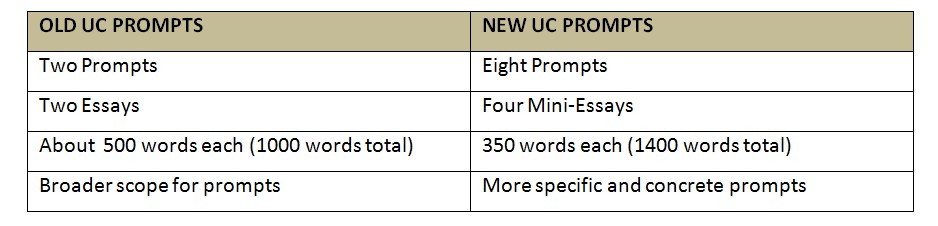
For Incoming Freshmen of Fall of 2017, the UC Personal Statements have changed their format and questions. They now are asking EIGHT “personal insight questions” instead of two broad questions. You need to choose FOUR of those questions to answer. 

Because having more choices is never debilitating, right?

Oh yeah, and you have only 350 words per prompt. Max. Compared to the 650 max on common app, you’re really just writing four blurbs about yourself.

But not is all bad news!

The pros are the prompts are way better. Before, students wrote abstract ruminations about how the world they come from somehow shaped their aspirations. Students often sacrificed examples and details trying to cover the entire scope of the prompt. These updated questions are more genuine and are easier to answer because they’re more specific. Which means now, hopefully, your answers will be more specific too.

It’ll just be more laborious because you need to write more essays--short, pithy essays at that. Short essays are harder since it’s easier to data-dump rather than exercise judgment. But the prompts help ground you to one experience, so that’s nice.

So in sum:


So, What Do UC Readers Really Want in an Essay?

They want concrete examples. Specific details. Clear insights. They want visceral examples that will, in the words of the UC, “express who you are, what matters to you and what you want to share with UC.” Stories that will conjure your soul and spirit before the eyes of the reader, and help serve as proof that you meet their 14-Point criteria. Narratives that will ultimately inform their decision to admit you or not.

The UC Reader wants to know who you are and what matters to you. The reader will be asking questions about you, such as: “Are you curious? Courageous? Do you take initiative or are you a follower? Why did you choose the path you chose? What are you passionate about and why? How do you react to setbacks and failures?” And then the follow up question is: “How do I know that’s true?”

So you need two major parts of your essay. You need to tell a good story. And you need to explain what that means about who you are. You need to give clear-as-day specifics of what you’ve done. So that way the UC Reader can tell another: “This student is an impassioned leader. How do I know that? Well, he had this powerful and clear example of how he… [INSERT STORY HERE]”

See how that works? A strong example is now proof that you are who you say you are. A good story is now concrete evidence you belong to their campus. So give them one. Or four.

So, without further ado….

The Personal Insight Questions for 2017…..As Episode Titles

The prompts are pretty confusing since they’re one giant block of text. I figured they could each use a title. One of my favorite TV shows was FRIENDS growing up, and each episode is titled: “The One With…” or “The One Where..” Like “The One Where Nana Died Twice” or “The One With The Jellyfish.” You get the picture.


In that same vein, I decided to title each prompt like it was a TV episode. Hopefully it’ll help ground you in a clear, specific example of sorts. Enjoy.

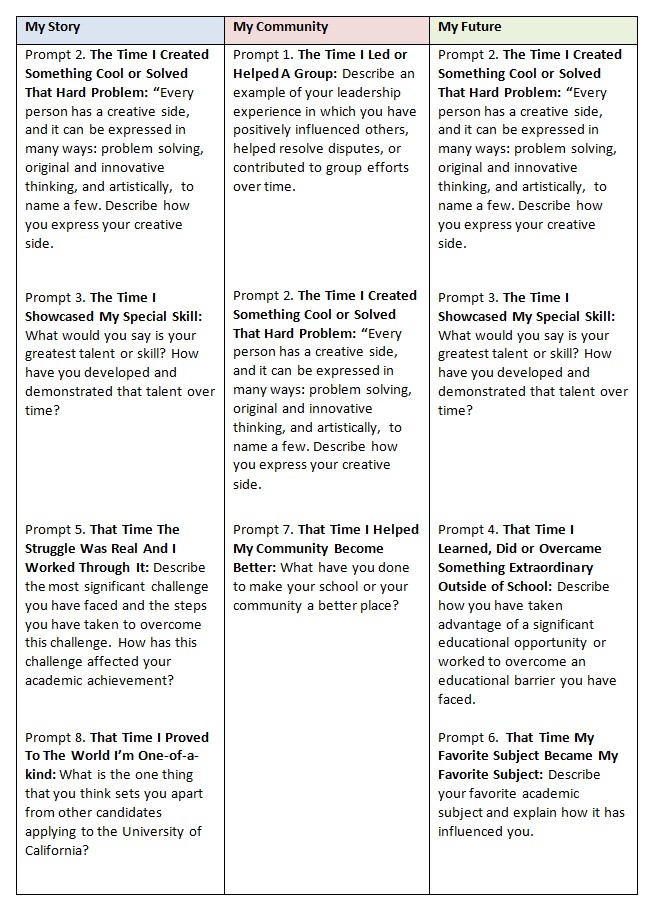
Prompt 1: The Time I Led or Helped A Group: Describe an example of your leadership experience in which you have positively influenced others, helped resolve disputes, or contributed to group efforts over time.  

Prompt 2: The Time I Created Something Cool or Solved That Hard Problem: Every person has a creative side, and it can be expressed in many ways: problem solving, original and innovative thinking, and artistically, to name a few. Describe how you express your creative side.  

Prompt 3: The Time I Showcased My Special Skill: What would you say is your greatest talent or skill? How have you developed and demonstrated that talent over time?  

Prompt 4: That Time I Learned, Did or Overcame Something Extraordinary Outside of School: Describe how you have taken advantage of a significant educational opportunity or worked to overcome an educational barrier you have faced.

Prompt 5. That Time The Struggle Was Real And I Worked Through It: Describe the most significant challenge you have faced and the steps you have taken to overcome this challenge. How has this challenge affected your academic achievement?

Prompt 6.  That Time My Favorite Subject Became My Favorite Subject: Describe your favorite academic subject and explain how it has influenced you.

Prompt 7. That Time I Helped My Community Become Better: What have you done to make your school or your community a better place?  

Prompt 8. That Time I Proved To The World I’m One-of-a-kind: What is the one thing that you think sets you apart from other candidates applying to the University of California?

Annndddd, I bet a few of you are feeling like this now:


UC Essay Brainstorming Tool--Which Prompts Should I Choose?

Okay. Don’t panic. I know looking at the eight different prompts can be overwhelming. How do you know which four to choose?

 I have always found it more useful to help students approach the essay inside-out instead of outside in. What I mean by that is it’s more authentic when you begin with your memories and then match them to a prompt. When start outside of yourself and use the prompt to remember a story—it sometimes becomes forced, inauthentic, and false.

So, before you use this UC Essay Brainstorming Tool, you are going to need a list of significant memories or moments in your life.

Lucky for you, I’ve adapted a process called a Life Map to help you do that. It uses sticky notes and crafting, and it originally was a counseling tool that I’ve now adapted into an essay tool. Because that’s how teachers roll.

So. Stop Right Now.


Step 1: Complete your Life Map Exercise —then come back here.

Have Core Memory list handy? Okay, let’s move on.

College Essay Archetypes

To help narrow it down, we have three main college essay archetypes that show up either in the Common App Prompts or private college supplemental essay prompts.

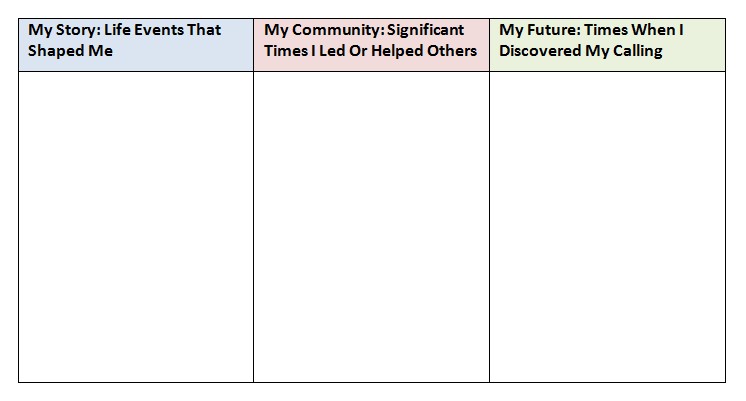
1.       My Story-Significant life events that shape who you are. What makes you you?

2.       My Community-Significant times in which you led or helped a community become better or solve a problem. Your contributions to a group.

3.       My Future-Significant times in your life in which you began to discover your life’s purpose and calling in terms of a career. Think of classes you’ve taken, clubs you’ve participated in, programs you attended, and projects you did in one field of study.  Think about why this has led you to choose the major you want and why.

Almost all prompts can fit into one of those three categories. So remember, we are moving inside out. Take your memory list, and work with the next part.

Step 2: For the tool, under each section, list a significant Core Memory that could fall under that kind of prompt.

Step 3: Now you’ve organized your memories, you can finally choose your prompts. We have categorized the 2017 UC Personal Insight Questions under these three main college essay archetypes. Identify the prompts your memories best fit. Please note that some prompts show up in more than one category.

And there you have it—you have identified which prompts you want to answer (hopefully). 

How To Start Drafting:

Once you got your prompts, you can start drafting. My students’ least favorite part, but with this tool, I hope it’ll be easier.

Follow this format. Copy and paste the following into a separate document and free write from there. 

Prompt (copy and paste prompt here):

Memory (150-200 words): Ground us in what happened. Narrate dialogue, descriptions, and details.

Reflection (150-200 words): Reflect on what this memory says or shows about who you are and what your aspirations are. Answer the reflection questions listed below by the UC (and the ones in bolded are written by me). The UC Provided an additional worksheet here

Reflection Questions

Prompt 1: Leadership

1. The Time I Led or Helped A Group: Describe an example of your leadership experience in which you have positively influenced others, helped resolve disputes, or contributed to group efforts over time.  

Things to consider: A leadership role can mean more than just a title. It can mean being a mentor to others, acting as the person in charge of a specific task, or a taking lead role in organizing an event or project. Think about your accomplishments and what you learned from the experience.  What were your responsibilities?

Did you lead a team? How did your experience change your perspective on leading others? Did you help to resolve an important dispute at your school, church in your community or an organization? And your leadership role doesn’t necessarily have to be limited to school activities.  For example, do you help out or take care of your family?

My questions: How did you manage conflict or communicate clearly? How did you practice perspective taking and empathy? How did you foster kindness, harmony, forgiveness, unity and teamwork?


Prompt 2: Creativity

2. The Time I Created Something Cool or Solved That Hard Problem: “Every person has a creative side, and it can be expressed in many ways: problem solving, original and innovative thinking, and artistically, to name a few. Describe how you express your creative side.  

Things to consider:  What does creativity mean to you? Do you have a creative skill that is important to you? What have you been able to do with that skill? If you used creativity to solve a problem, what was your solution? What are the steps you took to solve the problem?

How does your creativity influence your decisions inside or outside the classroom? Does your creativity relate to your major or a future career?

My questions: What inspired you to create something new? How did you go about it? Was it successful-why or why not?

What problem did you identify? Why was this problem significant? What was your process to try and come up with a solution? Was the solution successful-why or why not? What does this process showcase about your passion, your intellect, and your heart?


Prompt 3: Talent or Skill

3. The Time I Showcased My Special Skill: What would you say is your greatest talent or skill? How have you developed and demonstrated that talent over time?

Things to consider: If there’s a talent or skill that you’re proud of, this is the time to share it. You don’t necessarily have to be recognized or have received awards for your talent (although if you did and you want to talk about, feel free to do so). Why is this talent or skill meaningful to you?

Does the talent come naturally or have you worked hard to develop this skill or talent? Does your talent or skill allow you opportunities in or outside the classroom? If so, what are they and how do they fit into your schedule?

My questions: What started your interest in this skill and why did you keep on doing it? How did this skill begin to shape and inform other areas of your life? What has this skill taught you? How has it changed your outlook on yourself, others, and the world?


Prompt 4: Educational Opportunity or Barrier

4. That Time I Learned or Did Something Extraordinary Outside of School: Describe how you have taken advantage of a significant educational opportunity or worked to overcome an educational barrier you have faced.

Things to consider: An educational opportunity can be anything that has added value to your educational experience and better prepared you for college. For example, participation in an honors or academic enrichment program, or enrollment in an academy that’s geared toward an occupation or a major, or taking advanced courses that interest you — just to name a few.

If you choose to write about educational barriers you’ve faced, how did you overcome or strived to overcome them? What personal characteristics or skills did you call on to overcome this challenge? How did overcoming this barrier help shape who are you today?

My questions: What was especially thought-provoking about this experience? How did it confirm one way or the other your career goals? How did you showcase your passion or interest in this certain area of study?


Prompt 5: Significant Challenge

5. That Time The Struggle Was Real And I Worked Through It: Describe the most significant challenge you have faced and the steps you have taken to overcome this challenge. How has this challenge affected your academic achievement?

Things to consider: A challenge could be personal, or something you have faced in your community or school. Why was the challenge significant to you? This is a good opportunity to talk about any obstacles you’ve faced and what you’ve learned from the experience. Did you have support from someone else or did you handle it alone?

If you’re currently working your way through a challenge, what are you doing now, and does that affect different aspects of your life? For example, ask yourself, “How has my life changed at home, at my school, with my friends, or with my family?

My notes: Reserve answering this question ONLY for truly significant life experiences. You can’t write about failing a test or getting a low grade in class. The topic here applies more to some truly traumatic life experience that few teenagers have to go through—to the point that it actually impeded on other areas of your life. Give this topic the gravitas and respect it deserves.

My questions: What were your beliefs about yourself and the world before this event happened? What was lost or gained because of this episode? How did you heal or work through this difficult life circumstance? Who are you now because of it and how does it inform your beliefs about others and the world? Because of this, what hopes do you have for yourself and others?


Prompt 6: Favorite Subject

6.  That Time My Favorite Subject Became My Favorite Subject: Describe your favorite academic subject and explain how it has influenced you.

Things to consider: Discuss how your interest in the subject developed and describe any experience you have had inside and outside the classroom — such as volunteer work, summer programs, participation in student organizations and/or activities — and what you have gained from your involvement.

Has your interest in the subject influenced you in choosing a major and/or career? Have you been able to pursue coursework at a higher level in this subject (honors, AP, IB, college or university work)?

My questions: What was especially thought-provoking about this class? How did it confirm one way or the other your career goals? How did your part in the class showcase your passion or interest in this certain area of study?


Prompt 7: Community

7. That Time I Helped My Community Become Better: What have you done to make your school or your community a better place?  

Things to consider: Think of community as a term that can encompass a group, team or a place – like your high school, hometown, or home. You can define community as you see fit, just make sure you talk about your role in that community. Was there a problem that you wanted to fix in your community?

Why were you inspired to act?  What did you learn from your effort? How did your actions benefit others, the wider community or both? Did you work alone or with others to initiate change in your community?

My questions: What problem did you identify that this community was facing? What was your process to try and come up with a solution? Was the solution successful-why or why not? What does this process showcase about your passion, your intellect, and your heart?

How did you manage conflict or communicate clearly? How did you practice perspective taking and empathy? How did you foster kindness, harmony, forgiveness, unity and teamwork?


Prompt 8: Unique

8. That Time I Proved To The World I’m One-of-a-kind: What is the one thing that you think sets you apart from other candidates applying to the University of California?

Things to consider: Don’t be afraid to brag a little. Even if you don’t think you’re unique, you are — remember, there’s only one of you in the world. From your point of view, what do you feel makes you belong on one of UC’s campuses? When looking at your life, what does a stranger need to understand in order to know you?

What have you not shared with us that will highlight a skill, talent, challenge, or opportunity that you think will help us know you better? We’re not necessarily looking for what makes you unique compared to others, but what makes you, YOU.

My questions: What is an experience or quality that really sets you apart and why? What values does this event or quality showcase about you? Who are you now because of it and how does it inform your beliefs about others and the world? Because of this, what hopes do you have for yourself and others?


And there you have it! Hopefully you have at least some drafts and ideas to begin tackling the 2017 UC Personal Insight Questions! Writing is a process, and so give yourself plenty of time to revisit these steps and revisit your essays.

I know there’s still a lot of panicking going on, but hopefully after this Unofficial Guide to the 2017 UC Personal Statements, these new essays won’t be something you’re panicking about. 

Update: If you wanted these brainstorming exercises in a word document so it's easier to work through--you can access the file here. Also in there is some insights on how to best structure a college essay as well. Enjoy!

- John and Lynn Chen

If you have more questions about the new UC application essays, or want to chat with an Ilumin Counselor about how to craft the perfect application please contact us here


New SAT vs. New ACT: 4 Major Changes You Must Know

Elton Lin

My usual advice to students trying to decide between ACT and SAT has gone something like this: SAT and ACT are equal in college admissions. Colleges do not prefer one over the other. As you’re approaching junior year, take a practice test for both without any preparation, and make the decision based on your stronger score. Or, if the scores are similar, go with the test that seems more comfortable to you.

I tell students that SAT questions tend to be tricky. Part of doing well on SAT requires students to interpret the questions correctly. On the other hand, ACT is more straightforward without the tricky questions. ACT calls for a quicker pace when compared to the relatively slow, methodical approach required by the SAT. Both tests cover math, reading comprehension, and writing. ACT also includes a science section that isn’t about any particular field of science but basic scientific principles, like the scientific method.

With ACT’s increasing popularity as the more accessible option to SAT, College Board has unveiled a new version of the SAT in March 2016 that is, well, more like the ACT. ACT has also instrumented some changes to its test in 2015. What do these changes mean for students?

1. How is the new SAT more like the ACT?

The new SAT is designed to be more closely aligned with standard high school curriculum, specifically Common Core. For example, roughly 60% of the math section is now comprised of algebra and data analysis, with only 10% dedicated to advanced math topics like geometry and trigonometry. This change balances the new policy of no calculators allowed for most of the SAT math section.

In the reading section, the obscure vocabulary that SAT is infamous for has been replaced with what College Board terms as “high utility” vocabulary, words commonly used across many disciplines. Students answer questions about vocabulary used in context of a passage, as opposed to fill in the blank.

And, no longer will students be penalized for a wrong answer on SAT with a 0.25 deduction, making guessing on the SAT a better bet. Now, for both tests, it’s always better to guess rather than leave an answer blank.

More here on how the SAT and ACT sections have changed.

2. Is the essay really optional?

Yes and no. The new SAT essay is technically optional now, just like the ACT. And, the scoring for the SAT essay is now a separate score that doesn’t factor into your overall SAT score, also just like the ACT.

The new SAT essay score includes three scores, each between 2 and 8, for Reading, Analysis, and Writing. The ACT score has also changed, now including 4 scores, each between 2 and 12, on Ideas and Analysis, Development and Support, Organization, and Language Use and Conventions.

So, does that mean that students don’t have to take the writing test? It’s true that not all colleges require the writing test, but there are so many that do, such as the University of California, that it’s usually in a student’s best interest to opt for the writing test. For sample prompts and essays, see here for ACT and here for SAT.

3. What is a strong SAT score?

Ultimately, a strong SAT or ACT score is your best score. Ask yourself: is this my personal best? If the answer is yes, your time would probably be better spent on your academics and pursuing meaningful activities outside of class than taking SAT or ACT again and again.

If you think you can improve on your last SAT or ACT score, then you haven’t reached your strongest score. That is, until you’ve reached the zone where there isn’t a statistical difference in admit rates. Typically, for ACT, the sweet spot is roughly in the 35-36 range, while for the previous version of the SAT, it was roughly 2300 and above.

Now that SAT is reverting back to a 1600 scale, the “don’t take another SAT” score is about 1530 and above. See here for a detailed breakdown on the most competitive SAT scores.

4. What do I need to know about the new version of the ACT?

The changes for ACT are more subtle than SAT’s overhaul. The two main changes have to do with the new “Enhanced ACT Writing Test” and what’s called paired passages in the ACT reading section.

The ACT writing test not only includes a new essay scoring system, as mentioned above, but a more complex essay prompt. Students are not just asked to take a position, but to analyze multiple positions. And, the prompt is much more open-ended. Clearly, the new ACT essay requires students to practice the new format. More here about how to prepare.

The other ACT change worth mentioning is the addition of one set of paired passages to the reading section. Essentially, students read two passages before answering questions that involve analyzing the information from both passages. Although this change is not as dramatic as the changes to the writing section, students should familiarize themselves with this new reading format. See here.

With the new SAT and ACT formats, how will my advice to students change? Not as much as you might think. The SAT still includes more challenging vocabulary than ACT and allows for more time per question. So, ACT remains the more accessible yet faster-paced test.

Regardless of which test, you decide to go with, I do recommend that you pick either SAT or ACT, as opposed to doing both. High school students have enough to contend with these days without preparing for an extra exam. Despite the trend in recent years of students who take both exams, the goal is for you to achieve your personal best on either SAT or ACT.

-Azure Brown