Webinar Transcript: Planning for College Tours and How to Start Your College List
Anna Lu
(This is a transcript of a webinar from February 2026, a recording of which you can find on our YouTube channel.)
Elton Lin: Hey, good evening, everybody… Excited to have everybody join us.
I want to take a quick opportunity to most of you are used to seeing Anthony here, and so I just want to introduce you to Anna Lu, who is one of our marketing content managers… and I'm also proud to say that she's a former student of mine, University of Chicago grad, and… Anna's been awesome.
So, Anna will come back at the end, and jump in and work on some questions with us together, but—great to have Anna with us together.
Anna Lu: Thank you.
Elton Lin: Alright, alright. We'll see you in a bit, Anna. Alright, fantastic.
Hey, before we get started, if you don't mind, go ahead and go onto the chat and let us know where you are calling in from. I know there's always a range of people from different places. Just go ahead and just kind of put down your city and state, or country, and we certainly have had families, students calling in from the Far East, we've occasionally had some Europe.
But appreciate all the California people coming in strong. Sunnyvale, Los Gatos, Northern California… Oklahoma City! The Oklahoma City participation has always been strong, so I appreciate Oklahoma City. San Jose, lots of Northern California… Winnipeg, Manitoba, Canada. I have family in Winnipeg, and have been to Winnipeg. It's awesome. And so… but a lot of Bay Area, SF, San Jose, Northern California, Palo Alto…
Appreciate all of you who are coming in. We'll do our best to get through our topic for tonight.
And those of you who are on the West Coast, you can go back home and watch the finals of Olympic women's ice skating, which… It's certainly what I have earmarked with my wife later tonight. So, I'm excited for you.
Hey, tonight's topic is building a college list that works for you, and invariably, as I was preparing the content for tonight, the reality is that this is a conversation that probably deserves an 8-hour ultimate guide that we can talk about in 6 parts—and perhaps we can pitch as a 6-episode series, whatever the case may be. There are so many little nuances, and I think once we get into some of what we're gonna talk about, I think, it will invariably lead to more questions.
So, just as a reminder, please go ahead and post questions in the Q&A box. We will tackle all of them at the end. And I think we'll have ample time at the end to answer a lot of questions, so go ahead and post whatever you'd like at any time. And Anna's going to come on together with us to work our way through all these questions.
But nevertheless, the goal for tonight, for me, is just to introduce the topic, and to give you a beginning point of where to go. And as you go.., there might be more questions or whatnot… But where do we get started with all of this?
Elton Lin
CEO/Founder of ILUMIN Education
15+ years in college counseling
400+ students/year, 2,000+ apps/year
Students admitted to all top 50 + Ivy
Up to 7x the national average to top-15
Nationally recognized college admission expert profiled in National Public Radio, ABC News, US News + World Report
Elton Lin: Let me do a quick introduction of myself. My name's Elton Lin. I'm the CEO and founder of ILUMIN Education. I've been doing college advising for more than 15 years. Our team at ILUMIN Education—we work with more than 400 students a year, submit 2,000 apps a year, read probably over 3,000 essays a year…
So, even within our team—you know, 13 counselors across the United States—we see quite a few results and have gone through quite a bit. Our students have been admitted to every Top 50, including every Ivy League, multiple times over. Our admit rate to Top 15 schools is up to 7x the national average. And I've been grateful to have been profiled in a good, wider range of publications.
But, invariably, what I'm here to do is to try to do my best to provide as much helpful content as I can, especially as it relates to the college list.
Topics for today
What factors matter when choosing colleges
How to start building a list of colleges
Questions
Elton Lin: So, topics for today…
What factors matter when choosing colleges? There's just a ton of different ways you can break that down. So we're gonna talk about what I would consider as the more important factors, and the factors I think you should think about first.
Certainly, there are lots of very personal factors, as in, you know, “my grandmother wants me to apply to Harvard, wants me to go to Harvard, all my family went to college in Los Angeles.” I mean, there are some very personal factors that are totally fine.
But perhaps we can talk about, I think, some factors that I believe should relate to everybody.
Secondly… how do you start building a list of colleges to apply to? I mean, where do you begin? There’s… over 4,000 educational institutions in the United States, over a thousand four-year universities… Like, where do you begin? There's so many schools, and there are a lot of good schools. Where do we get started?
And then we'll cover some questions at the end.
What are the most important factors when choosing colleges?
Elton Lin: So! What are the most important factors when choosing colleges? Let me outline three basic things that I think everyone should be at least touching upon and thinking about.
Critical Factors for Choosing Colleges
Academic fit
Financial fit
Social-cultural fit
Elton Lin: Number 1 is academic fit, number two is financial fit, and number three is social-cultural fit.
Choosing Colleges: Academic Fit
Does the school offer my major?
Do I prefer small, discussion-based classes (Liberal Arts) or large, lecture-hall environments (Research Univ)?
How many students return after freshman year and how many graduate in four years?
Are internships accessible? What are the post-graduate job placement data? What is the graduate school placement rate?
Elton Lin: And, and as it relates to academic fit… it might seem a little bit basic, but: does a school offer my major, right? I find that there's a lot of students who say, “I really want to study business, and I really want to go to Stanford,” but Stanford doesn't have an undergraduate business program…
So there's a basic element of: does the school offer my major, and does it have the resources for me to pursue my area of study? Do I prefer small discussion-based classes or large lecture hall type environments? How many students return after freshman year, and how many graduate in four years?
I mean, in relation to the graduation rate, it's important because a higher graduation rate means that the operational support and access to classes is to such a degree to where students are able to complete their courses and to be able to secure the degree within 4 years or even 6 years. If the graduation rate is low, it gives a sense of perhaps the kind of resources that the students may or may not be lacking in that particular institution.
Are internships accessible? What are the postgraduate job placement data? What is the graduate school placement rate?
These are all a smattering—and there's more, I mean, we can post fix, six, seven, eight more questions here—but a smattering of questions to help you, students and parents, understand what's really most important to you.
| UC Berkeley | Northeastern | Pepperdine |
|---|---|---|
| 19:1 student/teacher | 16:1 student/teacher | 12:1 student/teacher |
| 60% get internships | 98% get internships | 70% get internships |
| 85% employed/gs | 97% employed/gs | 86% employed/gs |
| 51% med school | 80% med school | 91% med school |
| 92% graduation rate | 91% graduation rate | 84% graduation rate |
| 6 Fortune 500 CEOs | 1 Fortune 500 CEO | 1 Fortune 500 CEO |
Elton Lin: And so, if I could maybe do a little bit of a comparison, right? So, if I were to compare 3 schools here—UC Berkeley, Northeastern, and Pepperdine… and maybe—I mean, I would assume most of you are familiar with UC Berkeley, a lot of Northern Californians here. Northeastern, located in the Boston area. Pepperdine, also located in Southern California.
But if you were to kind of scan some of this information—and I don't need you to… I will highlight a couple of things, but I don't need you to kind of glaze over all the numbers—but the question being is, what's really most important to you?
So, if, say, going to med school is important to you, and you knew that UC Berkeley's med school matriculation rate is 51%, Northeastern 80%—and remarkably, Pepperdine's matriculation rate to med school is 91%. If that was the hierarchy of what is valuable to you, you might really want to consider going to Pepperdine. I'm not saying you absolutely should, I'm not saying anything like that, but it's a consideration, and perhaps it should be a consideration.
If you're looking for, you know, “will I be able to get a job immediately after graduation?” If you look at the stats here for Northeastern: 98% get internships, 97% are employed, within 6 months after graduation. (The “employed/gs” is “employed/grad school”.) So 97% of students are either employed or in grad school within 6 months of graduation.
And so, when you look at this data—and one of the reasons [for these stats] is because Northeastern has a mandatory co-op/internship program, where students are then often pipelined post-graduation back into one of those co-op internships that they did while they were in school. And so, they have a remarkably high employment rate, and it's why Northeastern is actually super popular right now—even though Northeastern ranked maybe in the upper 40s, lower 50s, depending on what year you're looking at the U.S. News.
It's become a remarkably popular school for this reason, right? So, perhaps if you're looking at employment rate, that's what might be valuable.
But what if you're just looking for, say, how many Fortune 500 CEOs attended each school? And maybe that's important to you, because maybe it's a reflection of network, maybe it's a reflection of a group of students who are very ambitious, maybe it's students who are kind of fitting into the corporate ladder in a more effective way. Certainly, UC Berkeley has more Fortune 500 CEOs.
The reality is that there's not one—you can't just say that just because Berkeley is ranked higher than Pepperdine or Northeastern, it's automatically the better fit school for myself. There are a host of different factors that sort of factor into what really makes a school a good fit for you as a student.
Higher-ranked schools do NOT guarantee a better fit.
Elton Lin: And so, as I mentioned, higher-ranked schools do not guarantee a better fit.
This is where I'm wanting to encourage students and families to really think about what's important. What's important for you? Not what's important for your classmates, what's important for other families who live somewhere else—what's really most important for you? And to do your best to really articulate clearly what will help me thrive for the long term, and less about what other people are doing and what the rankings just say.
Questions to ask yourself:
What are my career goals?
Do I prefer “deep” or “wide” learning?
What learning environment best suits me?
Does the college support all my academic needs?
How difficult is it to get research or internships?
Will the college help me find employment?
What if I change my mind?
Elton Lin: So… maybe a few questions to ask yourself [are]: What are my career goals? Do I prefer “deep” or “wide” learning?
And the deep or wide learning has to do with—every school often has a different kind of core or graduation curriculum. Some universities, like many of the Ivy Leagues, but including, like, a Columbia—they require a wide breadth of classes in a specific range of disciplines. So even if you're studying engineering, you have to take a certain amount of English courses, a certain amount of humanities courses, you have to take an extremely wide range of courses before you can graduate, while other universities allow you more freedom about what you can do with those general education courses, and… it's not necessary for you to take as wide of a breadth [of courses].
So, thinking about what's important to you is important.
What learning environment best suits me? As we talked about earlier: whether it's smaller classes or larger lecture hall type environments; whether it's kind of closer to your professors, or you feel comfortable learning with grad students; whatever [the best-suited learning environment] might be.
Does the college support all my academic needs? So if you think about… what are some of your academic needs, whether it's study abroad, whether it is research opportunities, whether it’s internships—[whatever] it might be.
How difficult is it to get research or internships?
And will the college help me find employment?
Maybe the last thing that I would consider as equally as important is: What if I change my mind?
And the reality, as I think I'll mention later in this presentation, is that 60% of students actually change their major before they graduate from college. So, if you're one of that 60%, then likely you might rethink whether you want to do electrical engineering, and you might change your mind, or whether you want to do English and maybe switch over to data science, whatever it might be.
If you change your mind, does a school have the resources to support you?
Now, I think most schools have an extremely wide academic breadth department set. But, you know, certainly when you think about a school like, say, Carnegie Mellon, which tends to be, you can argue, one of the top engineering schools in the world… But if you wanted to study, say, European history, is that really the best place to be? If you change your mind, does this school have what you need to pivot into different directions?
Critical Factors for Choosing Colleges
Academic fit
Financial fit
Social-cultural fit
Elton Lin: Alright, financial fit. I'm not gonna do an extensive conversation on financial fit, because we're going to bring on a college financial planner to do another webinar presentation—so please jump into that, if this is an important topic for you.
Choosing Colleges: Financial Fit
Questions to ask yourself:
What can I afford per year for college?
Does the school meet 100% of demonstrated need?
What is the “net price” of the school?
>> Net Price Calculator
What are the hidden costs (airfare, labs fees etc.)?
Is the financial aid front-loaded/renewable?
Elton Lin: But I did want to cover a couple of things, because I do think it's important as it relates to, I think, most families, and especially because college is getting way more expensive every year, and until something changes, the cost of colleges is remarkable, right?
The first question is: what can I afford per year for college? So, I think, really doing an honest assessment of what financial ability you have, in order to make sure that you count the cost as you put together a list of schools.
I did have a family a couple years ago who said, “we specifically only have around $45K per year to allocate to our daughter's college education.” And that's totally fine. I mean… $45–50k a year would cover in-state UCs, especially for those of us who are here in California. But then we began looking at private schools where that student's academic level would then likely encourage that private school to give a merit aid package to try to attract that student to come.
Oftentimes… I think, when I was growing up, I only thought about the UC system, I only thought about Fresno State, which was where I'm from, and I only thought about public schools because, in my head, public school meant more affordable. But the reality is that many private schools are more able to give out merit aid, and to give out aid to reduce the total cost of attendance for their particular school.
So, I always encourage students that, even if cost is an issue, to consider applying to a range of private schools to really see what kind of package you might get. Because I often—maybe, to paint the example… if you get into, say, UC Santa Cruz, but Occidental or Loyola Marymount gave you maybe $20,000 or $25,000 a year to go—would you consider going?
And I would say most people would at least consider it. And you only know if you actually submit the application to some of these schools. So, understanding what you can afford can also help you put together a selection of other schools that might be able to fit your needs as well.
So, number two: does a school meet 100% of demonstrated need? This is actually all on the school's common data set, so if you just search the university plus “common data set”, you'll actually see… if you're able to demonstrate a specific need via the FAFSA or the CSS—if you demonstrate that need, and if the school says they meet 100% of that demonstrated need, then you could be clear, you could be more confident, that the school would be able to meet that.
The third question is: what is the net price of the school? Every university has what they call a net price calculator. So you can just search school plus “net price calculator”, and you can enter in some basic family financial data, and then get a ballpark figure on what the total cost might be for your particular situation. So I would encourage you to use a net price calculator.
I will admit that I think the net price calculator [has] varying levels of accuracy, and you can't bank on it to the actual… to the specific dollar, but it does give you a good sense of where the financial aid package might be once you get it, once you get the package after you’re admitted.
What are the hidden costs? I mean, if you think about having to… if you live in the Bay Area and you need to fly out to Ithaca, New York, to go to Cornell—not a common airport, maybe flying out is a little bit more expensive. And then you think about how many times you need to come home back and forth. Those are fees that add up, right? So, whether it's lab fees, because you're into research, or whatever the case may be, what are the hidden costs that go into attending college?
And then lastly: is a financial aid front-loaded or renewable? Oftentimes, schools will give a, like, scholarship or financial package, or aid package, and then sometimes they give a big amount in the first year, but they're not clear on whether that amount is renewable every year. You need to kind of be clear on asking those questions.
Critical Factors for Choosing Colleges
Academic fit
Financial fit
Social-cultural fit
Elton Lin: Alright, and then there's a social-cultural fit, which…
Choosing Colleges: Soc/Cultural Fit
Questions to ask yourself:
What is the “Typical Student” archetype?
Is this a “Suitcase School” (commuter)?
How much does “school spirit” matter to me?
Are there “enough” people who share my identity?
How does the school handle conflict?
What do people do for fun that isn’t partying?
Elton Lin: Maybe a few questions to ask yourself is: what is the typical student archetype? I mean, what type of student really succeeds well at this particular school?
And so, I mean, the student who does well at Washington State is gonna be a little bit different than a student who does well at Claremont McKenna, a little bit different than a student who does well at USC, right? So I think understanding the typical student type is helpful.
Is the school a—what they call—a suitcase school, which is kind of a strange term, but is it a commuter school where students come in during the week, maybe they attend class, and then go home, and then the school ends up being very empty?
And I've heard some comments, specifically [from] a family who decided to attend—their daughter decided to attend University of Pacific in Stockton. And they were really impressed by the academic resources, and there are some really interesting academic resources, but it's a total commuter school. Nobody's there on the weekends, very few people are there in the evenings, and it wasn't really the cultural fit that was right for that student.
And how much does school spirit matter to me? You know, I have students who come in and they want… like, a higher priority for them is to go to a big football game. So if you're talking about a University of Michigan or an Ohio State—those are fun football games. I've been to a few, and so I can understand it. How important is it for you?
Are there enough people who share my identity? So whatever identity you might be thinking about, or find that is important to you—are there enough of those people there? And it doesn't mean that it needs to be a lot, but it's just, how might you define enough people? It's fair and right to ask yourself that question, and whether you feel like you might fit in.
How does the school handle conflict? I mean, I think we've seen in the news over the last couple years, especially with a lot of protests on campus. How does the school handle conflict? And you might want to, you know, might wanna check the news and see how each school has been handling it.
And what do people do for fun that isn't partying? Fortunately or unfortunately, every school does have a party environment or party group. But what do people do other than just partying? And if there's more access to different types of activities, or the way people have fun, then it's gonna be a better environment for you as well.
College tours!
Elton Lin: So, college tours! Maybe a couple of things to discuss as it relates to college tours—and maybe the lead-in to that is that, as you've kind of looked at all these questions, are thinking through what might be of a higher priority for you… you might think that going to a college tour might be really helpful, and I would concur. So, let's talk about college tours, and…
College tours: BEST PRACTICES
Students: sign up for official tour using YOUR email.
Can set up Q&A w/ admission staff.
Talk to students who are not leading the tour.
Eat at the dining hall.
Read the posters at the student union or dorms.
Visit your specific department.
Sit in on a class and/or observe classrooms.
Be honest about weather.
Visit all types: public, medium private, liberal-arts
If I had to describe this school in one word, what would it be?
Elton Lin: Let me give you a couple of best practices.
The first one is: if you go on a college tour, it is important for students to sign up for the official tour using their email—and specifically the email that they're gonna be using for their college application platforms.
So if you sign up for a Common App, or you sign up for a University of California application platform using a particular email, then students should use that same email to register for tours, because there's no other way that universities are tracking whether students are actually interested in them, other than with your email. Or… there are other ways, but that's the primary way.
So, let me encourage you: if the whole family is going, have the students sign up using their email.
You can set up, maybe, like, a 10 or 15 minute information meeting with someone in the admissions office. I'll be honest with you, I think it's a little bit hit and miss—depending on the year, you don't always get a response—but if you do, then you might be able to meet with the person who's actually reading your application.
You can imagine if—at least a little bit of FaceTime, grabbing a card, sending a thank-you email after the 15-minute information session—it goes a long way… So if you're going to do some visits, then reach out! You have nothing to lose. See if you can see if you can get 15 minutes to just ask some questions to the admissions staff who's in charge of your region. You can do that.
Talk to students who are not leading the tour. There's gonna be—invariably, you're going on a tour, there are students who are leading the tour. Do your best to try to talk to students who are not leading the tour. So, it could be if you're walking through the dining commons, or you're just walking through the student union, don't be afraid to just talk to students and ask them some questions. Because the reality is that they are going to give you a less filtered perspective on their student experience.
Number 4: eat in the dining hall… I mean, eat in the dining hall, if you can, give it a taste test. I really love Santa Clara University, by the way—I don't know anybody who's here from Santa Clara—I think the food is not that great. I mean, my goddaughter goes to Santa Clara University, I sometimes go by to grab lunch with her, and I just find it to be less than satisfying. I love Santa Clara as a school. Food's not that great.
Alright, number 5: read the posters at the student union or dorms, because what is often on the post-up boards is often what's important to students. It's often what types of initiatives the university is putting forth to the students.
I was at Washington University in St. Louis, maybe about 5 years ago, and I did notice that on all the dorm bulletin boards, the student union bulletin boards, there were a lot of flyers about, if you're struggling or having, perhaps, a mental health crisis, please speak with X. Or, if you need extra support for stressful classes, please access the tutoring center.
And so, there was a period of time where Washington University in St. Louis was known to be one of the most stressful schools in the United States. I think they've addressed that very well. I certainly highly endorse, you know, a school like Washington University in St. Louis… but you can get a sense of what's important at school just by looking at what's on the bulletin boards.
Obviously, visit your specific department, the academic department that's important to you.
Sit in on a class and or observe the classroom. So if you can kind of see, sometimes there's a lot of classes that are sort of theater-style. You can kind of get a sense that, like, that's the type of lecture environment it's going to be. Maybe there's more classes that are smaller, that are maybe around a conference table. That kind of dictates or demonstrates what type of classroom environment it might be.
Number 8: be honest about the weather.
I feel like if you're visiting in the summertime, things might feel great, but if you're in the Northeast or in the Midwest in January, it's pretty cold, so I feel like… Just be honest about it. I don't necessarily feel like the weather should overly determine where you should go, but just be honest about where you sit on that.
Number 9: visit all types. No matter whether you have a preference—visit public schools, medium-sized private schools, liberal arts colleges. Give yourself an opportunity to be in that environment and see what is a good fit for you.
And I would suggest, if you go together as a family, to ask this question at the end: if I had to describe this school in one word, what would it be? Have everybody in the family, including the student and parents—and even the siblings, if they're going—have them try to reduce down their visit to just one word. You can get a sense of whether—automatically, whether that might be a good fit.
I did ask my goddaughter after our tour of Santa Clara, what she thought about it. I had been on a couple tours with her, and I asked her… how would you describe this in one word? And her one word was home. And I was shocked. So, I'm happy because it's down the street from where we live, but nevertheless, that sort of crystallized for her what her experience at Santa Clara was.
College tours!
Questions to ask students (not leading the tour):
What’s one thing you could change that would make your student experience 10x better?
How late does the campus stay ‘alive’?
What do you wish you knew before moving into the dorms?
Does it feel like you’re competing against or with classmates?
Is it easy to find a tutor, or are you on your own?
Is it easy to get the classes you actually need to graduate on time?
How helpful is the Career Center?
Do alumni actually respond if you reach out to them on LinkedIn?
Do students from different ‘cliques’ or backgrounds actually hang out, or is it pretty segregated?
Elton Lin: All right! and maybe a couple of questions to ask students who are not leading the tour.
My favorite question is, what's one thing you could change that would make your student experience 10x better? I always find that asking good questions to students, who, again, who are not leading the tour, will kind of get you a more real glimpse.
Maybe a few extra questions here: How late does campus stay alive? Is it easy to find a tutor? Do you feel like you're competing against or with your classmates? Questions that I think, again—asking students who are there would really help you get a better sense of what the experience is like.
Right Fit College
Academic + career fit
Financial fit
Social fit (campus culture, size, diversity, etc.)
Location fit
Admission fit
“Excitement” fit
Elton Lin: All right, so right fit colleges… we talked about academic career fit, financial fit, social, social-cultural fit—[now,] just a couple of other considerations that I didn't mention: location fit, admissions fit (are you gonna get in? I think that certainly a consideration), and the all-important excitement fit, which is, I think…
There's something very subjective and personal about whether you can see yourself at a school, and it's very difficult to quantify, but it is not an unimportant factor. Like, do you feel excited about going? That does matter.
What Matters Most for College
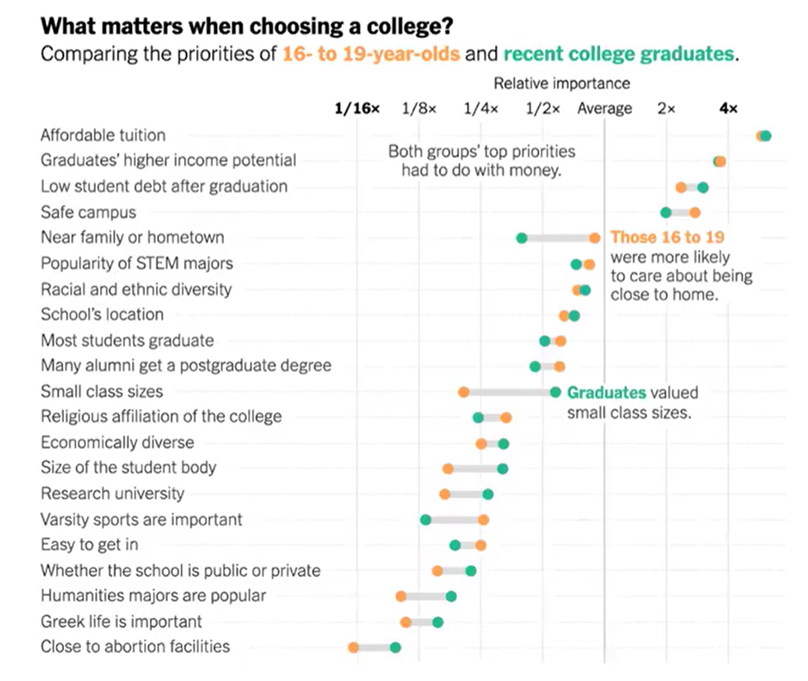
Elton Lin: Let me share with you a little bit of data—and I forgot to kind of post the source on this, I can send it to you if you’d like—but: [in] 2024, Independent Institute did research on what matters when choosing a college? They asked students when they were teens, when they were still in high school, and then they asked recent grads, and they compared the two.
So you can kind of give yourself a little bit of a glimpse into where it’s at. You can kind of see that maybe… When you're, you know, when you're in high school, maybe “closer to home” might be more important. You can see that for a lot of students who just graduated, the class size became more important.
Maybe to kind of give you a quick summary of this chart…
What Matters Most for College
What mattered most for high school students/parents:
Location or near home
Popularity/prestige of STEM majors
Safety
What mattered most AFTER students graduated:
Small class sizes
Research and/or internship opportunities
Low student (or parent) debt
Elton Lin: What mattered most for high school students and parents, at the start of the college search. was location or near to home, popularity or prestige of (what this survey did) with STEM majors, and/or safety.
And what mattered most after students graduated was small class sizes, research and/or internship opportunities, and low student debt.
So I think, you know, when you think about what… I always try to tell families to have an open mind—even though maybe the preference is closer to home—to really consider broadly across the United States—even though, again, maybe the higher priority is to stay more near to home—to, yeah, again, broaden that perspective—have the option!
…I would find this aspect of safety to be a little bit deceptive, too, because I feel like oftentimes the campuses that feel less safe are not as unsafe as you think they are. The campuses that feel very safe tend to be less safe than you think they are.
Just as a data point, just so you know: Stanford has always come up as one of the top 1, 2, or 3 highest crime rates among four-year universities in California, right? So, the reality is that, I mean, often, especially for those of us who live in the Bay Area, [it] seems like Stanford is a very kind of pristine area, seems like a very safe campus, but it always comes up as a school with a fairly high crime rate.
So my thing is to… my encouragement is to perhaps think more broadly—and maybe, learning from students who just graduated—that maybe looking at smaller class sizes, better access to research and internships, and lower student debt is probably going to be a little bit more important.
How do I build a college list that is right for me?
Elton Lin: Alright, so how do I build a college list that is right for me?
This is, again, a 6-hour conversation that I will only spend 10–15 minutes [on] as an introduction, and if there's more requests, we can cover more of this topic in another webinar.
Right Fit College:
College major
Estimate for what I can afford
Other non-negotiables: location, weather, community, access to research, family, etc.
Elton Lin: But, if you have a sense of what your college major will be, you have an estimate for what you can afford, and you have some other non-negotiables, like location (I need to be in warmer weather, I need to be closer to my family, whatever the case may be)... maybe you have a couple of preferences or non-negotiables.
If you have these three things in mind—I would encourage you to think through these three things first before coming in to build a list.
College List Creation
Compare student’s average GPA, test scores, and resume to determine an appropriate range of colleges.
National Averages
HS Naviance Data
Grade Point Average and Test Assessment
Extracurricular Activities
Early Admission Programs
Other Factors
Elton Lin: But if you have these three things, my thing is that you need to begin to define what your admitability is. Like, what's a good admissions fit?
You can begin with comparing a student's average GPA test scores and resume to determine an appropriate range of colleges.
Maybe you can start looking at national averages, which I think are actually the least accurate.
You can look at your specific… your high school-specific data. I mentioned Naviance here because Naviance is a… it’s a CRM data platform that allows high schools to maintain their own high school-specific data for students who are going out to college. But there are other platforms, like MaiaLearning or Scoir.
But whatever brand it might be, almost every high school uses a college data storage place, [a] place for students to be able to search for colleges, and for them to review the admissions trends that have been happening at their own high school.
So: looking at high school-specific data through, in this case, Naviance data; looking at your GPA and your SAT and ACT scores; extracurricular activities; early admission programs, which—I'm talking about early decision. (We are not gonna go in-depth into ED1 and ED2, that's another webinar.)
But you should begin by… understand where you sit, where your GPA, test scores, and resumes sit in relation to other students nationally, and specifically with your school.
National Averages
Determine Reach, Target, and Safety:
Safety: Above the 75th percentile
Target: Within 50th–74th percentile
Reach: Below 50th percentile
Elton Lin: And oftentimes, we use this as a beginning point. This is not a hard and fast rule, so don't… please, I know, as I say this, I can understand that people are maybe screenshotting this slide.
It's not hard and fast, but generally speaking, one way to begin to look at whether a school is a good fit for you… or whether you might be admitted, is to take a look at the average GPA and test score data. And if you're above the 75th percentile, then you can kind of get a sense. And if there's an average entry GPA, there's an average entry SAT or ACT score—if you're at the 75th percentile, then you're in a stronger position.
If you're somewhere within the 50th to 74th percentile, I would say that you're kind of in that target—maybe, you know, 50/50 likelihood of getting in.
And if you're below that 50th percentile, it becomes more of a reach, right? That's kind of a basic understanding of it as it relates to national averages.
Now, maybe just to define this quickly: a safety school… and our definition might be… a safety school might be, like, you have a 75% chance of being admitted. Target school may be around 50%, and then for reach schools, you know, maybe 25 to 30% or less chance of being admitted.
National Averages
Determining Reach, Target, and Safety:
Cornell 75th Percentile:
GPA – 3.88/4.35
SAT 1470 or ACT 33
Theo:
GPA – 3.75/4.21
ACT 34
Determination: REACH
Elton Lin: And so, maybe to kind of give you an example of a student that we've worked with. This student… his name is Theo, applying to Cornell. If you look [at] the national averages—actually, this might be different, this is maybe, like, 3 or 4 years ago—but, if you look at national averages, it's a 3.88 admitted GPA, underweighted GPA, and a 1470 on the SAT.
Theo's GPA is a 3.75, and his ACT is a 34, which is higher than the average ACT of a student being admitted to Cornell—but his GPA is lower than the average GPA of a student being admitted to Cornell. So, for us, the determination is that this is a reach school for Theo.
There's really no other way to look at it in that sense.
Naviance Data (HS Specific Data)
Important data points to consider:
Average GPA of students admitted
Average SAT or ACT of students admitted
Application History (# applied, admitted, enrolled)
Percentage Admitted on the Regular Deadline
Percentage Admitted on the Early Deadline
Average GPA/Test Scores Accepted on RD
Average GPA/Test Scores Accepted on ED/EA
Percentage Waitlisted
Elton Lin: If you do have access to your high school-specific data—whether it's on the Naviance platform, the Scoir platform, the MaiaLearning platform, whichever platform it is—the datapoints that you want to be paying attention to are: average GPA of students admitted (they will have, from that particular school, the average GPA of students from that particular high school being admitted to Cornell, to George Washington, to Arizona State… and you'll be able to see that data more specifically); average SAT of ACT of students admitted; application history; number of applied; number of those admitted; [number of] those enrolled; percentage admitted on the regular deadline; percentage admitted on the early deadline (not every school will have all of that data, but these platforms will have a lot of that data… and so, it's important to take a look at what's happening at your own high school, and not what's happening on the national level); average GPA test scores accepted on RD, average GPA test scores accepted on ED/EA, (they're likely gonna be a little bit different, and so it’s important to understand that); and then sometimes some platforms will have percentage waitlisted (that’s not as common, but occasionally some schools will collect that data).
GPA and Test Assessment
Determining Reach, Target, and Safety (Naviance):
| Below Average GPA | Above Average Admitted GPA by 0–0.15 pts | Above Average Admitted GPA by 0.20 pts | |
|---|---|---|---|
| Below Average SAT/ACT | Reach | Reach | Reach |
| Above Average SAT/ACT by 0–50pts (SAT) or 1pt (ACT) | Reach | Between Reach & Target | Target |
| Above Average SAT/ACT by 100pts (SAT) or 2pt (ACT) | Reach | Target | Safety |
Elton Lin: This is just a kind of a quick way to kind of decide whether to put a school in a reach, target, or safety realm.
So if you look at the top line: If you're below the average GPA, obviously it's probably gonna… almost every situation's gonna be a reach. If you go to the far right: if you're above average… if you’re above the average GPA by, say, 2 points—and this is on a standard 4-point scale… some schools are on a 6-point scale, a 7-point scale, [I understand]... but just, generally speaking, on a 4-point scale—if the average entry GPA is 3.6 and you're at a 3.8, then you're .2 points higher, right? If you're, say, above the average admitted GPA by .2 points, and if you go to the bottom, you're above the average SAT score by 100 points on the SAT, or 2 points on the ACT, then you can probably be comfortable that it's a safety school.
But otherwise, for a lot of other schools, it's better to put that school into a more conservative bracket, and to make sure that you build a list that is safer.
There may be questions on this. We can talk about this another time.
GPA and Test Assessment
Determining Reach, Target, and Safety (Naviance):

Determination: REACH
Elton Lin: Here is a little cutout of a screenshot of what it looks like on Naviance.
So, if, in this case for Theo, he's applying to Cornell University—you can see there's a college match tool on Naviance to where you can line up the students' data with the universities that you're thinking about, and then see which schools might be a better fit for that student. Utilize the tools that your high school has to really understand how to make better choices. So that's what it looks like here.
College List
Extracurriculars:
For top 30 universities, resume means more
Activities need to support the intended major especially for very selective majors.
Elton Lin: And then, for your extracurricular activity resume… for Top 30 universities, the resume does mean more. And the reality is that you can probably understand, for students who are applying in the top 30 schools… I mean, the majority of students, overwhelming majority of students, have very clean grade point averages and high test scores.
If you're coming in, if everyone has good grades and good test scores, what's the differentiator between one student and the next? And it's really gonna be in what you do outside of class. So, the resume becomes more important.
Activities need to support the intended major, especially for very selective majors.
As you probably, maybe have heard from other friends or other families, students who… in the last 5 or 6 years, students who are applying to computer science have been having a hard time getting into the schools that they've been wanting to get into. There are majors that are more difficult to gain admission [through], and invariably, some majors where it is not as difficult. I don't want to say it's easy, because that's not really accurate, but… where, you know, the amount of students who want to apply into the number of spaces, there's not as many, right?
Most Popular Majors 2024
Most In-Demand Majors
Nursing
Computer science
Business
Accounting
Physical therapy
Math and statistics
Information science
Finance
Software engineering
Marketing
**Source: Indeed
Top Majors Based on Salary
Computer science
Electrical engineering
Mechanical engineering
Chemical engineering
Industrial engineering
Information technology
Civil engineering
Statistics
Nursing
Management Info Systems
**Source: Glass Door
Elton Lin: So maybe to kind of give you a quick glimpse at the most popular majors for 2024…
I think you can kind of get a sense of, you know, business, pre-health (which is biology), econ, computer science is up here, engineering—engineering is always more difficult by and large, so engineering’s gonna be in this bracket as well.
But just to kind of give you a sense of what are the more selective majors…
Bachelor Degrees 2012 vs 2022
| 2012 | 2022 | Difference | |
|---|---|---|---|
| Biological and biomedical sciences | 100,397 | 131,462 | +40% |
| Business | 360,887 | 375,418 | +5% |
| Computer and information sciences | 50,961 | 108,503 | +113% |
| Engineering | 85,987 | 123,017 | +43% |
| Health professions | 180,437 | 263,765 | +46% |
| Psychology | 114,446 | 129,609 | +13% |
| Social sciences and history | 177,767 | 151,109 | -15% |
| English language and literature | 52,401 | 33,429 | -36% |
| Foreign languages | 21,647 | 13,912 | -36% |
Source: Dept of Education, National Center for Statistics
Elton Lin: And maybe to give you some comparison data, from… as it relates to number of degrees conferred, you can kind of get a sense that computer science and information sciences and engineering and pre-med have grown the most.
The other majors—social science, history, English language and lit[erature], foreign languages—have not grown, in contrast.
So that might maybe give you a sense of the majors that may be more challenging to be admitted to, and maybe some majors that are maybe slightly less challenging.
College List
Extracurriculars:
For top 30 universities, resume means more
Activities need to support the intended major especially for very selective majors.
Leadership demonstrates student initiative.
Research + academic competitions demonstrate subject matter depth.
Community service demonstrates awareness and concern for those around them.
Elton Lin: I want to save time for questions, so let's see if I can get through this last bit of content as quickly as I can.
As it relates to the assessment of your resume, leadership is important, there's no question, and I feel like this is another… extracurricular activities is like another two-hour webinar, so apologies.
But leadership demonstrates student initiative, research and academic competitions demonstrate students' subject matter depth, and community service demonstrates awareness and concern for those around them. Most schools are paying attention to all three.
Has a student demonstrated leadership? Has a student demonstrated some matter of subject matter depth? I'm not saying that research and academic competitions are the only way—don't read it that way. But they are looking for subject matter depth, and they are looking to see whether a student is aware of what's happening in their community.
So this is certainly another conversation we can get into in more depth at another time.
A basic guide to the depth of extracurricular involvement related to college ranking
| Ranking | SAT/ACT | GPA | UC-GPA | AG | Honors/AP | EA Hrs | Leadership |
|---|---|---|---|---|---|---|---|
| 1–20 | 1540/34+ | 3.90+ | 56+ | 20+ | 3,000+ | 4+ | |
| 21–35 | 1490/33 | 3.80+ | 4.15+ | 52+ | 16+ | 2,000+ | 3+ |
| 36–50 | 1400/30 | 3.70+ | 3.95+ | 48+ | 12+ | 1,500+ | 2+ |
| 51–65 | 1270/27 | 3.60+ | 3.70+ | 44+ | 8+ | 1,000+ | 0+ |
Elton Lin: I'm gonna throw this in here only because I want it to be helpful as a barometer. I don't want it to be a hard-and-fast sort of threshold, so don't read it as such.
But generally—normally, in order to just sort of give ourselves, internally—this is maybe some, some, a barometer for whether a student is even in the ballpark. Oftentimes, we kind of come back to, you know, if you're looking to apply into top 20 universities, do you have around 3,000 hours of extracurricular activity involvement? Like, over the course of 4 years. If you total it up, I promise you, students have way more EA hours than you think.
But how involved are students outside of school?
For the honors and AP number, it's number of semesters. How many semesters of AP or honors courses do you have by the time you graduate? So if you're talking about 20 semesters of AP or honors courses, you're talking about, maybe, 4 APs junior year, 4 APs senior year, maybe one AP sophomore year, maybe a couple of honors classes in freshman and sophomore year—comes out to around 20 semesters, right? So oftentimes—just to kind of give you a quick barometer—it doesn't mean that… nobody's been admitted to a top 20 university who's had under 20 semesters. That's not the case either. But just to kind of give you a ballpark about whether a student is more viable for a particular range of school, this is something to consider.
College Research Exercise
John
Saratoga High School (CA)
Unweighted GPA: 4.00
Weighted GPA: 4.40
Tests: ACT 33
Extracurricular Activities: Orchestra – Violin, Robotics Team Captain, MIT Launch Summer Program (Launched iPhone App, 5k DL’s)
Personality: Natural leader + hands-on learner
Major: Electrical Engineering
Elton Lin: Alright, let me give you a couple of examples before we open up the questions.
These are real students, but unfortunately not real photos. Just to kind of give you a few examples: Saratoga High School, a student had a good GPA, a reasonably good test score on the ACT, involved in orchestra, was a robotics team captain, attended an MIT launch summer program, where he launched an iPhone app that had 5,000 downloads, and he's a natural leader, a hands-on learner, and wants to study electrical engineering.
Just to explain quickly, I think this student's resume is not bad. I think there are a few other things, there's maybe a couple other leadership opportunities, some involvement, but I wouldn't say it's a top 5% type of resume.
College Research Exercise
John
Saratoga High School (CA)
Unweighted GPA: 4.00
Weighted GPA: 4.40
Tests: ACT 33
Reach: Johns Hopkins, UCLA
Target: UC Davis, Purdue
Safety: Ohio St, Texas A&M
Elton Lin: So maybe, again, to give you an example of what a college lists—just some examples of what was in the student's college list… we did consider applying early decision to Johns Hopkins, to UCLA… UC Davis, Purdue for target… Ohio State, Texas A&M. But if you understand these schools, these are all actually classic, well-funded, very well-equipped-resource engineering schools. This student wanted to study electrical engineering, really wanted to get into the nuts and bolts of his area of study, and these are really classic places to do that.
So this is what his… and if you look at the Ohio State and Texas A&M, even though the student's GPA is very strong, this student wants to make sure that no matter what happens, this student has good options. And I would argue that Ohio State and Texas A&M are amazing engineering schools when you dig into it.
College Research Exercise
Ronald
Hamilton High School (AZ)
Unweighted GPA: 3.40
Weighted GPA: 3.65
Tests: SAT 1300
Extracurricular Activities: Martial Arts, Model UN Vice President, Finance Internship
Prefers: Big cities/not small schools
Major: Business/Econ
Elton Lin: For another student named Ronald: Hamilton High School, specifically in Chandler, Arizona; 3.4; 3.65 weighted GPA; 1300 on the SAT. He was a martial arts person, a Model UN VP, and had an internship in finance. He prefers big cities, not small schools. He's excited about that big city and big campus environment. And he wants to study business/econ.
College Research Exercise
Ronald
Hamilton High School (AZ)
Unweighted GPA: 3.40
Weighted GPA: 3.65
Tests: SAT 1300
Reach: Univ of Illinois, Univ of Washington
Target: Rutgers, Loyola Marymount
Safety: George Washington, Arizona St
Elton Lin:So schools that we put onto his list, or suggested to be put onto his list: University of Illinois, University of Washington; Rutgers, Loyola Marymount for target schools; and then for safety schools, George Washington in Washington, D.C, and Arizona State, which is his home university.
But if you kind of dig into it, these are all actually very, again, well-established undergraduate business schools. Lots of resources, good access to internships. Most of these are in fairly large metropolises, so they kind of fit into what he was looking for in a university setting.
And yeah… was remarkably admitted to the University of Illinois, thankfully.
College Research Exercise
Taylor
HK International School
Unweighted GPA: 3.63
Weighted GPA: 3.82
Tests: ACT 31
Extracurricular Activities: Songwriting Club President, Speech and Debate
Prefers: Small group discussions, knowing profs, and being on the West Coast
Major: English
Elton Lin: Alright, and then Taylor, who attended Hong Kong International School, unweighted GPA 3.63, 3.82, ACT 31, songwriting club president, speech and debate. Surprisingly, even though she was in speech and debate, she prefers small group discussions, [is] a little bit more introverted, wants to know her professors, and prefers being on the West Coast, and wants to study English.
College Research Exercise
Taylor
HK International School
Unweighted GPA: 3.63
Weighted GPA: 3.82
Tests: ACT 31
Reach: USC, Pitzer College
Target: Univ of San Diego, Chapman
Safety: Occidental, Seattle Univ
Elton Lin: And so her school list looked a little bit like this. You know, weighted towards the West Coast, looking at schools that are a little bit smaller. USC's not small, but USC is also not Ohio State, right? So USC, Pitzer, University of San Diego, Chapman, Occidental, Seattle University—obviously very weighted towards the West Coast and a slightly smaller school, with a very developed English department.
College List Items We Didn’t Discuss:
We have future webinars planned for:
Early Decision Strategy
Choosing the right college major
College financial planning
College hidden-gems
Post in chat: what topics do you want us to cover?
Elton Lin: So… college list items, or college list topics that are important that we didn't discuss today: early decision, choosing the right college major, college financial planning, college hidden gems. They are forthcoming in another webinar. And I would love it if you could post in chat what topics you want us to cover in the future! So please feel free to do that.
College Considerations:
Being a “higher” student at a lower ranked school vs. a “lesser” student at a higher ranked school
Undergrad is only one stop on the education journey.
College prestige matters “some” but much less than you think.
On average, 60% change majors before graduating.
Location has an impact on post-grad recruiting.
Elton Lin: But a couple last considerations before they go to questions.
Maybe something to think about is that, might it be better to be a “higher” student at a lower-ranked school versus a “lesser” student at a higher-ranked school. And maybe I should really rethink the “higher” and “lesser” terms—but oftentimes, perhaps going to a school where you're at maybe the top half or top third of the sort of academic spectrum of that school may lead to a place where you have more access to internships, [and] you feel a little bit more confident.
There's an interesting, fascinating sociological study that compared the top 20% of students who graduated from Michigan State versus the bottom 20% of students who graduated from Dartmouth. And they found that the top 20% of students who graduated from Michigan State had double the mid-year career earnings of the bottom 20% students from Dartmouth. So, something to think about.
Undergrad is only one stop on the educational journey.
College prestige matters some, but I would contend much less than you think, and I think the data does support this, and so we can certainly cover that in another webinar.
And then, on average, 60% of students change majors before graduating. Certainly, this is not… you know, there are opportunities to change your mind.
And then location does have impact on post-grad recruiting. Oftentimes, a lot of the regional companies that are recruiting from particular universities are doing it regionally. For example, I had a student that graduated from computer science at UIUC. His first job was with Target, which is based in Minneapolis, and he was with the software development arm of Target, and he was recruited because he was at UIUC—University of Illinois, just south of Minnesota.
What do I do?
Do your research! There are GOOD colleges out there!
Apply to BOTH public and private schools! Privates can provide more scholarships!
Review admissions trends at YOUR high school
Apply to MORE safety schools
Elton Lin: Lastly, do your research. There are good colleges out there.
Apply to both public and private schools, because private schools can provide more scholarships.
Review admissions trends at your high school.
And I always encourage people to apply to more safety schools.
Final Word
Remind them (often) that you love them regardless of how the results turn out. 🧡
Elton Lin: And then lastly, as my kind of consistent encouragement to all families and students, especially in a very stressful college app cycle is just: remind your student that you love them regardless of how the results turn out.
I always find that students know—they feel the pressure, they know what's at stake. Continue to remind them that no matter where they go or where they end up, or what they get admitted to or not admitted to, that you are a safe place. So, just as an encouragement to you, a reminder.
And let's go on to some questions.
Questions!
Elton Lin: Let me invite Anna back! And it's 6.56pm West Coast time. We will definitely go a little bit past the hour, so those of you who need to drop can certainly drop whenever you'd like.
Thank you!
Elton Lin
CEO, ILUMIN EducationClick here for a free consultation!
Elton Lin: But we'll hang out for a little bit and try to answer some questions… so if you have some questions, go ahead and please post them on the Q&A.
Anna, you know, what do we got today?
Anna Lu: Yeah, well, please feel free to open up the Q&A and send us any questions while we're answering these first few, but we have a question about college selection timing. What is the best time for—or even just the right time, for a student to kind of get started researching, building their list… whichever class they are, if they're a junior or senior, I suppose.
Elton Lin: Yeah, I mean, I think one thing I did mention here is that… I think the optimal time to do college tours is spring break of 11th grade, because spring break of 11th grade for a lot of students is sometime in April. Whatever college you go to, that college is most likely not on spring break. So you can see that college in full bloom, talk to people who are in the admissions office possibly, and then get a sense.
I think it's good to do some research starting second semester, 11th grade. Some families will maybe want… students and families will want to do it earlier. But the reality is that your academic profile and activity profile is not finalized yet. So you have through the end of the summer after 11th grade to kind of finalize everything academically, and finalize your profile, so to speak.
And so, I oftentimes tell families to—yeah, maybe second semester [of] 11th grade, begin to put together some schools that you think might be a good fit, go take a few tours, see what type of excitement fit might be good for you as you think about what school might be fitting. And then you have the beginning points of what type of environment may be a good fit, so…
Anna Lu: For sure.
Yeah, actually, speaking of college tours: since spring break is coming up for a lot of people, how do you recommend that they make the most out of a college tour, or even if they're going just by themselves without going with, you know, [a] prescribed college-run tour, if they're going by themselves, what do they do for this college visit?
Elton Lin: Yeah, I mean, I did post some questions you can bring, and also a few best practices, but definitely sign up for an official tour. So if you're able to go visit the school, I think that's great. Certainly, there's a lot of benefit to that, but I know not everybody is able to actually go out to every school, or go out to even a few schools.
I would suggest still going to… there's a lot of people from the Bay Area… If you're not able to go out of region, then go to the local schools. So even if you visit Santa Clara, UC Berkeley, Stanford, University of San Francisco, those are 4 extremely different schools. And then you can get a sense of what type of environment may be a good fit for you. Even if none of those four schools are exactly on your list, visiting locally will still help you.
I do feel like the biggest thing I mentioned was, you know, signing up using your student's email, and then trying to talk to students who are not leading the tour. So again, going into the student union, dining commons; be brave and talk with some students and ask them some questions, and then get the real juice on what's going on on campus.
Anna Lu: Yeah, I know there are a lot of student events that happen to be going on, sometimes overlapping with your visit, so it might be worth a shot also to see what's going on there.
Someone asked, is it too late to arrange college tours for this spring? I'm assuming maybe this is a senior, or a parent of a senior?
Elton Lin: If it's a parent of a senior, I think if you're getting… certainly not every family or student will go on college tours in the spring. But, oftentimes what families might do is that they'll wait for all the college results to come through, and then they'll go do their visits. So, right now, it's [the] middle of February, results are slowly trickling in, but you'll probably get the most of your results in March and maybe even early April.
And then once you get all the results, I have students who are just, like, families who are then doing mad dashes across the U.S. to go visit several schools to see where they end up going. So, you can certainly do that as well.
Is it too late to schedule tours? I mean, I think they're filling up, but no, I think you can check the… you can just search whatever school, and then search for official tour or tours, and then you’ll get the link to see what the availabilities are.
Anna Lu: For sure. Also, they corrected me, sorry—junior student—but this advice still stands, I would say.
Elton Lin: Okay, sounds good. Agreed, yeah.
Anna Lu: Also, yes, this session will be posted on the website, or rather, on our YouTube channel, so this will be sent out also as a link to all the attendees, so don't worry about… if you want to go back and see something that you missed, this will be there and accessible.
Someone asked about a specific slide that you had on extracurricular rankings. What do the acronyms AG and EA mean?
Elton Lin: Oh, okay, alright, sure, sure. So…
Let me go back to that slide, just so that we… and there's a sort of intentionality to not want to spend that much time on that slide, but I understand the curiosity, so maybe we can talk about it.
So… AG is, is A through G credits, so this is specifically a University of California review rubric process, and A through G is part of the UC's assessment of how many A through G credits you have completed by the time you graduated. So this is the number of semesters over the course of your entire high school career. So obviously, again, not every… it doesn't mean that you have to have completed 56 semesters of A through G courses in order to get into UC Berkeley, UCLA—but, to also be honest, the UC does count the number of A through G semesters that have been completed as one of the 13 factors that are part of the UC rubric.
I think that was the only question on what A through G… AG was, correct?
Anna Lu: Yeah, that was the only one.
Elton Lin: Great. I'm gonna flip off this slide so that we can go to the…
Anna Lu: Sounds good.
Elton Lin: Any other questions?
Anna Lu: We have one more question, I think this is kind of in relation to, maybe the trajectory of someone's… oh, sorry, they said also EA. They want to know what EA stood for.
Elton Lin: Extracurricular activities.
So, yep.
Anna Lu: All right, but yes, going back to the other question, this kind of connected the trajectory of someone's kind of high school transcript, I think, over the years, but someone was a little concerned about, “okay, what if my child, or what if I, as a student, gets a relatively lower grade in maybe freshman year? How does that affect the course of my admit later on.”
I think the answer is always that improvement is better, but you could probably go more in depth.
Elton Lin: Yeah, that's a good response, Anna.
Anna Lu: [laughs] Thank you.
Elton Lin: [laughs] One thing I didn't talk about is certainly the contour of the transcript, and certainly, not everybody is able to maintain a perfect GPA. That's just not how life is, right?
But an upward trend is always better than a downward trend. I think that's… if I were to summarize it all into one statement, I'd probably say that.
So… student gets a B in 9th grade? By far not the end of the world. Absolutely not. And my encouragement [for the] student is just: continue to make improvement, have some reflection on what you can do better, and make some adjustment over the course of the forthcoming semesters and beyond.
Anna Lu: Alright, well, I think that's all the questions that we have, unless someone has one last burning one, but I think that's it.
Elton Lin: All right, all right. So we'll all get to go home and watch some figure skating tonight. That comment's not gonna date well on an old YouTube video, but nevertheless, we'll enjoy it.
Hey, thank you so much, everybody, for coming on. We have a full lineup of webinar topics coming up for this coming year, so please keep an eye out on the emails. And I really appreciate you joining us tonight
If you want to schedule a free consultation, you can do so there. And happy to answer more specific questions on your particular student case, and to give a little bit more detail where needed.
So, thank you, everybody. Thanks so much, Anna.
Good to see everybody. Talk to you soon.
Anna Lu: Thanks, everyone!