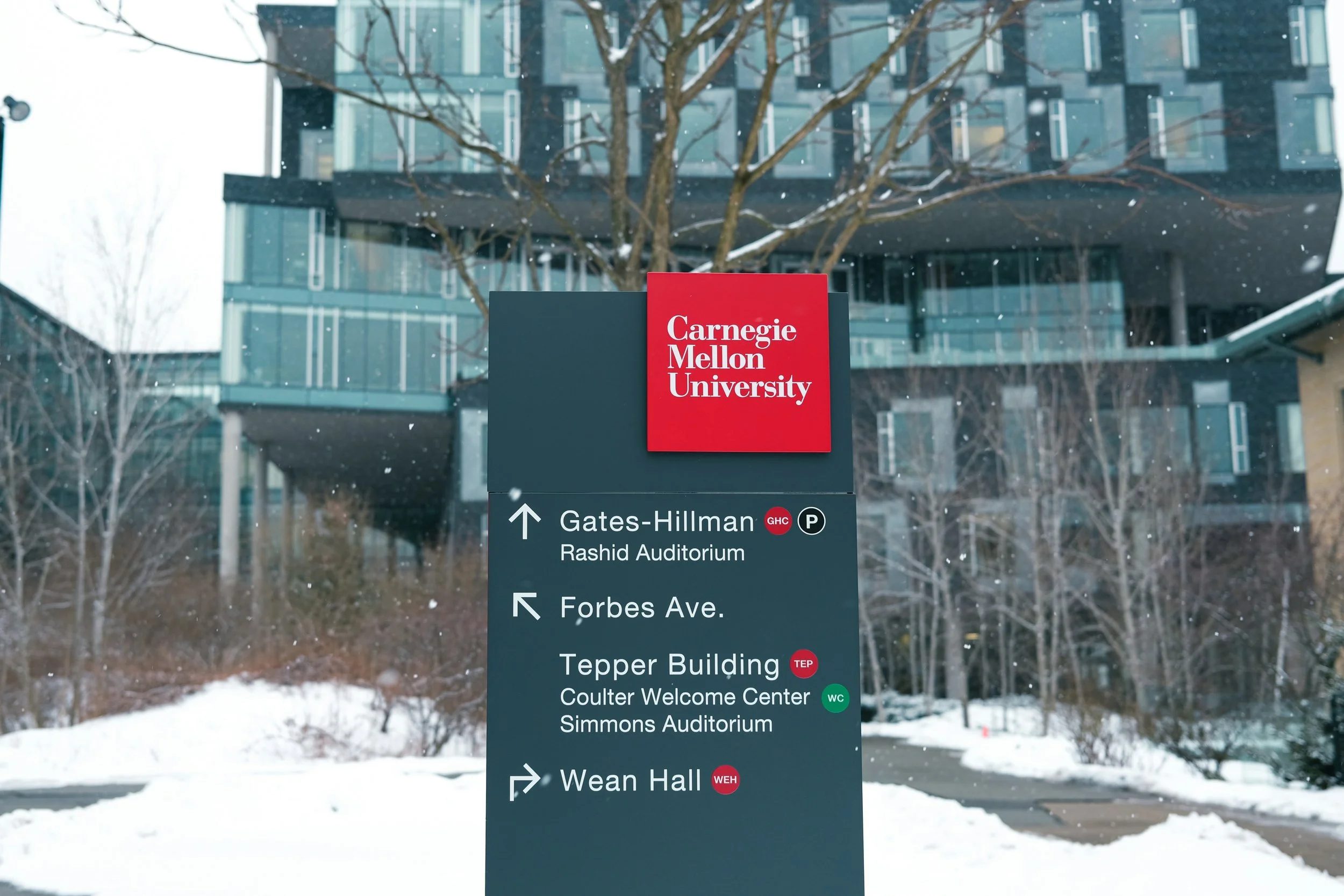
Webinar Transcript: Live Q&A with Carnegie Mellon University Senior Associate Director of Admission (2026)
Anna Lu
(This is a transcript of a webinar from October 2026, a recording of which you can find on our YouTube channel.)
Elton Lin: All right. Hey, good evening, everybody. West Coast time, it's five; East Coast time, Pittsburgh time, eight o'clock, Andrew?
Andrew McMillen: Yes, it is, yeah.
Elton Lin: Alright, fantastic, so hopefully you've eaten. I'm inching my way towards… I was gonna say inching my way towards dinner, but I'm inching my way towards reading more essays, because it's getting close to deadlines.
As we watch everybody roll in… appreciate everybody joining us again for our webinar series. If you would be so kind as to go ahead and go into the chat, and let us know where you are calling in from. Again, I'm always really, you know, pretty encouraged by students and families who are calling in from all over the United States, including… we've absolutely had students calling in from Asia, some parts of the Middle East—and so, always appreciated.
Hong Kong—fantastic, thank you, Hong Kong, love it. And L.A., Dallas… Hinsdale, Illinois. Fantastic. I lived in Chicago for a bit, but Southern Illinois is its own territory, so—appreciate Hinsdale, Illinois. Definitely a lot of Bay Area. Chicago people… I'm there. Miss me some Italian beef. Highland Park, Illinois, fantastic.
Andrew, we're not gonna have a cheesesteak [versus] Italian beef conversation, but perhaps that’s another webinar.
Andrew McMillen: [laughs] I like it all. I like it all.
Elton Lin: [laughs] You like it all.
Andrew McMillen: That's the great part about being an admission professional: You get to travel lots of different places, and eat lots of great food.
Elton Lin: So, go ahead and keep posting—thank you, yeah, absolutely, thank you, Andrew. But go ahead and keep posting where you're calling in from, and [I] want to note that if you have a question at any time during our time together, go ahead and post it on the Q&A.
Anna, who's our marketing content lead, and just my trusty partner in the webinar journey, will jump back on at the end, and we'll methodically go through all your questions. So go ahead and post them at any time, and we'll come back to it.
And then, certainly, there's some new developments. But yeah, go ahead and post on the Q&A box or Q&A window. You should be able to—it should be clickable somewhere, and then you can post at any time, so…
But hey, Andrew, thank you so much for joining us. Let me do a quick intro of Andrew.
Andrew is a Senior Associate Director of Admission at Carnegie Mellon, where he has been helping guide applicant selection and enrollment strategies since 2010. So you've been at it for quite a bit of time. [The] 2010 admissions environment was not the same as 2026, and we're going to talk about it.
So, known across… there's enough on the internet to say that Andrew is known across the admissions world for his refreshingly candid and practical advice, deep knowledge of highly selective admission, and excels at cutting through the noise and demystifying the college journey for students and families.
Having had Andrew on the show previously, I agree that you excel at cutting through the noise.
So, hey, Andrew, thank you so much. Before we kind of get into more hard-pressing questions about the admissions process, tell us a little bit about your story, how you got into admissions.
Andrew McMillen: Yeah, sure, Elton, thank you so much for having me.
My experience was not the typical one for most admission professionals. They usually worked in an admission office within their college or were a tour guide or something similar to that. I happened to be very fortunate to fall into it.
I graduated in 2009 from college and immediately went up to New York City and did a business development role that I did not like whatsoever. Was not for me. I had always thought about going into education throughout my four years in undergrad; I'd taken some classes within education at the grad school of the school that I went to.
Was very fortunate that I knew the then director of admissions at CMU. His three kids were the same year as my three kids at our high school—local high school, here in Pittsburgh. And I called him or emailed him, and eventually he said, “Yeah, I have time for you.”
So in the middle of February, during app review time, he gave me about 45 minutes to an hour on the phone in an evening, just talking about the admissions world and higher education in general. And [I] was very fortunate to [have him] also say, “And by the way, you could be a great fit for us, and we have an opening. Would you consider, you know, applying?”
So I did. That person was Mike Steidel, as well. A lot of people might know him for a long time, an amazing career at CMU.
[I] was there for five years, went to Allegheny College for a little bit, [a] small liberal arts school just north of Pittsburgh. And then I was on the high school side as well. So I do have experience on the counseling side before coming back to CMU four years ago.
Elton Lin: Fantastic, fantastic.
So, a lot has happened in the last 5 or 6 years. We've gone… you know, perhaps, maybe two of the topics that are very sort of prevalent in the ether right now… certainly this whole shift back to testing, and the prevalence of AI.
And I remember asking you about AI last year… but the reality is that, obviously, AI is changing, its presence in every industry also is changing, and it's changing a mile a minute in many respects. And so, even though we talked about it last year, I'm sure it's going to be a different topic this year…
But let's actually begin with testing, and the reality is that there's been certainly a trend, especially with top schools, to transition back to test-required. All the Ivy Leagues have done so, and there is certainly this feeling that, even for schools that are test-optional, that there is a re-emphasis on the test score and its presence in the application review.
Can you tell me a little bit about how that part has potentially evolved for Carnegie Mellon? And then what are your thoughts?
Andrew McMillen: Yeah, for sure.
So, prior to the pandemic, CMU had always been a test-mandatory school, and even whenever I went through the admission process way back in the day, they required subject tests as well—the SAT subject tests. Those no longer exist, right? It's just the SAT or the ACT. But they always required testing prior to that.
When the pandemic happened, we, of course, like many other schools, realized that students were not going to be able to potentially take it or it was going to be a very difficult journey to try to get testing in, so we went test optional, and in the past year and a half, two years or so, we also started looking at, you know, the ways in which we review, and the ways in which we can help decide on who the best fit students are for the class.
So, our senior leaders within the school, along with a lot of the enrollment leadership, went back to requiring tests of some kind.
And we have a slightly different policy for the different academic areas. So, for our School of Computer Science, we do require the SAT or ACT. For all of the other areas, we are saying we need something, but it's test-flexible, so you don't have to submit the SAT or ACT if you have AP scores, IB scores, French Bac, A-levels, et cetera. You can submit those instead of SAT or ACT.
And then for our fine arts areas—still test-optional, because those students are, you know, still required to do a portfolio or an audition, so they're not off the hook, right? They still have to do a pretty big portion for their side.
And I do think that overall, test scores are always going to have a potential great way in which they can help support an application. Are they always the most indicative? No, I think there's plenty of research out there that shows that students from certain areas, communities, backgrounds—[for them,] the test score might not play as big of a role in terms of determining their ability to perform well in a curriculum versus, you know, other students, where it might be a much better predictor.
So, we will look at all of those factors when going through the application review process, and always looking towards what is going to be, again, the individual part, the holistic review part, for a student in the app.
Elton Lin: Would you be—and what I hear you saying is that, like, Carnegie Mellon has largely gone back to test-required for particular majors, certainly [with] recognition that maybe it's not as telling for… you know, maybe artists or performing artists, and to where you're really making a contextual application of that test requirement—which I think is great, and I think, which is… pre-2020, maybe a wiser application of that test requirement.
Can you give us maybe… but you're giving maybe a nuanced response as far as, like, does the test score really tell us something important about your application, even if it is required, or maybe it's test-optional, or a student were to submit it…
Can you give us, maybe, an example of perhaps, in context, where might the test score not be as important? Maybe it's for a student in a different major, but—maybe give us some examples of what that might look like.
Andrew McMillen: No, for sure.
So, let's take a, you know, an engineering student, for example, where they might not be the best overall test taker when it comes to unplanned tests, like the SAT or ACT, versus them, whenever they have the ability to study for a full year on a subject, on a topic, they're getting not only an A in that grade, but then also a 5 on that AP score, right?
And so they might have, you know, the equivalent of a very good score, but possibly not a score that would be in our middle 50 percentile of admitted students. And so, in a case like that for an engineering student, we would potentially miss out, right, on that student if we were only saying, your AP score is not what's going to be considered, your SAT is the only thing that's going to be considered.
So we do end up, I think, hav[ing] a pretty great opportunity with the way that our test policy is to get into, like you said, the nuance and to be able to see [this dynamic].
Additionally, there are definitely a lot of studies showing that students from very lower socioeconomic backgrounds, students from under-resourced high schools, et cetera, students that don't really have access to as much of the test prep and different things like that, are naturally going to have lower scores, but don't necessarily… that doesn't necessarily equate to any lesser intelligence, any lesser ability to perform well in a college curriculum.
So we definitely will always try to look at, again, not only the individual student context of what they are and how they are managing, you know, tests in their own programs, but then also, again, the much broader context of where that person is growing up, the resources that are available to them, et cetera.
Elton Lin: So, what I hear you saying is that, like, when you're looking at an entire class of students that are representative from, like, different people groups, geographic locales from around the United States, from around the world, it allows you to really kind of put it all into context… which I think is, I think, very reassuring for the—I know there's a lot of counselors who are on the call, and a lot of counselors who are representing, maybe, a wide array of student audiences.
Then I’ll speak with, maybe, another audience of mine: I'm in the San Francisco Bay Area, certainly I… you know, there's a lot of students that we work with who are maybe not from the backgrounds that you mentioned. And then, it seems like that audience is very, sort of, densely populated with high test scores, and to where, if I don't have a high test score, I might feel like I'm already sort of on the outskirts with regards to the admission likelihood for Carnegie Mellon.
Is that something that would be a fair assessment, and how might that apply to a group? Like, I'm San Francisco Bay Area, but I'm sure there's families here in Seattle, Austin, Washington DC, Boston, that might feel the same way as well.
Andrew McMillen: No. Of course.
Well, I was gonna—before you said that, I was gonna give the California folks a very big reassurance that California is our number one feeder state, so don't worry.
But, no. We have a great level of representation in many states. Actually, Pennsylvania isn't even our top five when it comes to feeder states, believe it or not. Right? So, definitely, you know, a unique place for us.
But I will say that it really is a difficult thing no matter who you are, right? You know, we're an 11% admit rate school. So it is definitely, you know, a scenario where we are saying, you know, a waitlist or even a deny to students that are very well-qualified. Anywhere from sometimes forty to fifty-five percent of the students that apply each year are capable, are admissible. They could come and do the work, and we would feel confident in them being able to graduate from CMU.
And so, again, when you can only admit a fourth or less of those students, even, it doesn't feel good, right? You definitely feel like you're gatekeeping as opposed to being able to do that. But that's where, again, the holistic review comes in.
And so that's where I've always said: you first have to be admissible, right? And your test scores and things like that show you're admissible. And then after that, it's about so much more than just a test score, or the academics, or things like that. It's, additionally, how well you're able to talk about your fit for our programs—how well do you understand what you're getting into in CMU as an institution where you're applying directly to a college or program, or even major, in some cases—and then being able to describe what your college experience is going to look like, and how well it matches up to what the CMU experience might be.
And the students that do that the best are usually the ones that are going to get the most amount of consideration possible in our process.
So yes, you have to have the test scores, you have to have the academics—you know, we're not going to admit a student that we don't think is going to be able to come and be capable of doing the work. But then after that, there's a lot of ways where even if you are not the 800, 800, 1600 perfect SAT, you've got a great shot at being admitted if you're able to describe that, and show why we should want you on our campus at CMU.
And I think that's the biggest thing that a lot of times students don't realize, is that their voice in their application counts just as much as almost any other piece.
And I think that's… if anybody takes anything off of tonight, that would be—the biggest thing that I can help share is: Make sure that it is your voice in your application, and that whenever I get done reading or reviewing it, I should have a pretty good idea about what you would be able to do and how you'd be able to impact our campus. And if I've done that, or if you've done that, then you've done everything possible to give yourself a great shot at being admitted.
Elton Lin: So, two things I want to hone in on: number one, from what you just said—number one is that you were saying something to the effect of, like, 45–50% of the students that you reject are admissible in the sense where [they have] good grades, good test scores, maybe on some level, it just… there's just too many students, too many students in too few spaces, and you might wish that you can accept everybody, but that's just unfortunately not how it works.
And so, you would still feel confident about them doing well, completing their degree, and functioning properly on campus—it's just that there's just too many students, right?
So I think, you know, oftentimes I really try to tell students and parents that it's really—and I hear the same thing from a lot of admission representatives from a lot of highly selective schools—is that there's a lot of students that are very admissible. It's just that you can't do it, right? So it’s not personal.
… But maybe the second thing… I want to hone in on what you just said, which is, which is fit.
And then, I'd love it if you could—now, certainly remove any kind of identifiable details, but, like—have you seen a… you've read so many applications. Have you seen a student really articulate well their fit for Carnegie Mellon? And can you give us maybe a couple examples of how that might look?
Andrew McMillen: Yeah, no, for sure.
I do think it can be done in a lot of different ways, so I don't want any of my examples to kind of, you know, make it seem as like, “I've got to say what Mr. McMillen said on the Zoom, and then that's going to get me admitted,” because that won't, right? If it doesn't match you, it's going to seem like it's out of place, right, in your app.
But I think… Let's take our first question where we [as admissions officers] ask, you know, “What program are you applying to and why?” You should be able to describe not only the way that CMU teaches that subject, [but also] what you're going to get out of it, and why.
So, for [the] School of Computer Science, for example, that is very much a degree that is, of course, programming, but there's [a] high level of mathematics and theory involved in it. And so students should be able to describe how they want to be the ones that are helping to build and create things, and not just being the programmers that are developing software code, right? They want to be pushing the boundaries of computer science into the future.
And that would be a great example of where some students kind of miss, and they talk all about the programming aspects and different… it's like, well, you can go [to] a lot of places and have a great computer science degree and just learn programming, right? And so I think that's a good example.
Also, [another example is] a student that might be applying to our CFA programs, especially in music or drama, and [they] talk about how they're really excited to have more of a traditional liberal arts experience, et cetera, when [at CMU] those are conservatory programs, right? And so you're going to be eat[ing], sleep[ing], dreaming everything about music or drama, and so much so that you might not have an opportunity to take a lot of classes or even minor in an academic area because of the intensity of what a conservatory fine arts experience is, right?
So I definitely think knowing the school and knowing our programs is definitely going to help you describe that in your essays really, really well.
Elton Lin: Got it, got it. Terrific.
Let's shift over to the dreaded conversation of artificial intelligence, or may I suggest, super intelligence. [laughs]
But, regardless of how you're referring to it, what's been happening on, at least, the application landscape is that there are more schools that are reducing or taking out their supplemental question package.
Maybe there's some implied feeling that schools are not learning… like, the additional essays are not telling a school enough about the student, or it's not really, you know, really changing the review process. Perhaps schools are thinking that essays are kind of coming in a little bit more homogenous than they were. And so certainly there's a lot of conjecture, a lot of reasoning, but it seems like there are—schools are working towards reducing their required essay package.
Before we kind of get into a little bit more specifics with AI, what are some things you all are noticing? Over the last… because certainly, three years ago, when retail AI was introduced—like, it's a very different world.
What are some things you've noticed over the course of the last 3 years as it relates to, maybe, student-written work, and maybe how that relates to AI?
Andrew McMillen: Yeah, no. So I do think there has been a difference.
And again, we get 36,000 applications a year, so it's a large amount of applicants, but we have an individual person read and review every single one of them, right? As long as it's complete, we're going to read and review it, and it's going to get a full review, including the essays for it.
I would say, on an anecdotal side—and again, this is just me, but I have… you know, I do think there's a lot to it, since I coordinate our app review process for CMU—there is probably less students that you can tell are putting in less effort just by the visual, right?
So, before, you would see, “Hmm, okay, so the student's personal essay can be a max 650 words, and they wrote 250 words. And our sub-essays each could be 300 max words, and they might have written 300 total words between the three.” Just by seeing that, you're usually going to be able to… I don't know if a student put in a lot of work or effort into these, right? Whereas now, a lot of students are able to fill, you know—you tell AI, “Write a 600-word essay on XYZ topic for a personal essay.” You're gonna be able to get something, right?
And so it's actually just doing a little bit more work on our side as we're reviewing to see, “Does this make sense for what we've seen in the other parts of the app?” But it hasn't really changed how many students are taking it seriously versus not taking it seriously.
I think it's just, again, a little bit easier—or a little bit harder to tell just by visuals alone.
We don't have any policies against use of AI, so we encourage students to use it as a tool, but I always caution them that, you know, very rarely can students create AI essays and then not do a lot of polishing on the back end in having it kind of still be in their voice, so to speak, and it turned out well.
We were able to do a number of different tests and try to figure out, you know, “What are our readers able to see and do? And is it AI? Is it not?” And a lot of times we were able to figure that out pretty well.
Again, for us, that's not a penalty, but it is something where, you know, we're going to be looking very closely at what the student is saying in the essays and [see,] “Does it make sense and does it match up well in the rest of their application?”
So I do think that, you know, [AI’s] here. Any schools that are trying to rail against it, it's a losing battle. We still had those professors that demanded that nobody ever used a calculator and would say, and I quote, “You're never going to have a calculator with you as you're walking around every day.” Well, guess what? You have a calculator and a TV and everything—instant library—in your pocket every day.
So, you know, we don't know what's going to come into the future, but we know that the students that are going to utilize it as a tool are going to be better prepared in the future, and that's why in our curriculum, within all of our undergraduate programs, it has been a charge from our provost and president's office to have them integrate AI technology into the classroom, so that students are learning how to use AI and being able to be very adept in it, so that if they need to use it in their fields once they graduate and are now in the industry, that they're going to be able to.
Elton Lin: So a couple of things I want to reflect back.
Number one is that you're saying that Carnegie Mellon actually doesn't have a blanket AI statement with regards to its use or non-use. You're not pumping essays into an AI detector, and then it's going to send you back a percentage. You're not doing any of that.
On the flip side, what you're saying is that essays that are just AI-generated, you know, certainly, you still need to… it still is a reflection of the amount of work that you put into a particular piece of writing.
And I'll go back, and I'll compare and contrast—we interviewed the admissions director for Northern California from Emory University last week. And just to relay that back, he was saying that if there is a sense to where the reader feels like the essay is AI—even though they also may not have, like, a specific policy—it automatically kind of shades the review. It automatically feels like you're reading something that, you know, it’s like, “Is this really the student's writing,” or “[Does] this really represent a student?”
Is there the same kind of bias, perhaps, from Carnegie Mellon readers, who might be reading something, and they can… because I actually remember last year, when we spent time together, you said that your team could detect an AI essay, like, 9 times out of 10, something like that.
Andrew McMillen: Yeah.
Elton Lin: And so, is there that bias as it relates to something that seems like AI?
Andrew McMillen: We very much do implicit bias training—[laughs] of course, explicit bias training as well—every year.
Elton Lin: [laughs] Implicit and explicit.
Andrew McMillen: Yeah, it's one of the things that we do; and so, you know, we're telling all of our readers that, “No, you should not be slanting your opinion of a student if you believe that they used AI.” But I do think, again, the overall ability for that essay to provide the necessary components that we're looking for in the review, that's different, right?
So that's, you know, use of AI, and they did a really good job with it to show their overall story, whether it's a personal essay or trying to help provide some anecdotes of the campus experience, if they maybe weren't able to visit campus, you know, with it. If you're using it effectively, and we can tell that your essay is well-thought out, and it matches the rest of your application, then no, it's not going to impact in a negative way at all.
But if it looks like it's AI-generated, and then we can't really tell, “Is this from the same student that we just read all of these rec letters and activities lists and different things and short writing type stuff, and then this just seems completely different?”—then yes, it would, but not because it was just AI used; [it’s] because… it doesn't match with the rest of the application.
Elton Lin: Right. So I think, maybe, the key thing that you're mentioning here is that, like, does the writing sample submitted—does it corroborate with the entire application? Does it really sort of paint a clear, like, clear unifying picture across all parts of the application, including the rec letters?
And since you mentioned rec letters, there are also some, maybe, implied things from other admission offices from other universities to where—because essays maybe have become a little bit more homogeneous [such] that… admission readers are leaning more into rec letters.
Now, that may or may not be an overstatement, but is there any kind of validity to that kind of assessment?
Andrew McMillen: Again, not for us. I can say for most of my colleagues that I've spoken to, not for them either.
Again, I think it always depends on what type of school you're talking about with that. When it's holistic reviews from most places that practice holistic admission, I don't think that that's going to all of a sudden become a much bigger portion than it already is. We already valued, to a large degree, what, you know, the colleagues across the desk have been saying about students. So that wouldn't be the case.
But again, for your Virginia Techs, or for some of the schools that have outright said, “Hey, we know that AI's probably being used a lot, and we're not going to be doing a lot more with essays, and we're going to be using a lot of this to go through and help analyze apps and make decisions,” then I certainly could see them, you know, doing that as well, and placing more emphasis on [rec letters].
But I think for most of the schools that, you know, are sticking to holistic review, are sticking to the same type of essay formats that they've had in the past. It's probably not going to switch all that much.
Elton Lin: Yep, got it.
Before I kind of continue with a few more questions, just want to remind you [the audience] that if you have a question that you want to ask Andrew, go ahead and post it in the Q&A box, and then Anna will come back and rejoin us to answer some of those questions.
… Maybe switching gears a little bit to the—maybe some of the shifts that have been happening that last maybe 4 or 5 years, especially as it relates to the pandemic… I think there's also been some conversation recently about, maybe, [that] the early decision pool may not be as robust. Maybe some of that is because of the current economy. Maybe families feel a little bit less confident about you know, committing to four years of private education and whatnot.
Are you seeing some of those changes, some of [that] evolution, and perhaps, how might that affect Carnegie Mellon's incoming applicant pool?
Andrew McMillen: Absolutely. And we have seen it, but I wouldn't… we are not the test case that people should use, because around that same time period, we also went from having both ED1 and ED2 to just having the equivalent of ED1, an early decision, and then regular decision.
So we did in fact have, you know, maybe a slightly higher ED1/ED pool… But we definitely overall are much lower in the overall ED pool without that ED2 option for students.
So our admit rate definitely looks like it's higher than our regular decision admit rate. I would argue that it's much more to do so with that denominator; the quality, especially at the top end of the ED pool, has not just stayed the same, it's gotten even better. So if you look at the metrics in terms of academics, extracurriculars, test scores, et cetera, all the things that we usually track—the ED pool is at least on par, if not maybe a little bit better, each year for us. But if you look at just the straight admit rate numbers, it's gonna seem like we are a little bit easier to get into as an ED school.
We have always, though, been a school that doesn't take a ton of students in terms of the overall percentage of the first-year class coming in, so we're always around 30 to 35%. This year, actually, we were targeting around 30%, and we came a little bit under—28%, I believe.
And so we're still a very accessible school for RD. So you, again, anywhere from seventy, sixty-five—this past year, 72% of the students came during RD.
So, we definitely see it, but we are also that school that says, “You should only apply ED if we're [your] top school and the finances make sense.” And we don’t give merit scholarships and other pieces, so we're very comfortable in that, but for some of the schools that are taking 50–60% of their class in that, and they're starting to see some dwindled numbers in ED, I know that that's definitely going to have a big impact for them as well.
Elton Lin: Got it, got it.
So, what I… maybe a couple of things to highlight from what you just said is that you're used to… from what you said, you've seen over the years that the students you're taking in from the ED pool are sort of increasingly getting stronger, and that sort of bracket of academic performance is getting pretty extreme, pretty exceptional.
But what it is, is that you're not taking an exceptionally high percentage of the freshman class in on the ED round, so that the RD round is still very accessible…
And maybe, perhaps, maybe one last kind of qualifier for all that: How does that relate to, say—certainly the School of Computer Science with Carnegie Mellon is the most, you know, well-regarded, and it's certainly, known [worldwide]—is there a determination with regards to your… the ED decision process is really trying to… does it think about placement with regards to each particular department, or… yeah, how does that factor into the process?
Andrew McMillen: Yes, absolutely. And I did see that one of the questions is in there [the Q&A box], so I'm going to talk about that as well.
How we read: We do read by major/program/college. So we don't read by region. We don't have territories, so to speak. So the people, as we're training them as part of our app review, they're getting trained on that particular program, whether it's engineering, computer science, business, Dietrich College of Humanities and Social sciences, et cetera. They're going to be the experts in that area.
And so because students can only apply to one academic area, they're going to be the ones that are going to read and review based off of that, which is a very comforting thing, I think, to most people, knowing that the people that are reviewing are going to have a great understanding of the program.
But then again, to your point: Yes, all of those different programs and schools have not only their own enrollment targets—so we don't have just one enrollment target; we have seven, and then the overall one as well. And then we get into things like the different schools within the College of Fine Arts; those are five individual ones within the College of Fine Arts as well.
So it can be pretty complicated at times. And yes, we are tracking all of that and we are basing all of the decisions on those.
Elton Lin: Got it, got it. Maybe a couple other questions before we go into Q&A.
What's in the news at Carnegie Mellon is that there's this massive donation for a Miami campus. Can you tell us a little bit more?
And what type of impact is that gonna have on students who want to apply to the Pittsburgh campus? Is it entirely separate, or is there any kind of cross-pollination?
Andrew McMillen: No, that's a great question, and unfortunately, we don't have a lot of answers right now.
We are very excited, of course, about the donation, and very excited that not only are we gonna have a new name for the School of Computer Science, but then also some great opportunities for some things and some programs, et cetera, in Pittsburgh. That was part of the donation.
Then, yes, the Miami campus is going to be a great opportunity for us to do a number of things within areas of education that aren't necessarily the most sought-after currently, but things like environmental impact, sustainability, et cetera.
But there's not a ton that we know about, you know, what our enrollment goals are going to be down there, what the makeup of the different types of programs and stuff are going to be yet. We just know that we're very excited.
They already have the land. They're going to be starting to break ground next year. I don't know, depending on how young any of the students are for the families that are on right now, if they're going to have the ability to consider that as an option, because again, they're gonna only start building next year, and then the exact start date of classes or programs for down there has not been established yet.
Elton Lin: Okay, so like, if I'm like a ninth grade high school student right now, it's probably not even going to be ready for me to apply to by the time.
Andrew McMillen: No, if you're a 9th grade student, it's certainly possible. I won't say that it's, you know, even fifty-fifty or anything, but I would not want to say it's not possible.
I think if you're a junior or senior, the odds of you having to spend any time down on the Miami campus might be limited, but again, who knows? They could end up, you know, surprising everyone, and a building project getting done early is not unheard of, even though it is a lot of times difficult to imagine, but yeah, but we…
There's a lot that we're still doing and trying to work the details out for, and I think they don't want to announce too much too early. They want to follow the proper protocols and make sure that accreditation and all of those things are going to come in order as well.
Elton Lin: Sounds entirely fair.
I'm gonna invite Anna back, and—we put out to our families on our email list some questions, like, “Hey, what do you want to ask Andrew from Carnegie Mellon on our forthcoming webinar?” And some families did submit some questions, and we also have some questions from the audience who's live with us today.
So, Anna, if you want to kind of walk us through, that would be terrific.
Anna Lu: For sure. We have a question: “At a competitive school where several kids do” —we addressed this a little bit earlier, but— “a competitive school where several kids apply in the same year with perfect GPAs and top test scores, what makes a student stand out, and does the committee have a cap on how many students it accepts?”
Andrew McMillen: Yes, so we definitely have a cap on how many students we accept. If, again, we accepted all of the amazing students that were capable [of accepting], we would be overfilled. You would have a class of, you know, 10,000 fellow students instead of 1,850 or 1,900 [students]. So we definitely can't admit as many students that are qualified, like I mentioned earlier.
But I do think, again, the same thing applies that, you know, if you've already done all the things to show that you're admissible, the best thing is to describe who you are, what you're passionate about, what you would bring to campus, and don't base it off of what some other student that you knew two years ago got in with, right? Because that's not you, and we're not looking to admit 1,800 of that person, right?
We're hoping to have a lot of diversity of thought, diversity of what students are into, and, you know, again, we have 350 different student organizations. We wouldn't have that ability for students to get involved in so many different things if we were looking for the same exact thing for every single student.
And so, I think there are qualities that certainly help as a part of some of the programs, so… For Tepper, it's leadership. So if you end up being involved in leadership within business, that's always [a] good quality to have. Problem solving within, you know, computer science and engineering is certainly always a good quality to have.
But you don't have to do every single thing that you think we need to see in an app. It really should be about you describing, again, yourself.
Anna Lu: I'm glad you mentioned personal qualities that you look for in specific majors, because we actually have a question—I think, probably from an engineering applicant—someone who asked what those qualities would be for an engineering applicant.
Andrew McMillen: Yeah, yeah.
So, we definitely, you know, again—people who love problems and love to try to solve problems, that's what engineers do every day. Not only that, but then, you know, “How can I make it the most efficient thing possible?”
I work on the back-end development team on occasion within CMU and write some queries and some different things—and it's always funny, the head person who does that for our enrollment management group, she always says, “You're getting the right answer, but this is not the most efficient way to do it.”
And so being able to come up with those efficiencies, being able to problem solve effectively, are great traits for that [engineering].
Also—and one of the key things that I think is getting lost on a lot of students now is the importance of being able to work in a group and a team, and being able to get more from that group than what you would individually get from each person. We've noticed that through career services and them working with a lot of the companies that recruit for us, for the past decade or so, they've said students who can come in and effectively work in teams tend to have much better, longer-lasting careers, and can move up much quicker, because they have that skill set.
And so we've been incorporating that into many of our programs, but especially for engineering, being able to work in a group and a team is extremely important.
Anna Lu: Absolutely, that makes sense.
We have a question about, “Do your strong applicants have a strong math background, or is this kind of major by major, and kind of what is the criteria for this? Is it specific AP classes? Could it be more advanced classes? Does it have to be electives?”
Andrew McMillen: Yeah, great question again, and yes, it is dependent on the major, right? Although we would love School of Music students to also be great at math, that is not the thing that we need the most, right? They need to be able to play the violin, sing, compose—whatever it might be in that specialty area.
So, if it is, again, generally STEM-related, then you can think that you're probably going to need to have some quality math and additional science background. Beyond that, you can show it in many different ways, and that's where the individual standpoint and how we review applications definitely comes through.
So, [for] a student at a very well-resourced high school—then, yes, try to get to the highest levels of math, physics, if it's the College of Engineering or School of Computer Science, that you can.
If you go to a school, or you're helping a student from a school, that might be a little bit more under-resourced we have things like the Schoolhouse.world portfolio that students can start to do early on in their high school career and build up some of those skills in a way that's, of course online, but that can help supplement a lot of the things that their school offers if they don't offer some of the higher level opportunities.
So there are many different ways to get to the point of showing the proficiency in the academic areas. And we hope that it's at your high school. Obviously, that means that you're able to stay in a very controlled and hopefully successful environment for that. But if you have to go elsewhere, we've at least provided the pathway for some tools that we'll accept and be able to look at.
Anna Lu: Then a little bit more about majors. One student—can you talk a little bit more about, like, what is the major changing process potentially like at CMU? Are certain majors capped? Is it a little difficult with other majors? What does that look like?
Andrew McMillen: Yeah, yeah, it's a great question. And so CMU, again, does admit by the college or program. And so each one of those colleges or programs [is] gonna be slightly different in how they allow students to choose majors.
So [for] the College of Engineering, for example, you can say undecided for your application for engineering, or you can say, “I want mechanical engineering, I want ECE, I want civil and environmental,” and then if you get admitted directly into that department, you have to choose the major in that department. You can't choose anything else, and so you can't transfer without potentially going through a very strict process.
Students that want to go into MechE and ECE later are probably going to have a really hard time. Very few students are able to do it. Very few students outside of engineering are going to be able to transfer into ECE or MechE from a different college or program.
Same thing for the School of Computer Science as well. They will ask students to go and do the full minor, completely before being able to try to transfer in or double major, and those students have to get all A's and can only get one B in all of the classes, and that only allows them to apply. And if we only have 4 spots, and twenty-some students were able to do that, then only 4 of them are getting to do that additional major or switch their major, right?
So, it can be very difficult at times. So, what I've always said to students is, even though we're very segmented in the way that we admit students in, and it might not be possible to switch your major—even though we will try, of course, we will try, we're never going to say, “No, no, no, no,” we'll say, “Okay, we'll see, but it could be a space limitation thing”—you can always, almost always, get a minor in other areas.
So if you are in, you know, Tepper, and you really love computer science, you can minor in computer science.
The only time that I've heard of students not being able to minor in an area is if they're not doing well enough in their first major, and then an academic advisor is very hesitant to allow them to go and get even more of a course when they're thinking, "You might fail out if we do it this way," right?
So that is a scenario that can happen. But for the most part, students are very easily able to go and get a minor in other areas.
Anna Lu: So at the college level… Oh, sorry, go on.
Elton Lin: I was gonna say, just to follow up: What you're saying is, “Don't count on it with regards to the transfer.”
Andrew McMillen: Exactly. Yeah. We unfortunately have had this problem, since I started in 2010, where students would sometimes knowingly want one major [and] think, “Okay. Well, there's a lower—or there's a higher admit rate in this program. I'm gonna get in, and I'm just gonna be able to go and switch into that other program.” And for sixteen, seventeen years, it's not been the case.
Now, [for] some students, it works, right? Some students are able to, but there are plenty of students where it did not work for, and, again, I would say as long as you are comfortable with the major that you're going to be in, and then, again, minoring in that other area and still having a great, well-rounded education in both of those two spots, then you'll be fine.
But if a student is really thinking, “I want XYZ, and so I'm going to try to backdoor in through another program,” then that's where it can end up being not great.
Elton Lin: You mentioned something I just want to get some clarity on. I don't remember it off the top of my head, but you said that—can you apply as undeclared engineering?
Andrew McMillen: Yes, you can apply as undeclared engineering, yeah.
Elton Lin: So if you apply undeclared engineering, you're admitted into the School of Engineering broadly, but you still run into the problem of transferring or declaring, like, say, mechanical engineering as a major, right?
Andrew McMillen: Nope, not at all. Yeah, so if you… if you come in as an undeclared engineering major, you can choose any of the five departments after your first year, including ECE and MechE.
Elton Lin: But if you're, like—let's just say I declare my—or I apply in as a civil engineering major and I come in and I get admitted as civil engineering, what about transferring to mechanical from that point?
Andrew McMillen: Very difficult.
Elton Lin: Very—okay, very difficult. Okay, I get it. Okay, understood. Good detail to know. All right.
Andrew McMillen: Yeah, if MechE or ECE is your choice, unless both of those are really a fifty-fifty split, you're better off applying and getting into that department directly. If you get into undecided, then you would be able to choose either of them as well.
But usually, if you're a MechE student, but you're also thinking, “I might want material science,” you should go into MechE, and then you can always transfer into material science if you need to.
Elton Lin: Okay, understood. I got it. All right, I'll pass it back to Anna.
Anna Lu: Slightly different angle now—or a completely different angle, actually. Can you talk about international students? Was there a decrease in first-year enrollment, and kind of, are there any plans in place to kind of handle the shifts in the current trends?
Andrew McMillen: Yeah, for sure.
So I was just in Bangkok, Hong Kong, and China earlier this fall recruiting. And so obviously we are doing quite a bit of recruitment. We were… one of my colleagues was in South America as well as other parts of Latin America. And so we are always going to be recruiting and wanting a really diverse group of international students coming from many different countries.
So very, very excited, always, to read and review the apps from all around the world.
We did have a slight decrease this year, so we're around 16%, but that's still a pretty robust number. We're usually anywhere from 16% to 20%. I think the [past] few years have been around 18%. So, slightly down, but not something that we are too concerned [about] overall.
I think in general, everybody is looking at the geopolitical standings of different groups and countries, et cetera, and trying to make sure that we're offering the amount of support that we need to for students when they're getting visas, when they're trying to get those appointments, and then when they're admitted and coming—and, you know, what else do they need to know that's going to be different than what their, you know, older cousin [had to handle] 10 years ago whenever they came to the United States to study, so…
We're doing a lot of that, and I do think that we're going to continue to be anywhere in that 16 to 20% range for international students, I would expect.
Anna Lu: And then a different angle, again: If, say, a student or an applicant comes in and they don't have the most ideal GPA, for example, what are some other aspects that you look at to see what their academic prospects are kind of looking like?
Andrew McMillen: Yeah, yeah, so I think GPA is, again, one piece of the puzzle.
I would always say, if you are a student that is trying to maximize the curriculum at your high school, and you're not getting a 4.0 because of it, that's not going to preclude you from being admitted at CMU. Like, you're taking a lot of rigorous courses, and you're pushing yourself to try to maximize the curriculum at your school, that's a thing that we want to commend, not something that we want to punish, right?
The flip side, I won't say is true. If a student isn't challenging themselves, right, in their curriculum, and they have a 4.0, I would say it might be rare for some of those students to actually be admitted.
So, again, I think, you know, the GPA is just one piece of it. If you're taking a lot of hard curriculum courses, that's a good thing. And I think if you can show your capabilities academically in other ways, then that might be a great thing, too.
Depending on how well you did, maybe in AP scores, et cetera—you might be one of those students that would actually benefit from the SAT or ACT and trying to get, you know, a pretty high score on those, because that, again, is just one piece of the puzzle, but can help supplement in some of those areas.
And then also trends. Nothing's better than being on an upward trend academically, right? So if you had some of those issues in sophomore year, and you're building on that junior and senior year, that's fantastic. If that happened junior year, I would say the only thing that you can do is continue to move forward and do as well as you can, but maybe ED isn't the option for you; RD is, so that you can show your first semester grades, hopefully improving on that in your junior year.
Anna Lu: Alright, and I think with that, I am out of questions unless someone wants to pull in a buzzer beater here. Elton, any other thoughts?
Elton Lin: All right, yeah, if there's any other questions, go ahead and post it on the Q&A box…
But I think, all in all, I think what I… maybe the tenor of what I'm hearing from you, Andrew, is that the review process for Carnegie Mellon, I mean, hasn't changed substantially. I think that there's definitely the holistic review process still in play. I think that it's almost like you've harkened back to some of what it was pre-pandemic in a sense of really finding the test score in context again about the type of student [who is applying], and then really seeing the whole thing in context.
So, sounds good. It looks like we got one more question before we all head out. Anna, what's our last question?
Anna Lu: Back to the major topic. So, for double majors, would a student who's already going into it, interested in a double major, would they have to be admitted for both, say, music and physics, and how would that work?
Andrew McMillen: So I'm sorry, I don't have enough time. I'm just going to cut the webinar short now at this point.
I'm just kidding. No, this is one of the most difficult.
[Everyone laughs.]
Elton Lin: Andrew’s out!
Andrew McMillen: Yeah, this is one of the most difficult topics to talk about because, again, it is just very different.
So, in your specific example: Yes, you could apply to both a music and an academic area, and you might get admitted to both, and then you can choose which program that you want to have as your primary, and then you would probably pretty easily, again, be able to minor.
Music, again, is a difficult one because [of] the conservatory piece; there's some things at play that you would have to work out with the advisors in both of the groups. That is also, again, one of the areas that I would say is the most doable, at least in terms of the architecture, art, design, the visual arts, versus the performing arts—again, unfortunately, it's just never an easy thing whenever we're talking about the conservatory programs.
For any of the other areas, you can obviously only apply to one academic area, and so what I was talking about before with the, you know, getting an additional major or changing your major, it's kind of the same spot. There are different seats for all students, and there might not be seats available in certain programs, so would you be able to get a minor in that area? Very likely, but there might not be an ability for you to be able to double major, necessarily.
Anna Lu: Then, I think, maybe one more question, [this one] about the information systems major. This person has heard that it's as competitive as the computer science major. Would you say that's true?
Andrew McMillen: I would say no, but simply from what most people talk about competitiveness is the admit rate. And so the admit rate for IS is not the same as for the School of Computer Science. They are two very different programs, though, so you wouldn't necessarily be competing in terms of a lot of the job market aspects for it.
But in terms of, you know, the quality of education that you're getting within info systems, I think it rivals any of the other similar programs in the country. It combines economics, management, obviously computer science, and things like philosophy as well in some of the Dietrich College areas, all into one really STEM-focused area.
So you can still get a concentration in AI within information systems, but the things that you're doing with AI is not going to be the same as what a CS major would be doing, necessarily, in the AI program. So, two very awesome programs… actually, info systems is what I would have went into had I gone to CMU instead of Penn, but it's, again, a very different program. Students can easily have interest in both of those areas, but you know, they're definitely not competing nearly as much as what some might think.
Elton Lin: Andrew, thank you so much for taking some time to be with us. Hopefully, it was super informative for everybody, definitely for us. And, Andrew, it's 9:00 PM Pittsburgh time, so hopefully you're able to get some rest. I know you're probably in the throes of reading applications, or soon.
But thank you so much for coming on, and thank you, thanks everybody for joining us. We'll see you on the next one. Alright, take care, everybody.
Andrew McMillen: Thanks Elton. Thanks Anna.
Elton Lin: Okay.
Anna Lu: Thanks, everyone.
Elton Lin: Bye.