Webinar Transcript: Admissions Trends 2026: What Changed?
Anna Lu
(This is a transcript of a webinar from May 2026, a recording of which you can find on our YouTube channel.)
Elton Lin: Welcome. I just want to do a quick intro of Anthony… as I see names coming up on the participants list—certainly, I recognize a few names… some of you have seen Anthony. Anthony is our operations director and faithful partner-in-crime in the webinar game all these years, so thank you, Anthony.
Anthony will jump back on with us—any intro words, Anthony?
Anthony Su (he/him): No, I'm gonna… [you can] put any questions you have in the Q&A and chat, I'll be taking a look at it so… [we’ll get through questions later] as much as possible.
Elton Lin: Alright, fantastic. Okay, so Anthony will join back in with us at the end, and I'm excited to have everybody on!
And as I always do, I'm always excited to see where people are calling in from, so if you don't mind, go ahead and go on into the chat and just let us know what grade you are in—if you're a parent, let us know what grade your student is in—and then what city you're from. That would be fantastic.
We've always—we've been getting a lot of families from all over the U.S., including, at times, from Asia, occasionally from Europe, and so, excited to have everybody here. Thank you.
Hey, Portland, Oregon, awesome. Certainly a lot of Californians—appreciate all the Californians—Stan from Hong Kong! Thank you, thank you. San Jose, Los Altos, Palo Alto, Cupertino—of course, we're based in California. Always appreciate the Californians who are here. And of course, Tracy, California. Hi, I'm from the Central Valley! So I appreciate the Central Valley people… and then, of course, Austin, Texas. So, appreciate that.
So go ahead and keep putting down in the chat where you're from, and also what age your student… if you're a parent, what age your student is in, or what grade your student is in, and then if you're a student, certainly, what grade you're currently in.
Excited to be with you today. We do this webinar once a year. It's the “College Admissions Trends for 2026.” What I try to do is I try to review all the incremental movements that are happening in the college admissions landscape, what I think is helpful—I think, for all high school students, but especially if you are a rising junior and senior, and you are approaching the college application process, I think it's important to think about some of these shifts and how it impacts maybe the colleges you're selecting to apply to, how you're preparing, whether you're taking the SAT or the ACT, and how you're navigating this forthcoming college app process.
And I do see some names that I have seen, certainly, on previous webinars. Number one, I'm grateful that you're here. Number one, I'm grateful for the people who have really enjoyed these webinars. The goal is really to… for it to be as helpful as I can.
And then, I do want to tell you that you're… if I can just make a suggestion to you—you can do whatever you'd like with the content—but, if I were to make a suggestion to you, just instead of trying to absorb everything that's here, because there's a fair amount of data, there are some adjustments to last year, even though the format, perhaps, of last year's trends presentation may be similar to this year's format. There is some different data that I'm going to present, but the goal isn't to absorb every data point. The goal is to, you know, really isolate maybe one or two, or maybe at most three things that you think are helpful, applicable to your situation. And then, again, find an opportunity to share that with somebody else, and interact with those takeaway points in your particular context.
As mentioned before, there's a Q&A box. Go ahead and go onto the Q&A box and post any question at any time. So just, you know, if you have a question. We'll come back to it at the end, but post it in the Q&A box so that we have this running log, and then we will tackle as many questions as we can.
I do have a fair amount of content; I will do my best to get through it. And then we'll do our best to hang on as long as we can to answer as many questions as we can. So let me do… oops, let me do a quick intro myself.
Elton Lin
CEO/Founder of ILUMIN Education
15+ years in college counseling
400+ students/year, 2,000+ apps/year
Students admitted to all top 50 + Ivy
Up to 7x the national average to top-15
Nationally recognized college admissions expert profiled in National Public Radio, ABC News, US News + World Report
Elton Lin: My name's Elton Lin, I'm CEO and founder of ILUMIN Education.
I've been doing college advising for almost 16 years. I mean, it's been a long time, and I've seen quite a bit. And, our team at ILUMIN Education, we work with almost 450 students a year, submit over 2,000 apps a year, read almost 4,000 essays a year, so even within our context, we see quite a bit. Our president and consulting director is a former UC admissions counselor. We have a former Brown, Rice, USC, UT Austin, UC Berkeley admissions director on our advisory board. So, we have a fair amount of visibility into the college app process.
We've had students submitted to every top 50, including every Ivy League multiple times over. Our internal admit rate to top 15 schools is up to 7x the national average. And I've been fortunate enough to be profiled in some national-level media outlets around the United States.
So, excited to be with you today.
Topics for tonight
Most critical trends for 2026
How to respond to trends
Student examples
Questions
Elton Lin: We're gonna talk about the most critical trends, how to respond to those trends… we may intersperse a few student examples in between, and then we're gonna do our best to try to answer as many questions as we can.
What are the current trends in college admissions?
Elton Lin: What are the current trends in college admissions? I think… Again, I don't think any of these trends are going to be blowing your mind—I think it, in some sense, is going to be as expected—but let's kind of dig into some of the nuances here.
Trend #1: Applications are UP ↑
Elton Lin: Number one, of course applications are up. That's not rocket science.
Applications UP - Admit Rates DOWN
- Almost 41% increase since 2020
- +8% increase in public schools
- +3% increase in private schools
- Slight decrease in international students
Elton Lin: But, I would also contend that the application increase from the difference between 2024-2025 and the 2025-2026 is less than what it was the previous year, so…
41% increase since 2020, increase in public schools, a slight increase in private schools. Actually, for some private schools, including some Ivy League schools, the applicant pool has declined.
Now, we can get into… if you're really curious, we can get into the why, we can get into it in Q&A, but there always is a little bit of ebb and flow in the applicant pool.
But by and large, even though—and I know there's some counselors who are on the call, they are very aware of a demographic cliff with regards to fewer high school graduates who are applying to universities—but the total number of applications has increased. But there also is a slight decrease in international students.
Now, you know, we can get into some of the… again, get into some of the environment ecosystem with regards to that, but those are some of the micro ebb and flows with regards to the applicant pool.
Applications UP - Admit Rates DOWN
| Schools | Admit Rate 2020 | Admit Rate 2025 |
|---|---|---|
| Harvard | 4.92% | 3.59% |
| Yale | 6.53% | 4.59% |
| MIT | 7.41% | 4.52% |
| Dartmouth | 8.80% | 6.00% |
| Rice | 7.70% | 7.80% |
| NYU | 15.30% | 7.70% |
| UCLA | 14.00% | 8.50% |
| USC | 15.83% | 10.40% |
| UT Austin | 32% | 7.8% OOS/INT |
| Univ of Washington | 51% | 39% |
Elton Lin: With regards to… I mean, if you're just looking at the admit rate between 2020 and 2025…
Harvard, 4.92%, the 2020-25 rate is 3.59%. Frankly, it doesn't mean much. They're all single digits, they're all very difficult to get into. MIT at 7%, MIT at 4.5%, you know, really about the same, to be frank.
So, everything for the most selective schools: it really is about the same, but when you start isolating schools like NYU, UCLA, USC, even like UT Austin, University of Washington—schools that, certainly when I applied to college, were considered more safe—even 10 years ago, were considered more likely… now in 2025, many of which are single-digit admit rates. You're talking about NYU at a 7%, UCLA below 10%, of course.
To me, USC at 10% is pretty absurd, [relative] from when I applied to college back in 1991. And the UT Austin, specifically if you're out-of-state/international—not the overall admit rate, but specifically out-of-state—it's 7.8%. University of Washington, 39%—did go up a little bit, 2024 was 38%—but I think that, again, the trend line for a lot of these schools is going downward, certainly due to greater selectivity.
Applications UP - Admit Rates DOWN
- Vanderbilt reported a record low 2.8% admit rate for RD.
Elton Lin: I do want to isolate maybe one newer phenomena. I don't think it's a surprise phenomena, but, specifically as an example: Vanderbilt University.
Vanderbilt, top 20 university, outstanding school. I think I sometimes find that maybe some families in the West Coast—I mean, we're in the Bay Area, you know—they don't recognize what an amazing school Vanderbilt is.
But if you just look at the applicant volume as compared to… If you compare Class of 2020 to Class of 2030, they went from a high 28,000 applicants to almost 50,000 applicants in the span of 10 years. And then when you're talking about, as compared to Vanderbilt's yield…
Yield, if you're not familiar with that term, is the percent of students… the percent of the admitted students who actually come, which means that Vanderbilt's overall yield has also increased, which means that in their class of 2029, over 60% of the students they admitted end up coming… which means that over the course of time, Vanderbilt has been able to.extend fewer and fewer offers of admission, which leads to a school like Vanderbilt having a record low 2.8% admit rate from this past year.
To me, it's a little crazy, right? And I can understand the, you know, whether you might consider Vanderbilt on par with, like, a Harvard or a Penn or a Yale… I mean, that's another presentation for another time… But what's happening is that a lot of the schools in that next tier—so if you're kind of maybe setting aside the top 15 schools, Ivy Leagues, Duke, University of Chicago, putting that aside, and then the next tier of schools, which includes, like, a Vanderbilt, a WashU, the USCs, the Carnegie Mellons—that next bracket of school is becoming increasingly more selective. Admit rate is going down.
And what ends up happening is that the students who maybe thought that they really have no chance for, like, a Harvard or a Stanford or a Princeton, they're focusing their attention on that next bracket of schools, often applying Early Decision, and then making that school, that school becomes, again, more selective, more difficult to get into. They're able to optimize some of their approaches to admitting a class, and then you get this super low admit rate.
So, I'm not saying every school in that, like, say, 50 to 30 range is a 2.8% admit rate, that's not the case; but it almost seems like it's moving in that direction, where that next bracket of schools is also becoming a little bit more… becoming more selective.
Applications UP - WHY?
- 1 in 5 students applied to 10+ schools
- Harder to get in! I'll submit more!"
- "New Ivies" or "Southern Ivies" becoming more competitiive.
- In-state publics also seeing growth
- Significant migration to southern schools
- Let’s take a look at the UC’s
Elton Lin: And then why is this happening? As I mentioned, 1 in 5 students are applying to 10-plus schools. If it's harder to get in, then you're going to apply to more schools. I mean, that's very normal, but that makes it challenging on both sides. It's challenging on the student side; it's also challenging on the university side, because they don't know who's coming. That will lead us into the next trend forthcoming.
But, more students are applying to more schools. There [is] this sort of sub-bracket of what they call New Ivies, or Southern Ivies, and Vanderbilt will be in that category. You're talking about a Vanderbilt, a Rice, [an] Emory, some might include a Tulane in there. But you're getting another bracket of very prestigious universities that are attracting a larger pool of students, and so you're having this type of branding phenomena that's happening among other groups of schools. Duke would also be in that category.
In-state publics also seeing growth because, again, you're applying to a lot of schools. If you don't get in, you end up going into the best in-state public school you can get into.
A different phenomenon that's been happening for a couple years, but super significant in the past year, is this migration to Southern schools. I do find that—and whether that matters to you, [who are] on this call right now… to be frank with you, with all the students and families that are working with us, we don't get a ton of students who are applying into southern schools. And when I say southern schools, I mean specifically, like a Tennessee, or an Auburn, or an Alabama.
But the reality is that… how it does affect us who may not be considering, like, an Auburn, is that there are more students from different other parts of the United States who are then moving towards the South. And that may possibly create more demand in other regions, and it may be to where the impact of Early Decision… may be more impactful.
Now, we can talk about that when we get to that section, but there's a significant migration to southern schools.
Let's take a look at the UCs.
UC Berkeley and UCLA
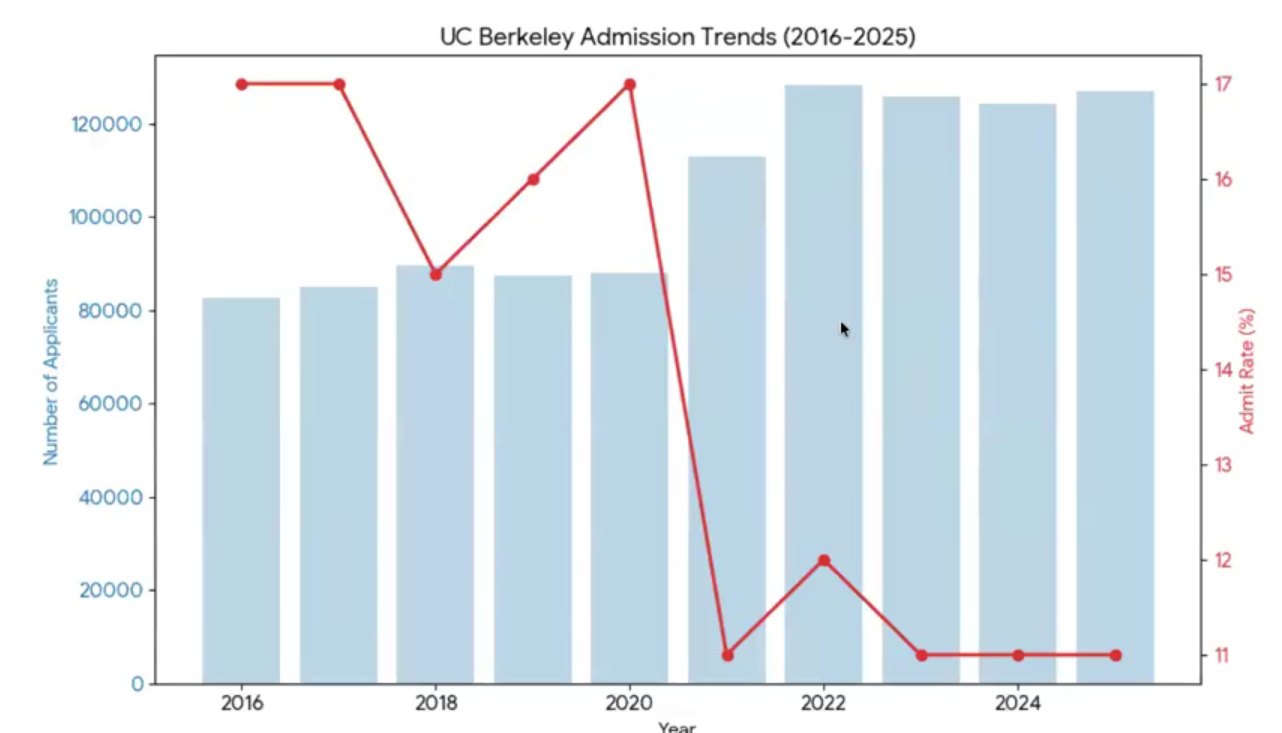
Elton Lin: UC Berkeley admissions trends… I don't need to over-explain this. [In regards to] applicant pool as compared to admit rate, I think what we're seeing is that it's increasingly become—it's still difficult. it's been difficult for a long time, it remains difficult.
UC Berkeley and UCLA
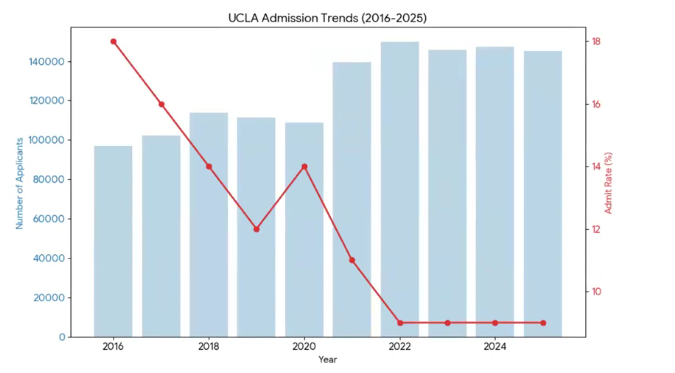
Elton Lin: UCLA, been about the same. I don't see UC Berkeley or UCLA changing.
UC Berkeley and UCLA
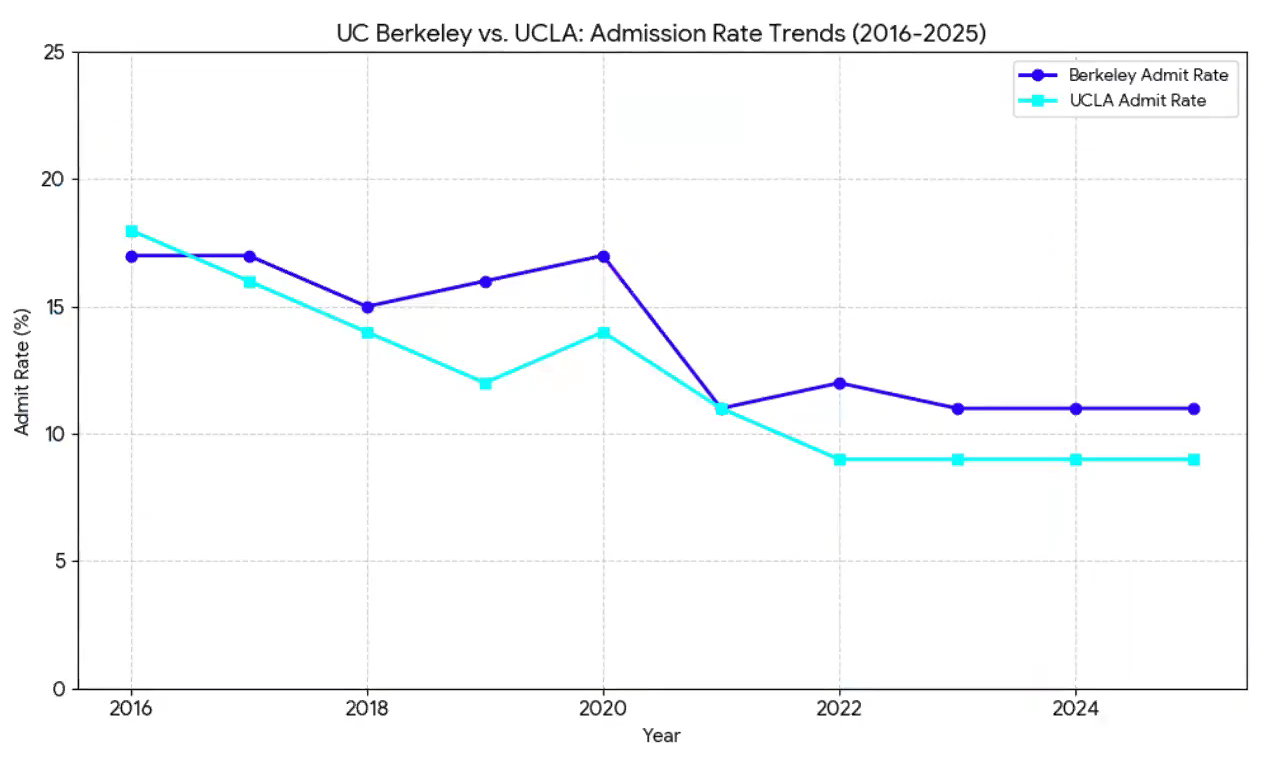
Elton Lin: Here is a comparison between Berkeley and LA with the admit rate.
I think it's—it is what it is, and it's not going to change significantly, but I do have some good news.
UC San Diego >> Enrollment ↑
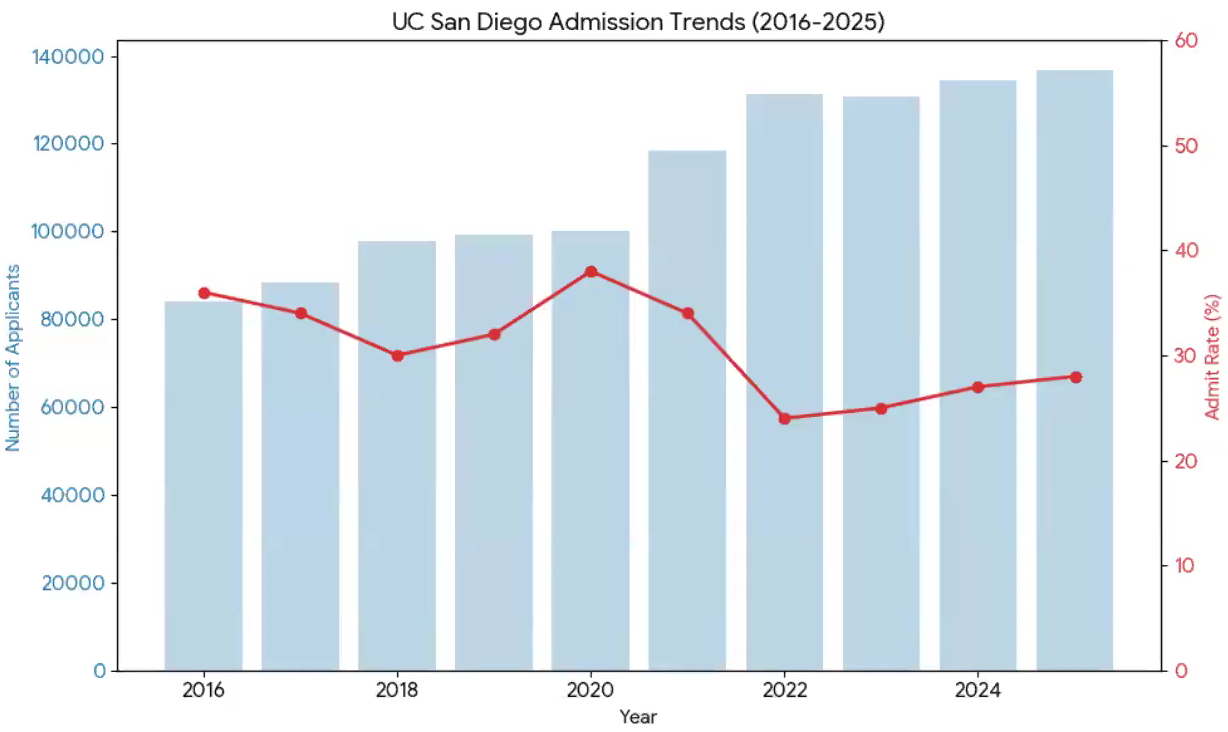
Elton Lin: Some good news is: UC San Diego is working to increase enrollment. And their goal is to hit… they're currently at around 46,000 student enrollment, and their goal is to get up to around 56,000 or 57,000 students in the next 10 years. So they are building—they are creating another college within the university, and their goal is to really admit more students.
And to be frank with you, I've always considered… I mean, there's merit to every UC, but I think in the hierarchy of schools, UC San Diego was really considered sort of the next one after UCLA and UC Berkeley. So, to me, UC San Diego creating more space is definitely a win for everybody, and I hope more public schools and private schools follow their lead, create more opportunity, and give—especially both in-state and out-of-state students—more opportunity to get a higher education at their institution.
Applications UP - WHY?
- 1 in 5 students applied to 10+ schools"
- Harder to get in! I'll submit more!"
- "New Ivies" or "Southern Ivies" becoming more competitive"
- In-state publics also seeing growth"
- Significant migration to southern schools"
- BUT... there are still GREAT schools
Elton Lin: So, with all that being said—with all the shifts, the increasing number of applications, all of this kind of jockeying around with prestige and notoriety—there are still great schools, and I still want to emphasize this to as many families as possible, that there are great schools out there, and many schools that still have really high admit admit rates, so I'll come back to…
Many Good Colleges Out There!
- Santa Clara University
49% Admit Rate
Ranked 7th for
“Highest Mid-Career Salary”
**Behind Stanford, in front of Dartmouth, Harvard
Elton Lin: I know some of you have seen this presentation, but I want to remind you: Santa Clara University, which is in our backyard, in the San Francisco Bay Area, ranks 7th for highest mid-career salary—behind Stanford, but ahead of Dartmouth and Harvard. So, I mean, if your goal is really to optimize and position yourself for having the highest mid-year career salary, you really shouldn't ignore Santa Clara.
Many Good Colleges Out There!
- Texas A&M
49% Admit Rate
Ranked 4th for
“Most CEOs among S&P 500 companies”
**More than Princeton, Brown, UC Berkeley
Elton Lin: Texas A&M? Forty-nine percent admit rate, fourth most CEOs among S&P 500 companies. And when you get into strongest alumni [networks] in the United States, you oftentimes hear of Harvard and USC, but Texas A&M has one of the strongest alumni [networks]. They hire within the family.
So, Texas A&M, super strong, relatively high admit rate. Again, most CEOs, fourth most CEOs among S&P 500 companies.
Many Good Colleges Out There!
- Arizona State University
89% Admit Rate
Ranked 14th for
“Highest Employability”
**Ahead of Cornell and UCLA
Elton Lin: Arizona State, ranked 14th for highest employability, again, ahead of Cornell and UCLA. Eighty-nine percent admit rate to Arizona State. So, tons of really interesting resources, and a lot of good departments.
Many Good Colleges Out There!
- Pepperdine University
50% Admit Rate
90% ADMITTED to medical* school
* Medical including all health grad schools
** 54% UC Berkeley, 47% UCSB
Elton Lin: Pepperdine, again, I come back to—I mentioned this in previous presentations, but we interviewed the Pepperdine admissions director, [and] she mentioned that they have their own counselor for advising their students who want to apply to med school. And she herself has a higher than 90% admit rate for students she works with to go to medical school.
So, to me, if, again, if your goal is to go to med school, you really need to think about which school will help set you up best. And, as I mentioned here in the bottom, UC Berkeley's matriculation rate at med school [is] 54%, UC Santa Barbara[‘s] is 47%, so… I mean, it behooves you not to think about schools that may be better positioned to help you reach your goals.
What do I do?
- Do your research! There are GOOD colleges out there!
- Apply to BOTH public and private schools! Privates can provide more scholarships!
- Apply to MORE safety schools
Elton Lin: So, what do you do? Do your research. There are good colleges out there.
Apply to both public and private schools, because private schools can provide more scholarships, so I oftentimes… I feel like this is another presentation for another time, but private schools are more able to provide merit aid to supplement, to even try to attract good students to come. So, I'd encourage you to apply to both, and apply broadly, and apply to more safety schools, because actually the safety school-range schools are also more likely to use merit aid to try to attract you to come.
Trend #2: College Major Matters
Elton Lin: All right. Second trend is, again, college major matters, and this… though, a similar trend [to] last year… there's some nuanced differences to it this year, just to share with you.
Bachelor Degrees Conferred 2022
| Agriculture and natural resources | 40,675 | Health professions | 263,765 |
| Architecture and related services | 9,462 | Homeland security, law enforcement | 56,901 |
| Area, ethnic, cultural studies | 6,658 | Legal professions and studies | 4,444 |
| Biological and biomedical sciences | 131,462 | Mathematics and statistics | 26,212 |
| Business | 375,418 | Parks/rec, leisure, fitness, kinesiology | 52,776 |
| Communication, journalism | 86,043 | Philosophy and religious studies | 11,230 |
| Computer and information sciences | 108,503 | Physical sciences | 28,301 |
| Education | 89,410 | Psychology | 129,609 |
| Engineering | 123,017 | Public administration/social services | 33,429 |
| English language and literature | 33,429 | Social sciences and history | 151,109 |
| Family, consumer, human sciences | 20,630 | Theology and religious vocations | 6,394 |
| Foreign languages | 13,912 | Visual and performing arts | 90,241 |
Source: Dept of Education, National Center for Statistics
Elton Lin: I wish I could give you more recent [than] 2022 data, but the Department of Education only has 2022 data. So, you know, we can talk about governmental funding for the Department of Education another time, but with that being said… scan over the majors that have the most degrees…
Bachelor Degrees 2012 vs 2022
| 2012 | 2022 | Difference | |
|---|---|---|---|
| Biological and biomedical sciences | 100,397 | 131,462 | +40% |
| Business | 360,887 | 375,418 | +5% |
| Computer and information sciences | 50,961 | 108,503 | +113% |
| Engineering | 85,987 | 123,017 | +43% |
| Health professions | 180,437 | 263,765 | +46% |
| Psychology | 114,446 | 129,609 | +13% |
| Social sciences and history | 177,767 | 151,109 | -15% |
| English language and literature | 52,401 | 33,429 | -36% |
| Foreign languages | 21,647 | 13,912 | -36% |
Source: Dept of Education, National Center for Statistics
Elton Lin: And then maybe we can isolate some of these.
Certainly, with regards to bio and health sciences, computer sciences, engineering, you're seeing a relatively massive increase. And I don't… I generally don't think those numbers are changing substantially for 2025; though, I'll contend that I think computer science is going down, so we'll talk about that in a moment.
Social sciences, English, foreign languages have had a relatively precipitous drop since 2012.
And so, just by nature, you can understand that if you're applying into a higher demand major, it's going to be more selective. Lower demand major, maybe a little bit less selective.
Case Study - UC Santa Barbara 2025
Overall acceptance rate: 38%
90 majors
~128,000 applicants (2025)
~12,000 (8%) applied to Computer Science
~8,500 of those 12,000 had 4.0 or higher UC GPA
~800 were accepted
Computer Science acceptance rate: 5.5%
Elton Lin: Here are some updated stats for UC Santa Barbara. Again, 90 majors, 118,000 applications… 12,000 applied to computer science, 8,500 out of those 12,000 had a 4.0 or UC GPA. Around 800 were accepted. Computer science acceptance rate for UC Santa Barbara, 5.5% admit rate.
I do think that's gonna change, so when we get 2026 data, maybe we'll do an updated presentation in the fall. I think we're gonna see computer science drop a little bit.
Major Admit Rates - UCLA
2025
Life Science - 11%
Computer Science - 7%
Physical Sciences - 14%
Humanitiies - 9.9%
Social Sciences - 9.3%
Nursing - 0.5% (1% in 2024)
Engineering - 6%
Design/Media Arts - 3.1%
Elton Lin: For 2025 at UCLA, you're talking about life sciences at 11%... computer science, 7% at UCLA last year, but in 2024, it's 3%. So I think you're already seeing this transition away from computer science into other disciplines, one of those being data science, the other being various other fields like applied math, other forms of engineering.
And then, nursing—I'll tell you right now, nursing's never going out of style. So… 0.5% admit rate to nursing at UCLA. AI is not impacting nursing in the way that it will impact other industries.
Engineering Admit Rates - UCLA
2025
Chem Eng - 12%
Civil Eng - 7.6%
Computer Science - 7%
Electrical Eng - 8.7%
Materials Eng - 11%
Mechanical Eng - 11% (5% in 2024)
Elton Lin: And if you were to focus, specifically, in on engineering admit rates… even within the engineering department, specific engineering disciplines have different admit rates. So, chemical engineering at 12%, materials [at] 11%, civil engineering [at] 7.6%.
Just to share with you, I think there's some… projections that civil engineering and electrical engineering admit rates are going to go down, [and] maybe higher demand into engineering disciplines that may not be as affected by AI. But civil engineering, electrical engineering, maybe mechanical engineering may be going down. So, we'll see how that goes.
What does this mean?
In-demand majors are more selective
Strong grades with many AP’s is not enough
Resumes must support your interest in higher demand majors
Elton Lin: What does this mean? In-demand majors are more selective. Strong grades with many APs [are], in many cases, not enough by [themselves]. And then resumes must support your interest in higher demand majors
Student Case Study
Student A: Computer Science
2 coding products used by school
1 internship
2 research summer programs
Results
Penn, Columbia, UCB, UCLA, UCD, UCSD, UCSB, UCI, UCSC, UW, UM, BU, Tufts, Purdue
Student B: Environmental Science
No relevant awards
1 internship
1 research summer program
Results
UCB, UCLA, UCD, UCSD, UCSB, UCI, UCSC, UW, UM, BU
Elton Lin: So let me kind of go into a… quick student example. I did update this with an updated student example from 2 years ago, as opposed to a few years back.
We had a 3.94 unweighted GPA, computer science, 1530 [SAT], 11 APs, president of the coding club, 2 coding products used by the student’s school—which I think is actually very interesting, you know, good job! Did have an internship, had 2 summer research programs.
And then as compared with the student who was studying environmental science—actually, specifically environmental science or ecology, depending on the school. 3.8 unweighted GPA, secretary of the sustainability club, no other relevant awards, one internship, one research program. And then they apply to these schools.
So, I don't want to… if we were in person, we would do a—you know, “raise your hands,” and we would do a, “who do you think got into what?” But if I may, let me just reveal this.
Student Case Study
Student A: Computer Science
2 coding products used by school
1 internship
2 research summer programs
Results
Penn, Columbia, UCB, UCLA, UCD, UCSD, UCSB, UCI, UCSC, UW, UM, BU, Tufts, Purdue
Attending: Tufts
Student B: Environmental Science
No relevant awards
1 internship
1 research summer program
Results
UCB, UCLA, UCD, UCSD, UCSB, UCI, UCSC, UW, UM, BU
Attending: UC Berkeley
Elton Lin: Computer science student applied [to] Penn, Columbia, a lot of the UCs. Unfortunately, was only admitted to UC Santa Cru. Was waitlisted to Columbia, San Diego, University of Michigan, Boston University. Was admitted to Tufts, was admitted to Purdue, and then currently attending Tufts.
Now, I think attending Tufts is outstanding, right? So I think the student is doing great. The program specifically—I like Tufts’s [computer science] program, because there's a lot of integration with cognitive science, psychology. I think it's fascinating.
But certainly, you might think that this student might have a few more options other than Tufts and UC Santa Cruz. And that's in large part due to computer science.
For student B, environmental science or ecology… applied to a range of UCs, was admitted to BU, UC San Diego, UC Santa Cruz, rejected to UCLA, but thankfully was admitted to UC Berkeley, and certainly attending UC Berkeley currently, studying environmental science.
What do I do?
Consider other majors (that are still true to you)
Apply to more target and safety schools
Build a resume that clearly communicates the student’s interest in major
Elton Lin: So what do I do?
You could certainly consider other majors, but certainly you need to think about other majors that are true of you, and honest to your narrative, because you can't just spend four years in high school exploring computer science and then want to study, you know, like, French, right? I mean, if you're an admissions reviewer on the other end, it's obvious that [the] narrative doesn't really match up.
So, it's important to really think about a major that is honest to you, true of what your activities are pointing towards, and your overall narrative of your application needs to support it. It still needs to be true of you.
Apply to more targeted safety schools.
Again, build a resume that clearly communicates a student's interest in your major.
Alternative Majors
| Computer Science: | Biology: |
|
|
| Business: | Engineering: |
|
|
Elton Lin: A couple of alternative majors, as mentioned before.
Applied math, cybersecurity… I don't think these majors are necessarily super easy to get into, but sometimes just being outside of the main pool of students is helpful.
Alternative Majors
- More colleges offering a CS x "other major" program
- Most notable example: University of Illinois
Computer Science Programs
Computer Science: 7.5%
Computer Science + X Programs: 19.6%
Elton Lin: And then, just to share with you again, University of Illinois Urbana-Champaign has a CS + X program where they pair computer science with other disciplines, which includes advertising, marketing, statistics, linguistics, and a lot of actually interesting, I would consider, combination majors.
And right now, the CS + X programs have almost a 20% admit rate, while the CS through the engineering school has a 7% admit rate.
So just kind of understanding what major options you have, certainly, can change your admissions likelihood.
Alternative Majors
CS X Majors at UIUC
College of Agricultural, Consumer and Environmental Sciences
Computer Science + Animal Sciences
Computer Science + Crop Sciences
College of Education
Computer Science + Education
The Grainger College of Engineering
Computer Science + Bioengineering
Computer Science + Physics
College of Fine and Applied Arts
Computer Science + Music
College of Liberal Arts and Sciences
Computer Science + Anthropology
Computer Science + Astronomy
Computer Science + Chemistry
Computer Science + Economics
Computer Science + Geography & Geographic Information Science
Computer Science + Linguistics
Computer Science + Philosophy
College of Media
Computer Science + Advertising
Elton Lin: And so these are some of the examples of the CS + X majors.
My sense is that… even the options of these sets of combo majors are going to evolve over the course of the next 2 or 3 years, especially as I think there's going to be a transition from computer science to more data science.
Yeah, more of this coming, and definitely consider options.
Advice for 11th and 12th Graders
- Don't randomly choose - admissions can detect majors that don't match
- Your activities should support your major
- You can MINOR or DOUBLE MAJOR in college
- Major in psychology + minor in computer science = artificial intelligence
Elton Lin: So don't randomly choose your major, because admissions people can detect majors that don't match, for sure. I mean, your activities should support your major.
And don't forget: once you get to college, you can also minor or double major once you get there. So, if your interests and motivation and curiosities reside in, you know, say, reside in psychology, you can go to college and attain a minor in data science or a minor in computer science to supplement your overall degree program, and to graduate with… if I were to suggest, graduate with multiple skill sets once you leave.
I did [another whole] webinar on AI-proof majors that… you can watch that video. It's likely we will redo that video again, or we will do that presentation again at the end of the summer with some more updated data.
But I'm really big on encouraging students to graduate with multiple skill sets, contrasting majors, get exposure to a wide range of disciplines, because the future job landscape is going to require students to interact in a lot of different places, and so start doing that once you're in college.
Validating Interest in Your Major
Elton Lin: Again, with… I mentioned a resume that supports your major. How can you validate your interest in your particular major?
Certainly, I think it's helpful to be in competitions, whether it's science fairs, Olympiads, art and writing competitions, DECA (which is a business club)—whatever competition, perhaps, allows students to maybe gain a few awards, have some form of outside validation to what they're doing, makes it easy for the admissions reviewer to sort of quickly ascertain whether your resume really supports your intended major.
Certainly, you know, whether you could be doing some form of research, whether it's: working under an established professor, publishing research in some cases; science fair; I've had some students patent technology that they designed. And so, anything, again, where you have some kind of outside validation to support your interest in a particular area.
And also consider other metrics, like if you're working on a fundraiser, work on raising as much money as you can. If you're working on a philanthropic project, what are ways for you to help as many people as you can? Or, you know, products sold, or whatever it might be. Think about how you might be able to increase your impact in some form or another.
Another way to validate your interest is through rec letters. So, like, outside mentors… I've had students do philanthropic projects with nonprofit leaders, and the nonprofit directors were able to write them an additional recommendation for their college app. So, outside rec letters can also be used to validate that interest as well.
Majors w/ Highest Unemployment
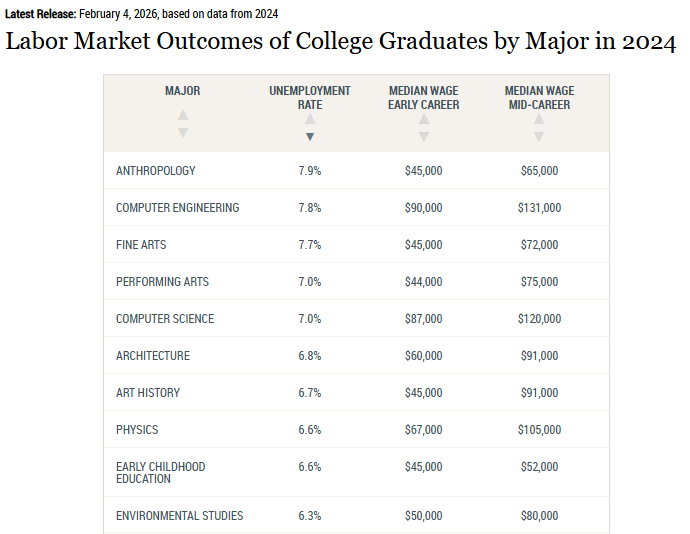
Source: The Federal Reserve Bank of New York
Elton Lin: I'm gonna include this only because I feel like it's in line with this college major conversation, but I don't wanna… I introduce it, but I'm gonna save the digging into it for our AI-proof college majors [webinar] more towards the end of the summer.
But there certainly is a shift away from purely computer science. And right, you know, this was a 2024 data on highest employment rate based on major, and, I can send, if you're interested, I'm happy to send you the link to this article. But currently, highest unemployment rate based on major, unfortunately, is anthropology. One of our consulting managers is an anthropologist by trade, but…
But second and fourth are computer engineering and computer science. Now, we can parse the data and kind of get into the fact that there are a lot of people with computer science degrees, there's been a lot of layoffs in the tech industry over the course of the last couple years, and there's a little bit of outsized impact that's happening in these industries.
But there's still a need for, obviously, computer science and computer engineering. All those things are true, and so I'm not trying to overstate what is being said here, but there are a lot of shifts that are happening that, I think, what we…
What we can't do is just say, “oh, just major in computer science and everything's gonna be okay.” That, unfortunately, is no longer here, right? So I think we need to really… go back to the basics of really how to think about your college major.
Certain?
Less impacted by AI:
Electrical Engineering
Biomedical Engineering
Mechanical Engineering
Civil Engineering
Nursing + Some Health Profs
Psychology + Counseling
Special Education
Social Work
Elton Lin: I think there are some pundits who are projecting some majors to be less impacted by AI, and some are saying that this range of engineering is a little bit less impacted by AI.
Certainly healthcare professionals, nursing, less impacted, [as well as] psychology counseling, special ed, social work.
But truth be told, we just don't know for sure, right? So, like, you could be saying this now, but it's really hard to tell, really, what's gonna be the case in 5 to 10 years.
Advice for 8th, 9th and 10th Graders
Gain a wider array of experiences
Pay attention to what fuels motivation, drives curiosity.
Go deeper in THOSE areas.
Find ways to help people.
Elton Lin: So, my encouragement to students is to really find—especially for younger students, if you're a family that's representing 8th, 9th, or 10th grade students—is to really pay attention to what fuels your motivation and curiosity.
So, my suggestion: gain a wider array of experiences; pay attention to what fuels motivation and drives curiosity; go deeper in those areas; and find ways to help people—this whole aspect of really expanding the metric of impacting people.
Been doing this for almost 16 years, and 100% [of the time], students always achieve higher, experience more joy in their areas of natural interest and motivation and curiosity.
And so, if I were to, you know, in light of college majors that are becoming a lot less clear, a lot… more confusing about how they lead to careers, let me encourage you to go back to areas that fuel your motivation and curiosity.
Trend #3: Colleges Admitted More via Early Decision
Elton Lin: Alright, colleges… trend number 3: colleges, admitting more via Early Decision.
What is Early Decision?
- Students apply to only ONE college on "Early Decision"
- Deadlines: ED November; ED 2 January
- Potential results:
- Accepted: student MUST attend based on ED agreement
- Deferred: student moved to regular deadline and released from ED agreement. Student may apply to another college on ED2.
- Rejected: student may not re-apply on the regular deadline. Student may apply to another college's ED 2 program.
Elton Lin: Maybe just to explain Early Decision real quickly: some schools have what they call an Early Decision program, where students can only apply to one college, and only one of those Early Decision colleges; and if you are admitted on that Early Decision agreement, then you must attend.
So, deadlines are normally early November [for ED1], early January for ED2. I can explain ED1 and ED2 another time.
And then what it is, is that if you apply on November 1st, Early Decision 1, you'll hear [back] by around December 15th. And a lot of families, like, they get the result, they're super happy, you can go into your winter break super relaxed, and just have a good time… so I think there's a lot of benefits to it.
Pros + Cons of Early Decision
Detriments
Can’t improve grades
Can’t compare Fin-Aid
Less time to finish app
Locked into ED choice (if admitted)
Benefits
Find out results early
Reduced stress
Access to housing
Improved chances of admission
Elton Lin: Some benefits [are] that, obviously, you find out results early, it reduces your stress. Sometimes you have earlier access to housing, if that's important to you. And then for some students, it improves your chances of being admitted.
Some detriments [are] that, like, if you need the first semester senior year to improve your grades and improve your GPA, you won't have it, because you've got to submit the Early Decision application on November 1st. So, they won't see the first semester grades from your senior year because you are submitting early.
You also can compare financial aid offers from different schools, because you're only applying to one Early Decision school. You have less time to finish your app, and then you're also locked into your ED choice if you're admitted on that ED agreement.
Why Do Colleges Like ED?
- Yield
- Colleges don't like guess work!
- Fit
- Colleges want to accept students who want to attend!
- ED is the ultimate form of demonstrated interest
- Competition
- Colleges want applicants who will meet their institutional priorities (e.g. first gen, rural, low income, underrepresented, majors with fewer applicants).
Elton Lin: Why do colleges like Early Decision?
Colleges don't like guesswork. Remember what I said earlier about, if students are submitting more applications, it's muddier for students, but also muddier for universities.
So what's happening is that… Early Decision allows the university… to admit you and know that you're coming. It makes their enrollment process much more clear, there's less guesswork, and they know who's coming. Colleges want to accept students who want to attend, so if you're applying Early Decision, obviously you are… you're interested in attending, right?
And ED is, for them, the ultimate form of demonstrated interest, the ultimate form of me demonstrating to the university that I really want to come.
Colleges want applicants who will meet their institutional priorities, so oftentimes, universities will use the Early Decision round to try to meet their institutional goals, whether it's a number of first-gen students, students coming from rural areas, low-income, underrepresented, whatever the case may be, but they like ED.
Admitting Higher % via ED (2024)
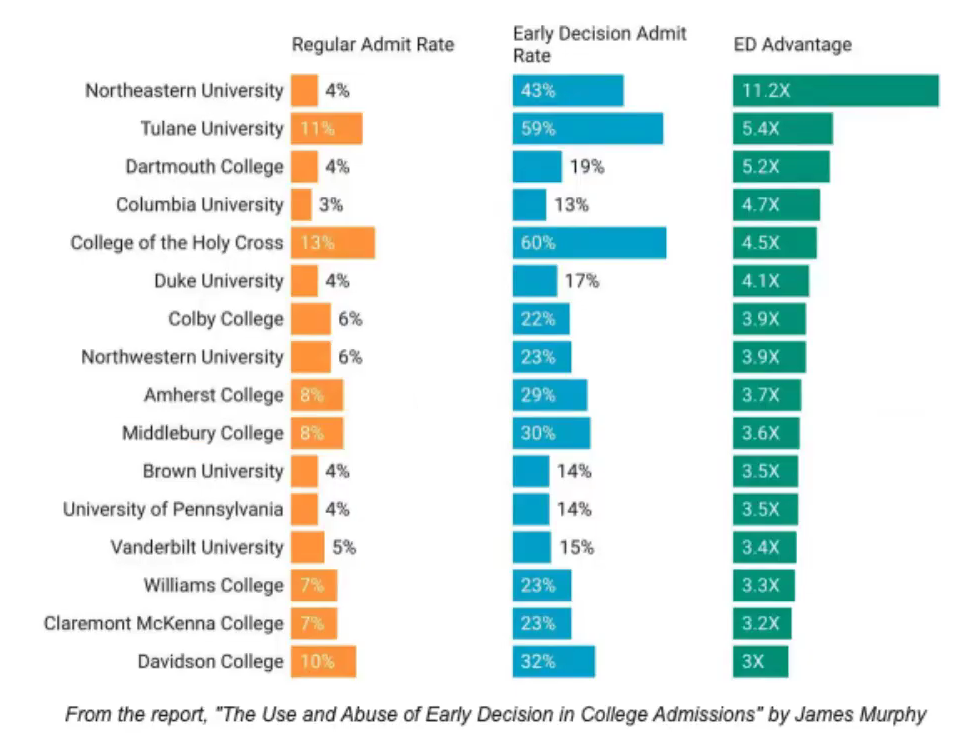
Elton Lin: Just to kind of give you a glimpse at the different Early Decision admit rate[s]... for a Dartmouth, it's 19%, as compared to the regular round[‘s] 4% admit rates; you're talking about, say, an Amherst at a 29% [ED rate] and 8% [regular admit rate]; a Northwestern at 23% [ED rate] and 6% [regular rate].
What you're getting is that you're getting an increased likelihood of being admitted if you’re applying on Early Decision. There's a caveat to that, and I'll get to that in a moment.
Admitting More via ED (2024)
📊 The number of applicants admitted through early decision divided by the number of students in the freshman class.
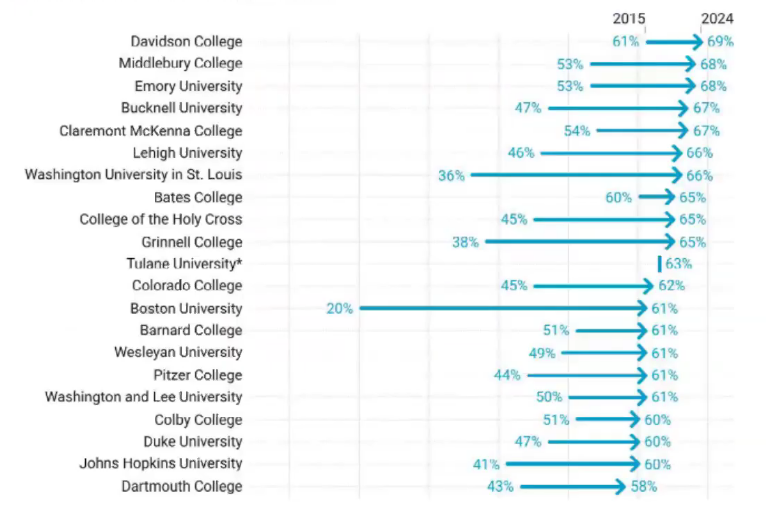
Elton Lin: But I think what is even more problematic is that the number of applicants admitted through Early Decision is also increasing.
This is a comparison of the percent of freshman class admitted on Early Decision. So, in 2024, Emory admitted 68% of their freshman class on Early Decision, as compared to 53% in 2015. If you look at Boston University, 61% of their freshman class was admitted on their Early Decision, as compared to 20%.
So I almost feel like, I mean, if Boston University is a high priority for you, it, again, almost behooves you to apply Early Decision, and to really make it a high priority, if that's a school that you want to go to.
So, schools are admitting a higher percentage of their freshman class [through], and they're leaning into Early Decision.
Why Do Colleges Like ED?
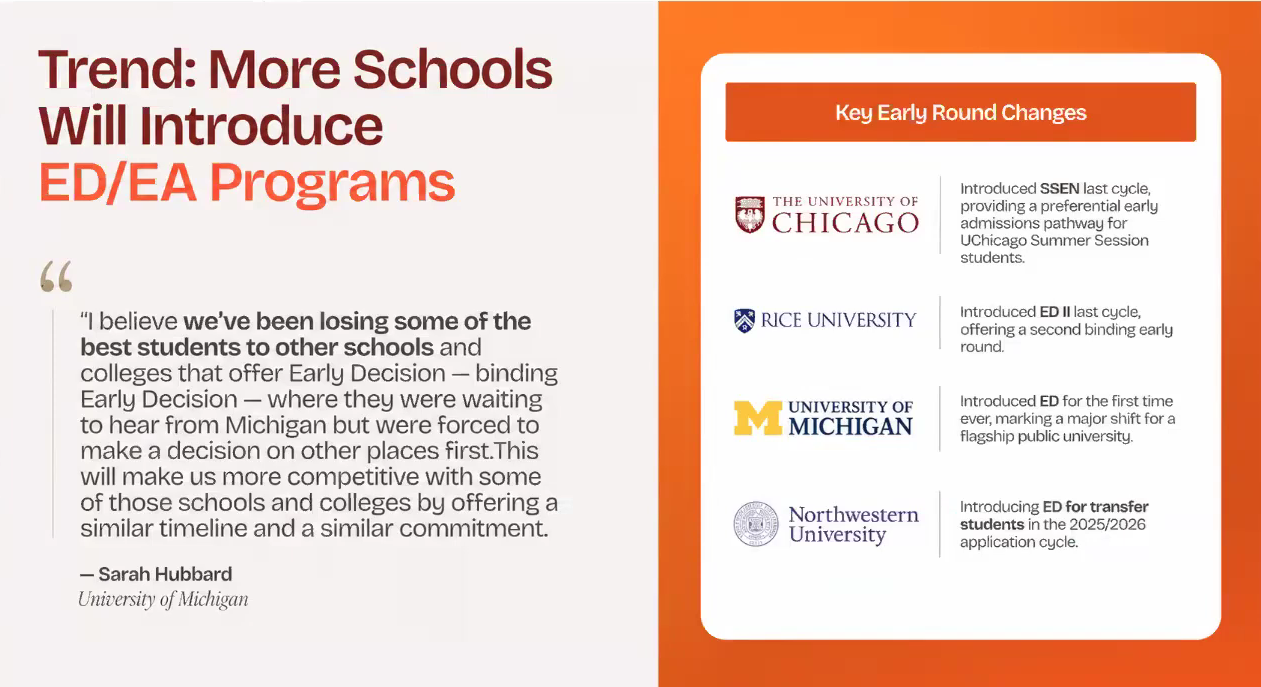
Elton Lin: And this is just a quote from the Dean of Students at the University of Michigan, and basically what Sarah Hubbard is saying is that [they]ve] been losing some of the best students to other schools, where they're waiting to hear from University of Michigan, but they're forced to make a decision on other places.
And so, they instituted Early dDecision for the first time last year. Everyone is sort of jockeying to try to lock in their student pool and make it more clear for them. So the University of Michigan's acknowledging this competitiveness.
If you look on the right side, Rice has instituted an Early Decision 2, so a later timeline cycle Early Decision. University of Michigan, obviously, first time.
University of Chicago instituted—we call this an ED0, right, but they call it an SSEN—but basically, it's an early results program for students who've gone to University of Chicago for a summer program. So that's where, if University of Chicago is a priority, you might want to consider going to one of their summer programs the year or two before, right? So then it gives you access to this program to apply into.
But the trend is that more and more schools will introduce some kind of strategic early program in order to help them better understand their freshman profile, freshman class.
Who Should Apply ED?
- Are done with standardized testing!
- Are in a financial position to use the ED option
- Have a first choice college (no regrets)
- Are at or above the 75th percentile for admits to the college
- The early pool has the strongest applicants; students with less competitive profiles will likely not benefit from ED
Elton Lin: It's 5:40, and I'm going to try to get through as quickly as I can, so that we can have more time for questions.
So, who should apply ED?
If you're done with standardized testing, great, because you need to apply November 1st! You can certainly still take the SAT or the ACT in August or September, but you're running out of time. So, if you're done with standardized testing, it's great.
Are you in a financial position to use the ED option? Again, you don't get to compare all the financial aid offers, so if you're in a financial position to do so, it's great.
Have a first choice college—like this is a school that you really want to go to, and there's no regrets.
And then you're at or above the 75th percentile for admits to that college.
So… we can get into this at another time. There's some college list webinars coming up.
But if you're, like, a 3.5 [GPA] with a 1200 SAT trying to apply Early Decision to John Hopkins, that's not going to improve your chances. You're going to get more quickly rejected, unfortunately, because you're not within the bracket of students who are being admitted to Johns Hopkins.
But, if you're… my suggestion is that you ought to be in that 75th percentile, the upper quadrant of students who are commonly admitted, and that oftentimes makes Early Decision a more viable and reasonable sort of push to push you over towards being admitted to that school.
Bonus Trend #4: Testing is Coming Back
Elton Lin: Alright then, last trend is: testing is coming back, unfortunately.
Colleges Requiring SAT or ACT
MIT
Purdue
Dartmouth
Brown
Yale
UT Austin
Harvard
CalTech
Cornell
Stanford
JHU
Miami
Penn
Ohio St
Princeton
Tennessee
Georgetown
Georgia
Penn
More?
Elton Lin: These are the colleges that are requiring SATs and ACTs. I'll tell you, the Ivy League that is not here is Columbia, and it's May, and Columbia might still announce that they're requiring SATs or ACTs; but as of today, they are test optional. As of May 2026, they're test-optional.
But these are the schools that are going back to requiring [standardized test scores].
Percent Admitted Submitting Tests
| School | % Submitting SAT | % Submitting ACT | % Submitting Tests |
|---|---|---|---|
| Emory | 42% | 19% | 61% |
| Penn | 51% | 19% | 70% |
| Michigan | 52% | 18% | 70% |
| UChicago | 46% | 30% | 76% |
| UNC | 34% | 47% | 81% |
| Princeton | 57% | 20% | 77% |
Elton Lin: I think the bigger issue here, again, is the percent of the admitted class that has submitted testing. And what ends up happening is that you're getting a higher… every year, you're getting a higher percent[age] of the freshman class that is submitting tests.
So, what that tells you is that the school is beginning to put a higher priority on test scores to review the student to assess whether the student is a good fit for the university.
Percent Admitted Submitting Tests
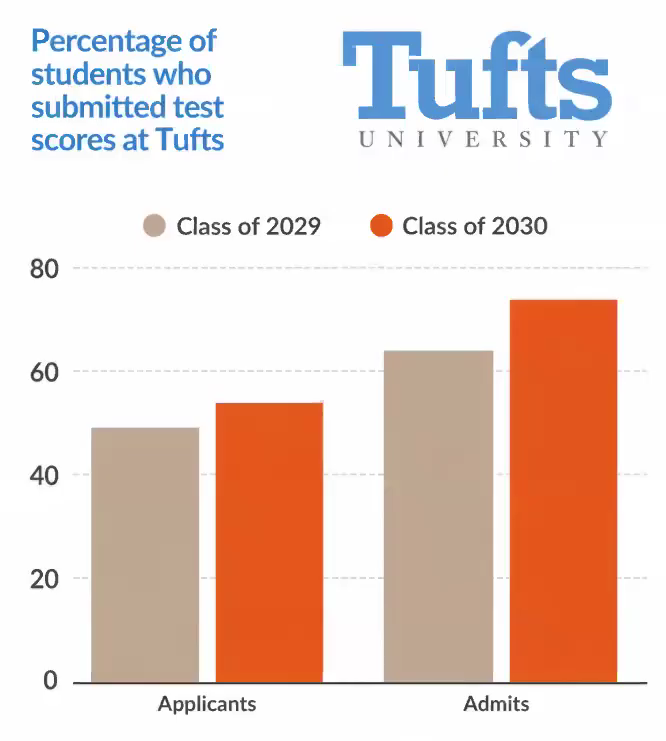
Elton Lin: Let me give you maybe another… this is the freshest data. I would say most schools have not released 2030 data… Class of 2030 data, which is very new, it's [from] this year.
But, for Tufts, compared to the Class of 2029, this is… the left chart is the number of applicants, the right chart is the number of admits, and then what ends up happening is that you're getting a higher…
The orange bar represents the percent of students who have test scores that are being admitted. So, for the class of 2030, you're getting somewhere in the 73% to 74% of the freshman class that were admitted had test scores, as opposed to the previous class, which had maybe around 53% or 54% of the admitted class having test scores.
So, the trend is moving in this direction… moving towards the importance of the test score on the college app review.
More Students w/High GPA’s
As of last year, 84% of college freshmen reported an A+, A or A- average in high school.
Strong grades and test scores show a student can handle hard work—but when nearly everyone applying has those, admissions officers need something else to tell apart the great from the truly exceptional.
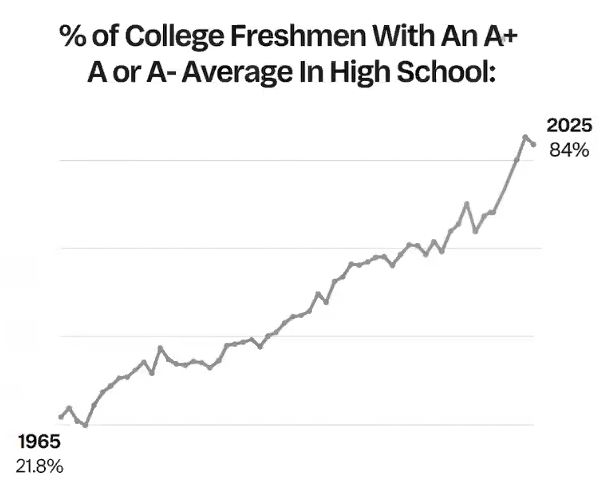
Elton Lin: One of the reasons this is happening is because more students have just higher GPAs.
So if you can look on the chart on the right, the percent of college freshmen with an A average in high school… as compared to 1965, has increased precipitously. So if you're an admissions officer and you're looking at a lot of transcripts, you're by and large seeing a lot of transcripts, a lot of As.
Some of this is because a lot of these students are coming out of the pandemic years, and oftentimes, there's been a sense to where teachers were giving a lot of benefit to the doubt, giving maybe, you know, maybe more A's than perhaps maybe they could have or should have.
We can kind of dissect the motivation another time, but what ends up happening is that there is a documented great inflation.
Quote from MIT:
“Our research has shown that, in most cases, we cannot reliably predict students will do well at MIT unless we consider standardized test results alongside grades, coursework, and other factors.” — Stuart Schmill, MIT Dean of Admissions
Elton Lin: [The] MIT Dean of Admissions says, “Our research has shown that in most cases, we cannot reliably predict students will do well at MIT unless we consider standardized test results alongside grades, coursework, and other factors.”
And the reality is that, yeah, the other factors are becoming a little bit more homogenous. We need to include test scores at this stage.
What do I do?
Elton Lin: So, what do I do?
Plan on taking the SAT or the ACT. Just work on it, especially if you're a 9th or 10th grader. You should prepare for it, plan on taking it, and if the score is an asset to you, that's great. And if it's not an asset to you, that's okay. There are actually still a lot of schools, including all the UCs, that are either test optional or don't consider testing… but it's important for students to prepare for it, and take it and give it a shot.
I would say with regards to the whole aspect of transcripts—even though I mentioned earlier that AP classes and grades are not quite enough—but it's still important to optimize your course selection to make sure you're taking as heavy a load as is appropriate for you. Don't take too many APs to where you're getting lots of B's and C's, but take as many APs as you can while maintaining as close [to] straight A’s as you can.
So, maximizing your rigor as much as you can, because again, you're trying to demonstrate to schools that you can handle it, handle… the transition to college, and do the best that you can.
And then you can also even consider supplementing your high school course load with community college classes, online AP courses, and you can even take them over the summer so that you can avoid… so that [you’re taking them] when you have a little bit more time, and then they can supplement your transcript from there.
Trends for 2026:
Applications are UP ↑
College Majors Matter
Colleges Using Early Decision More
Plan on Taking the SAT or ACT
Elton Lin: All right, so trends for 2026: applications are up, college major matters, colleges using Early Decision more, we encourage you to plan on taking the SAT or the ACT.
Don't forget!
There are good schools out there!
Build a major-focused resume
Consider ED if it’s right for you
Do the things you love 🧡
Elton Lin: Don't forget, there are good schools out there. It's important to build a major-focused resume.
It doesn't mean that you need to decide your major from the first month of 9th grade—but I've always used this metaphor of a pyramid: begin broadly, but begin to narrow down as you get to 10th, 11th, and 12th grade, and then that pyramid then builds a cohesive narrative that is more easy to communicate on a college app once you get to your 12th grade. So think about the pyramid. Broad, and then narrow down as you go from 10th and 11th grade.
Do the things that keep you motivated, that drive your curiosity, that bring you joy. That's important.
Final Word
Remind them (often) that you love them regardless of how the results turn out. 🧡
Elton Lin: Lastly—I've been finishing on this with all my presentations—students are stressed. I'm not saying that the stress is coming from families, it's just ambient stress, and we can get into a social media conversation another time, but students know what's at stake, they feel the pressure.
So let me encourage you as parents to remind your student that you love them. Regardless of how the results turn out, regardless of where they end up going to college, that your love for them is unshakable.
Questions!
Elton Lin: So, thank you so much. Excited to jump into questions! Let me invite Anthony back on. Ten solid minutes to answer questions; Anthony, what do you think?
Thank you!
Elton Lin
CEO, ILUMIN Educationinfo@ilumineducation.com
www.ilumineducation.comClick here for a free consultation!
Click here for a free admissions timeline calendar (2025-26 cycle)!
Anthony Su: We'll try to get through as many as we can. Of course, if you have anything that you want to go through, definitely put it in the comments, or put it in the Q&A section.
There was a request for that link of that previous admit rate data that you had, if you have that, Elton, the article.
Elton Lin: Yeah, I will send it. I think it's easiest if we send in an email after the [webinar].
Anthony Su: That works too, yeah.
Elton Lin: We'll send it out, yep.
Anthony Su: I'll send an email with the recording also, so you'll be able to take a look at that.
Elton Lin: Absolutely, yep.
Anthony Su: All right. A question about how… you were talking early on about finding right-fit schools, and people looking at the South as well. A question about how Bay Area students, basically, are—given the different cultural environment—how you've seen Bay Area students adapt in terms of going to universities in the South?
Elton Lin: Yeah, I mean, you know… it's one of those things, if you look at—like, I'll reference specifically, like, Auburn, Alabama, and Tennessee, which—I think they've done a great job on TikTok marketing and all their admission office tours. I think if you were to dig into some of those university campuses, resources are amazing. Buildings are very well developed, I think student experience is generally high.
And I'll be very frank with Bay Area students: we [at ILUMIN] just have not seen a ton of our students go to the Auburn, Alabama, and Tennessee. … This is not a debate on the merit of those schools, et cetera, it's just we just have not seen that many.
And I think, if you were to also include… Now, if you were to include, like, say, Texas as the South—I would say, if you include Texas and Georgia as a [school in the] South… I would say our students have been going to, like, say, UT Austin, Texas A&M, Emory, Georgia Tech, obviously Duke and UNC Chapel Hill. I think our students have been great in those places.
So I think those… there's certainly no reservation. A lot of those places I mentioned are big metropolises, and just very diverse communities, so I've not seen any issue with students transitioning to those areas.
I will say that I think the micro-impact is that since there are a significant amount of students based in the Northeast that are going to the South, that also makes the schools in the Northeast… it's making [universities’] predictive analysis on who's coming more volatile, which may mean, if you want an Early Decision to a Tufts, or a Northeastern, or a Boston University, they may lean more into that because their normal Northeastern student group may be going into other places in the United States, right?
So that's how you might want to think about that as it relates to… obviously, there's probably, like, 80% of the audience is California, but that's maybe how a Californian might think about that.
But even if you're in other parts of [the country], I do feel like if you're—you know, we have a family from Austin, Texas. Thank you for, thank you for being here. That also makes a student from the South who's applying into the South actually a little bit more… more challenging.
So that's a part of it as well… but thanks for the question.
Anthony Su: And then, yeah, question about Early Decision and financial aid, since it looks… it does seem like a school is definitely far more… potentially far more limiting with how generous a financial aid offer could be on an Early Decision.
The question was basically, are schools less incentivized to offer that for the Early Decision rounds?
Elton Lin: I've found that—I think schools are generally not…I don't think they're particularly predatory on the early round. I don't find that the case, right? So I think…
Every school has an estimated cost calculator. It's an Obama-era administration thing, and you can go on to any… every university should have that cost calculator. You enter in some of your household financial data, and they will prepare for you, a relatively close estimate on what that financial aid package will be.
So I would use that cost calculator… The package should be close [to that amount]. Won't be exact, but it should be close. So, no, I've not found it to be particularly predatorial, but with that being said, the way that you can get out of most ED agreements is if you can provide financial support documentation that, like, your current year's finances no longer fit the total cost of attending that school, and that is one way to get out of that ED agreement.
Anthony Su: And then, let's see, we have questions. They're all a little bit scattered, so I'm trying to group them when possible.
Question about legacies and being less relevant in general. Is there… do you have any insight about that as a potential trend? I think this is mainly from the Supreme Court case, but…
Elton Lin: Yeah, I’m not gonna go on record in saying that it doesn't matter, because that’s… there certainly is a push and move in that direction, and I think that schools are paying closer attention to making sure that they're not over-biasing on legacy.
Does legacy absolutely not matter? I won't say that either. You know, I think that would be… that would be unfair. But, I do feel like—I think schools are more sensitive. I think some of that also came from the Varsity Blues scandal that was going on, you know, like, 6 or 7 years ago.
So I think, there is a lot more paying attention to what some might consider as unfair admission practices. And I also feel like there is… yeah, there’s also a push for, you know, a move away from practices that represent diversity, equity, [and] inclusion. And I think it doesn't mean that universities don't want a diverse student body.
So in my opinion, they may go… they may move away from some of the more public practices of that, but they will find other ways to diversify their student body.
The UCs’ affirmative action was rendered illegal in the early 2000s, but the UCs are more diverse now than they were in the early 2000s. So schools will find a way to do so.
I realize that may not be the question, but… [laughs] So be it.
Anthony Su: [laughs] A question about the… I think this was early on when you were discussing major and relevance with particular extracurriculars, or being able to help a student plan that out.
But how would you help a student if they are not sure about the specific major, or intend to apply for schools that claim that, “hey, we don't expect a student to declare a major?”
Elton Lin: Yeah. There are—many of the Ivy Leagues are not overly major-focused, including schools like Rice, a lot of liberal arts colleges. They're… from a functional standpoint, like, once you arrive to school, they're not holding you to any particular major.
Now, that's different than saying… an admissions officer who's reading an application, and they're trying to understand your story in the span of 1, 2, and 3 minutes, right? So, if you're trying to read an application quickly, you're trying to understand the student's story, where they're motivated on, what direction they're going, in a very short amount of time.
So, oftentimes, matching the major with the student narrative, is a way to communicate that story more succinctly.
Now, if you don't know what you want to do, that's totally fine, that's totally understandable, and I think once you get to said college, the reality is that changing majors is not as difficult, I think, as most people think it is. Now, certainly, if you're trying to get into computer science at Carnegie Mellon, at UC Berkeley, it's extremely challenging. Understood, right? But aside from some of those niche examples, changing majors, generally speaking, is not that difficult and very doable at many schools, including many public schools.
So I often just say, I think it's okay to go undeclared, but if you do have some curiosities, begin with those curiosities. And if your activities and storyline [match] up—curiosities, the activities you're doing, if those two things line up—I think it makes more sense to declare that major first, begin there, maybe double major or minor once you get there, or you can consider changing majors once you're out, or once you're at the school.
So that's how I would normally think about major, because it's more than just, “I'm not sure what I want to do, I don't want to commit to something.” But you don't need to commit to it for the rest of your college years. You can make adjustments once you're there.
But think about how your application is read in the process.
Anthony Su: And then I guess we'll go through this one last question, but a question about the Cal State system, if it's getting harder to get into the tech majors for places like San Jose State or a Cal Poly—I think, places that we may have expected might be a little bit easier for students, or for some students might… they might kind of see that as, like, a safety or a backup for them. Is that also getting more competitive?
Elton Lin: Yeah, I think the CSUs… if you're talking about specifically California—and I think this probably relates… this probably applies also to the SUNY system in New York—I think, generally speaking, the schools are still pretty accessible. So I'm not overly concerned about a student trying to get into a San Jose State or a Cal Poly Pomona.
But now, if you're talking about Cal Poly San Luis Obispo, I do feel like… I mean, it's been competitive for engineering for 10 plus years… I think it still remains competitive, but I don't think it's—you know, using my Vanderbilt example, I don't think it's become Vanderbilt.
So, I think, if you want to dig into some of the UC stats, a lot of the mid-tier UCs in the 2024-25 admit pool, their admit rate actually went up a little bit. I do, to be frank with you, once we get the 2026 results from this past year for the UCs, I think that admit rate is gonna go down a little bit.
But all that to be said, the mid-tier UCs are not reflecting this Vanderbilt phenomena, right? So I think, for the UC system [it] is still available [or accessible], [the] CSU system is still very available, and there are still definitely some good schools out there.
Anthony Su: Okay. I think we will call it there. There's still tons of questions, but of course, feel free—there was a poll also that launched for a free consultation. You can always reach out to us there. We can set up another call, kind of talk a little bit more details about your specific student as well.
Elton Lin: Alright, thank you so much, and I mentioned there's a consultation link here. If you want to send us an email, you can, the email's there.
Thank you so much, Anthony. Thank you so much, everybody. I know that there's a lot of—we will send out the links, especially for the rankings, happy to send out the ranking links, like the highest employability, the unemployment rate article that I posted there. And so, we send out those links to you with the presentation.
And we will have more webinars coming, excited to have you guys on, and we'll see you on the next one.
Thanks, everybody.
Anthony Su: Thanks, everyone.
Yep, take care. Bye.