contact us

Use the form on the right to contact us.

955 Benecia Ave.
Sunnyvale, CA 94085
USA

(408) 479-4742

ILUMIN Blog

Helpful tips about college admissions, test preparation and just being a better student, leader and person from ILUMIN Education.

Filtering by Category: College Essay

Interview with Matthew Gallery, Boston University Assistant Director of Admissions

Elton Lin

We had the privilege of having Matthew Gallery, Boston University Assistant Director of Admissions, join us in a webinar Q&A a few weeks ago to talk about the upcoming changes to admissions and the unique challenges of higher education in the years ahead.

Read More

“WHY US?” OVERLOOKED RESEARCH TIPS FOR THE “WHY US” SUPPLEMENTAL ESSAY

Elton Lin

The “why us?” supplemental essay, or the student’s love letter to a college, is arguably the most-requested supplemental essay from college applications across the board.

Read More

BREAKING DOWN THE 7 COMMON APPLICATION PROMPTS

Elton Lin

With seven prompts to choose from, writing your Common Application personal statement can seem like a daunting task. Where do I start? What do I talk about? How do I make sure I use the right prompt? We’ll address these questions and take a look at the Common Application essay prompts, one by one.

Read More

THE ILUMIN UC ESSAY PROMPT GUIDE: BREAKING DOWN THE 8 UC ESSAY PROMPTS

Elton Lin

With eight prompts to choose from, writing essays for four UC Personal Insight Questions can seem like a daunting task. Where do I start? What do I talk about? Which prompts do I tackle? We’ll address these questions and take a look at the UC essay prompts, one by one.

Read More

INTRODUCING THE ILUMIN ONLINE ESSAY BOOTCAMP

Elton Lin

The most frequently asked question that students have when starting their college application essay is...

“Where do I start?”

Here at ILUMIN Education, we can now proudly point you to the ILUMIN Online Essay Bootcamp!

Read More

THE ABSOLUTE DON’TS OF COLLEGE ESSAY TOPICS

Elton Lin

While the personal statement is an invitation to share more about yourself, there are definitely topics that you should avoid. In an effort to save you some time from laboring over a draft only to realize the entire premise of the story is flawed, we’re going to spell out which topics you should avoid, from the “You can do better” category to the “Don’t touch this with a ten-foot pole” topics.

Read More

HOW DO I START MY COLLEGE ESSAYS?

Elton Lin

First of all, congratulations on making it to the application season! I’m sure the past few years of high school has been a tremendous period of growth, learning, and experimenting. We hope to help you capture these unique moments of realization you may have had during that time to strengthen your essays.

Read More

9 Tips for Writing Effective College Essays

Guest User

As students come back from summer break, the topic on the minds of many seniors is the college application. As in years past, the vast majority of colleges that utilize the Common Application (and Coalition Application) require that students write a personal essay. How do you write 500-650 words about yourself? Here are some of our suggestions:

  1. Start Now — While college deadlines may seem far off—after all, January 1st is over four months away—the fall of senior year is often one of the busiest times of a high school student’s life, and you’ll be glad that you started your college application essays early. With tests, homework, standardized tests, sports, leadership activities, and not to mention a social life to manage, many seniors are overwhelmed when they add college applications on top of their towering to-do piles.  And don’t forget that some early application deadlines (like Georgia Tech’s Early Action deadline) come as early as October 15th.

  2. Show, Don’t Tell — Because you only have a limited amount of space, it’s tempting to summarize your main points or to list achievements or activities for the Common App or Coalition App essays. But anecdotes and details will help your point come across far more effectively than just stating facts or conclusions. Think about how to tell a story to illustrate your point. For example, if you want to demonstrate that you are an innovative thinker, it’s probably better to share the story of that time you helped your robotics team come up with a different way of approaching your project rather than to list all of your awards from robotics (which you will do anyways in a different section of the application).

    Think about how to help the reader imagine a poignant moment or a significant realization you had. Oftentimes, direct quotes or even internal monologue can play an important role. You might want to use metaphors or imagery, and you should certainly feel free to start your essay in medias res (in the middle of the story).

  3. Simpler is Better — While some students think that using complex or rarely used vocabulary in their essays demonstrate their high level of linguistic competence, simpler is better. Don’t be afraid to use short sentences, contractions, and an informal tone. Of course, you’ll want to vary sentence structure and length, but make sure that you are communicating clearly. Write in the active voice.  And if you don’t normally use certain vocabulary in your speech or writing, don’t debut it in your personal statement.

  4. Avoid Common Topics — As we mentioned in our previous blog past [link this to the Essay Topics to Avoid post], there are some topics that are more common than others. For example, many students take (and write about) “The Trip.” Another very common experience is a sports (or any type of competition) victory.  This is not to say that you absolutely shouldn’t write about those topics, but that you should proceed with caution, knowing that you’ll need to make a concerted effort to stand out from the crowd if you do decide to write about these topics.

  5. Avoid Negativity — Most students don’t do this consciously, but we’ve read many essays that detail a teacher’s (or parent’s or coach’s) unfairness or harshness or complained about school or family culture. While these sentiments may be completely justified, they leave a bad taste in a reader’s mouth because without knowing the student, this is the first and only impression that an admissions reader will have of this person. You don’t want to waste your one chance to make a good impression. If you do experience significant challenges because of someone else’s actions and choices, please see below.

  6. Describe Growth and Change — Tough things happen in life. People get sick and/or die. Parents get divorced. Loved ones may become addicted to alcohol or other substances. Students have disabilities and some have depression or other mental illnesses. The natural response in these circumstances is to write about the situation and describe it in detail. But that’s exactly what you should not do in your personal statement. In some cases, students should write a more detailed account of the challenging circumstance under “Additional Information,” but for the college essay, you should focus not on the particulars of the situation but on how you grew or changed from having to deal with the situation.

    The most effective essays are those that focus on growth, even if the challenge is something as mundane as stage fright, moving to a new school, or even just a crippling shyness. You’ll want to display a “before” and “after” verbal snapshot of yourself and described what caused the change or what realizations you came to during the process.

  7. Write and Re-Write — I’m the kind of writer that likes to write just one draft. I’m not a big fan of re-visiting my own writing. This approach works in writing research papers and other types of essays, but it does not work in the college essay because your subject (i.e., yourself) is evolving and changing as time progresses. Our students are always surprised when we tell them to expect to write at least five drafts of their Common App essay. In actuality, the majority of students will write ten drafts of that essay. It’s also not uncommon for students to change topics midstream, abandoning the fourth draft of one essay to start a completely different one. And there is something invaluable that happens during the re-writing process: students get to know themselves better and learn how to reflect and express themselves in this type of genre.

    One note on word count: it often helps in writing college essays to overshoot the word limit in the earlier drafts to ensure that all the content you want to include is in there before cutting it down to size when editing the later drafts.

  8. Find a Trustworthy Editor — Although too many voices giving input to your essay may muddle your thoughts, you should find one editor that you trust. This person can be a friend, a teacher, or preferably someone who is familiar with the college application process. Have them read a close-to-finished draft and give you input on content and tone. Of course, you might have grammatical issues as well, but it often helps to have someone who knows you well read your essay to see if it reflects who you really are. Anyone can help you with grammar, vocabulary, and phrasing, but only someone who knows you can give you accurate input as to the content.

  9. Read the Final Version Aloud — It may sound crazy to do this, but this is one of my best tips for students before they submit their applications. I often catch errors or awkward phrasing in my own writing when I read it out loud. Because a college essay is an informal, memoir-style piece of writing, it should sound natural read aloud, almost like a short story or something you’d share with a friend (but written in a more polished form). Give it a try—what do you have to lose?

We have many more tips for students as they work on their college essays.  Contact ILUMIN Education for more suggestions: info@ilumineducation.com OR (408) 479-4742.

MAKE SURE YOU AVOID THESE COLLEGE ESSAY TOPICS

Guest User

Have you ever thought about what happens to your college applications and essays once you send them off? There are real human beings reading (and skimming over) every word on your application. The sentences that you wrote and re-wrote, the witty jokes that you inserted, the catchy introduction that you stressed over—they will all be read by an admissions officer….a tired, weary admissions officer who has hundreds of applications in her office waiting for her attention.

So how can your essay make you a memorable and attractive candidate? Here’s our best advice:

Write the essay that only YOU can write.

Our friends in admissions tell us that there are some essays that they seem to have read a thousand times already. There are many students who participate in athletics or are involved in trips or community service projects abroad. While it doesn’t mean that these topics are completely off-limits, it does mean that you should try your best to brainstorm other ideas. Failing that, you should think long and hard about how to personalize it to your situation. Here are some clichéd themes that we’ve seen over and over again that students use when writing about these experiences.

  1. The big game: It doesn’t matter whether you won or lost, it only matters that you tried hard, bonded as a team, learned endurance, etc. Alternately, as you crossed the finish line (or scored the winning goal or basket), you realized that all the early hours spent sweating in the gym was worth it.

  2. The trip: Traveling to India (or any other country) gave you a whole new perspective. Alternately, you realized what true poverty is and now you’re grateful for all of your opportunities. Or, you thought you were going to teach the kids/orphans/refugees but found instead that they taught you valuable lessons.

  3. Another topic that we often advise students to steer clear of is what we call the “The Three D’s: Death, Divorce, and Depression.” The mistake that many make when writing about these experiences is that the focus tends to be on the “dramatic event” versus on how the student grew and changed from the challenge. So we will often read sad and moving tributes to a beloved grandparent or a parent who passed away too young, but that type of writing tells us very little about the student himself or herself. Alternately, a student will dwell on their traumatic experiences with divorce (statistically, around 50% of American students have had this experience) or on a bout of depression (surprisingly common) without realizing that many others have unfortunately had the same struggles. If you must write about one of The Three D’s, make sure that your essay is focused on your own growth through the challenge.

And finally, there are two types of essays that you should avoid at all costs.

  1. My life story: Chronicles detailing your entire timeline will cause already tired eyes to glaze over. For example, “I was born in a small town in Mississippi to military parents. Two years later, we moved to San Diego, California, and I spent a lot of time on the beach. When I was five, my parents were transferred to Ohio, and I started kindergarten, which is also when I started playing soccer, etc. etc.” Does this make you want to keep reading?

  2. My love story: We understand. Your breakup or the story of how you got together with your boyfriend or girlfriend is probably the most dramatic, challenging, interesting (to you), or emotionally vulnerable experience of your life so far. However, this type of essay has no place in a college application. These types of essays tend to read not only as self-absorbed and unaware but also inappropriate. One Stanford admissions officer I’ve met has even cited an essay about a breakup as the main reason a top student from a prestigious private school was rejected.

I don’t mean to make fun of these topics, and it doesn’t mean that you can’t write about your significant experiences. But if you do write an essay on one of these clichéd topics, ask yourself: can someone else have written this essay? What makes this essay MINE? What unique character trait or quirk does it showcase?

Believe it or not, writing college essays can be fun! If you’re able to reflect on your life and tell your story well, it will also make a difference in your admissions results.
Of course, ILUMIN Education can help - reach out to us to set up a free consultation and we can help you get started on writing the right essay that will tell your genuine story and help you reach your college goals. Click HERE to reach out and set up an appointment!

College Essay Brainstorming: Creating a Life Map

Elton Lin

One of my classes for my Masters of Teaching program at BIOLA had us complete a “Life Map.” It was a framework and tool to help us identify significant moments in our life that helped inform our view of the world and ourselves. It was a really moving assignment that helped me to see in one big picture view everything that was important in my life. 

As I started teaching college essay writing, I realized that I needed a tool to help my students first identify the events that made them who they are. So I adapted the Life Map tool as a college essay brainstorming exercise. 

When we think about core memories, I want you to think of Inside Out. Riley, the main character, experiences a life event that gets logged as a memory. If it’s especially tinted with an emotion, that memory (signified by a little ball that records a short video of the event) becomes a Core Memory.

A Core Memory then becomes a part of Riley’s Long Term Memory and eventually fuels one of her “Personality Islands.” 

Here’s a clip of that whole process here.


I love that movie in so many different ways, but my favorite thing is how it’s a really creative (and fairly accurate) way to represent personality and memory to children. So with this life map, what I want you to do is ferret out your Core Memories. 


Use the following exercise to brainstorm out all the your important life moments and your “Core Memories.” 


1. List!
Grab a sticky note pad. For the next 15-20 minutes, as fast as you can go, fill out one life event or core memory per sticky note. Try to get through as many sticky notes as you can. 

What are some clear and important memories you have?
•    Times you moved
•    First day of ____
•    Last day of _____
•    Family vacations
•    Family troubles
•    Important classes
•    Important extracurricular
•    Start or end of a job or program or extracurricular activity
•    Start or end of a hobby
•    Successes and wins
•    Disappointments and hurts
•    Major changes or shifts in mood or relationships
•    Family or cultural traditions
•    A day when everything changed

2. Map!
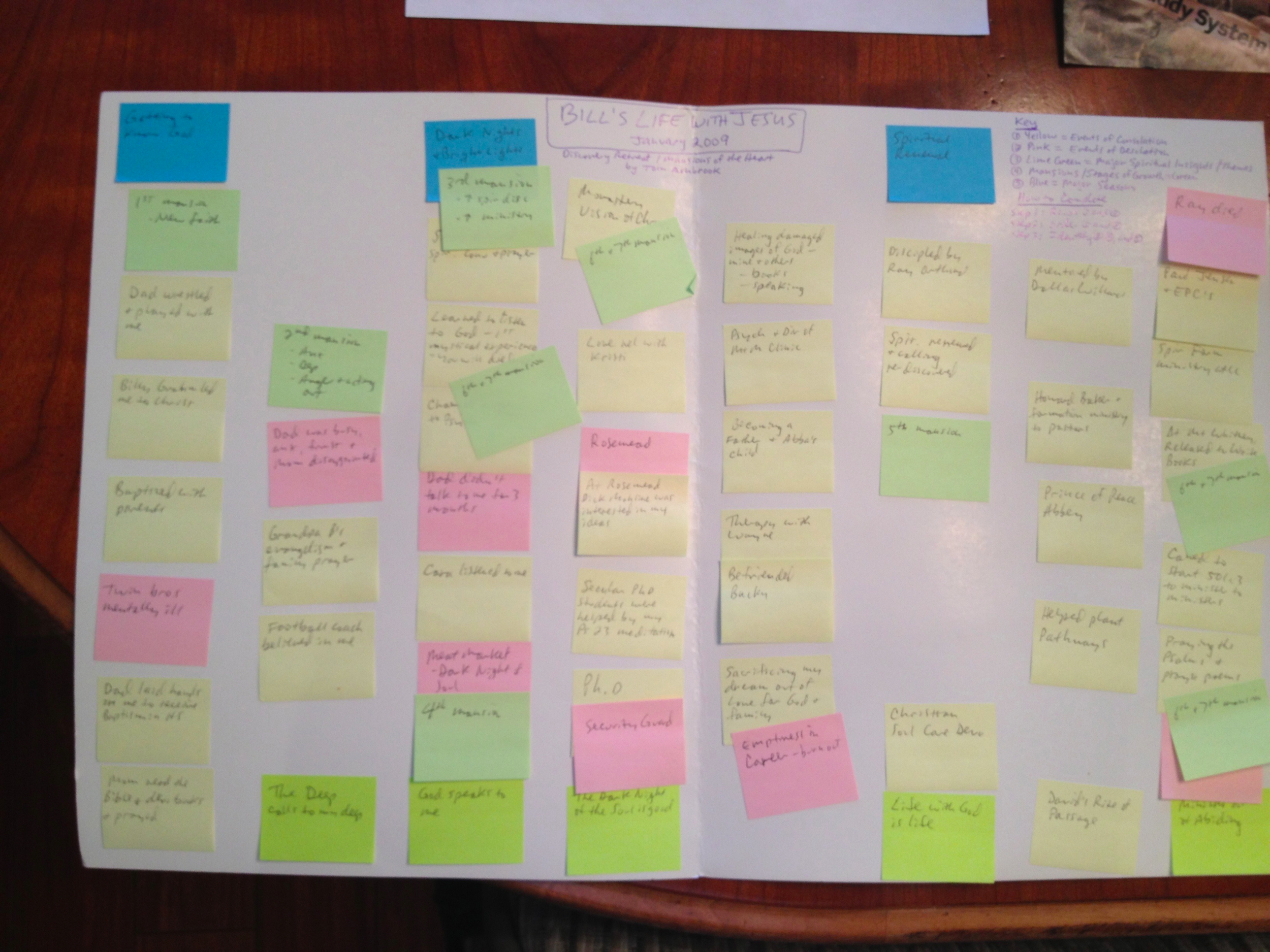
- On a blank sheet of paper, create 3-4 columns to represent every 3 - 4 years of your life. For example, this student broke it up into these years:  0- 10, 11 - 17, 18 -22, 22+. 


- Place the sticky notes in chronological order. If you want to, you can rewrite your negative experiences in a different color, so you can see the frequency of negative events in your life or if one era of your life had more positive or negative experiences. 

- Circle the most important life events that have made some lasting impact today. These events will be the topics for your college essay. 

It’s important to begin first with the important stories you have to share and then figure out which prompt to answer—it’s a more organic and authentic way of writing a heartfelt and honest college essay.

Here’s an example (I know, she has more than 2 colors and her ages aren’t very clear, but you can get an idea of what the final product looks like):

3. Write! 
Now you will have a large sheet of paper with a ton of sticky notes on it—each one containing an important Core Memory. It’s these memories that will become the building blocks of your college essay! Pick one memory and start writing your first draft.

Congratulations - you've completed the most challenging part of the essay process and now you're well on your way to completing your essay! 

- John and Lynn Chen

If you have more questions about brainstorming college essays, or want to chat with an Ilumin Counselor about how to craft the perfect application please contact us here