THE UNOFFICIAL GUIDE TO THE 2017 UC PERSONAL STATEMENTS
Elton Lin
After over a decade of having the same personal statement prompts (I would know, it was the same ones I used when I applied over 10 years ago), the UCs have finally decided to update their prompts!

BUUUUUUUTTTTTTTTT……it’s not all great. The new “Personal Insight Questions” (gone are the days of “personal statements” when we have “personal insights” to explore) have a few caveats. And we're here to walk you through the changes, and help you get started on writing your UC personal statements with this “Unofficial Guide to the New 2017 UC Personal Statements.”
This guide will help you:
- Understand the major changes
- Know what UC Readers actually want
- Have a shortcut to really really knowing what each prompt is asking
- Create a Life Map to ferret out your best stories to share
- Choose which 4 UC Prompts you should answer
- Start writing your “Personal Insight” essays
So, What Are The Major Changes?
I’m GLAD you asked!
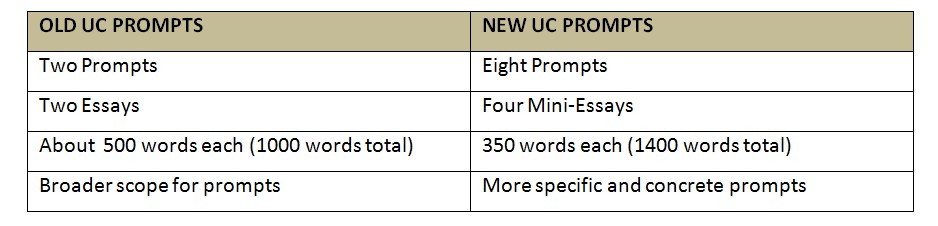
For Incoming Freshmen of Fall of 2017, the UC Personal Statements have changed their format and questions. They now are asking EIGHT “personal insight questions” instead of two broad questions. You need to choose FOUR of those questions to answer.
Because having more choices is never debilitating, right?

Oh yeah, and you have only 350 words per prompt. Max. Compared to the 650 max on common app, you’re really just writing four blurbs about yourself.
But not is all bad news!
The pros are the prompts are way better. Before, students wrote abstract ruminations about how the world they come from somehow shaped their aspirations. Students often sacrificed examples and details trying to cover the entire scope of the prompt. These updated questions are more genuine and are easier to answer because they’re more specific. Which means now, hopefully, your answers will be more specific too.
It’ll just be more laborious because you need to write more essays--short, pithy essays at that. Short essays are harder since it’s easier to data-dump rather than exercise judgment. But the prompts help ground you to one experience, so that’s nice.
So in sum:
So, What Do UC Readers Really Want in an Essay?

They want concrete examples. Specific details. Clear insights. They want visceral examples that will, in the words of the UC, “express who you are, what matters to you and what you want to share with UC.” Stories that will conjure your soul and spirit before the eyes of the reader, and help serve as proof that you meet their 14-Point criteria. Narratives that will ultimately inform their decision to admit you or not.
The UC Reader wants to know who you are and what matters to you. The reader will be asking questions about you, such as: “Are you curious? Courageous? Do you take initiative or are you a follower? Why did you choose the path you chose? What are you passionate about and why? How do you react to setbacks and failures?” And then the follow up question is: “How do I know that’s true?”
So you need two major parts of your essay. You need to tell a good story. And you need to explain what that means about who you are. You need to give clear-as-day specifics of what you’ve done. So that way the UC Reader can tell another: “This student is an impassioned leader. How do I know that? Well, he had this powerful and clear example of how he… [INSERT STORY HERE]”
See how that works? A strong example is now proof that you are who you say you are. A good story is now concrete evidence you belong to their campus. So give them one. Or four.
So, without further ado….
The Personal Insight Questions for 2017…..As Episode Titles
The prompts are pretty confusing since they’re one giant block of text. I figured they could each use a title. One of my favorite TV shows was FRIENDS growing up, and each episode is titled: “The One With…” or “The One Where..” Like “The One Where Nana Died Twice” or “The One With The Jellyfish.” You get the picture.

In that same vein, I decided to title each prompt like it was a TV episode. Hopefully it’ll help ground you in a clear, specific example of sorts. Enjoy.
Prompt 1: The Time I Led or Helped A Group: Describe an example of your leadership experience in which you have positively influenced others, helped resolve disputes, or contributed to group efforts over time.
Prompt 2: The Time I Created Something Cool or Solved That Hard Problem: Every person has a creative side, and it can be expressed in many ways: problem solving, original and innovative thinking, and artistically, to name a few. Describe how you express your creative side.
Prompt 3: The Time I Showcased My Special Skill: What would you say is your greatest talent or skill? How have you developed and demonstrated that talent over time?
Prompt 4: That Time I Learned, Did or Overcame Something Extraordinary Outside of School: Describe how you have taken advantage of a significant educational opportunity or worked to overcome an educational barrier you have faced.
Prompt 5. That Time The Struggle Was Real And I Worked Through It: Describe the most significant challenge you have faced and the steps you have taken to overcome this challenge. How has this challenge affected your academic achievement?
Prompt 6. That Time My Favorite Subject Became My Favorite Subject: Describe your favorite academic subject and explain how it has influenced you.
Prompt 7. That Time I Helped My Community Become Better: What have you done to make your school or your community a better place?
Prompt 8. That Time I Proved To The World I’m One-of-a-kind: What is the one thing that you think sets you apart from other candidates applying to the University of California?
Annndddd, I bet a few of you are feeling like this now:

UC Essay Brainstorming Tool--Which Prompts Should I Choose?
Okay. Don’t panic. I know looking at the eight different prompts can be overwhelming. How do you know which four to choose?
I have always found it more useful to help students approach the essay inside-out instead of outside in. What I mean by that is it’s more authentic when you begin with your memories and then match them to a prompt. When start outside of yourself and use the prompt to remember a story—it sometimes becomes forced, inauthentic, and false.
So, before you use this UC Essay Brainstorming Tool, you are going to need a list of significant memories or moments in your life.
Lucky for you, I’ve adapted a process called a Life Map to help you do that. It uses sticky notes and crafting, and it originally was a counseling tool that I’ve now adapted into an essay tool. Because that’s how teachers roll.
So. Stop Right Now.

Step 1: Complete your Life Map Exercise —then come back here.
Have Core Memory list handy? Okay, let’s move on.
College Essay Archetypes
To help narrow it down, we have three main college essay archetypes that show up either in the Common App Prompts or private college supplemental essay prompts.
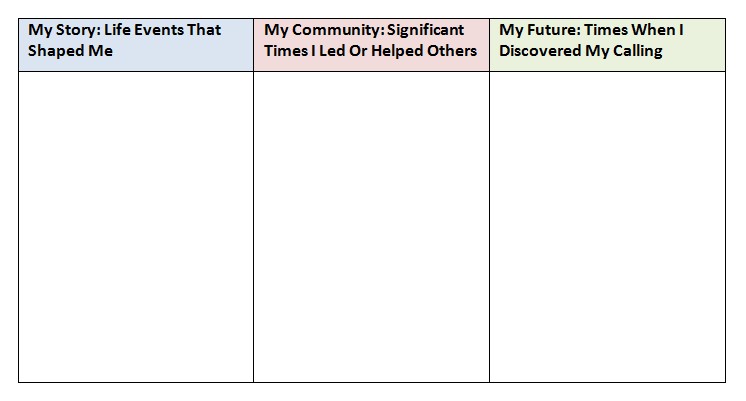
1. My Story-Significant life events that shape who you are. What makes you you?
2. My Community-Significant times in which you led or helped a community become better or solve a problem. Your contributions to a group.
3. My Future-Significant times in your life in which you began to discover your life’s purpose and calling in terms of a career. Think of classes you’ve taken, clubs you’ve participated in, programs you attended, and projects you did in one field of study. Think about why this has led you to choose the major you want and why.
Almost all prompts can fit into one of those three categories. So remember, we are moving inside out. Take your memory list, and work with the next part.
Step 2: For the tool, under each section, list a significant Core Memory that could fall under that kind of prompt.
Step 3: Now you’ve organized your memories, you can finally choose your prompts. We have categorized the 2017 UC Personal Insight Questions under these three main college essay archetypes. Identify the prompts your memories best fit. Please note that some prompts show up in more than one category.
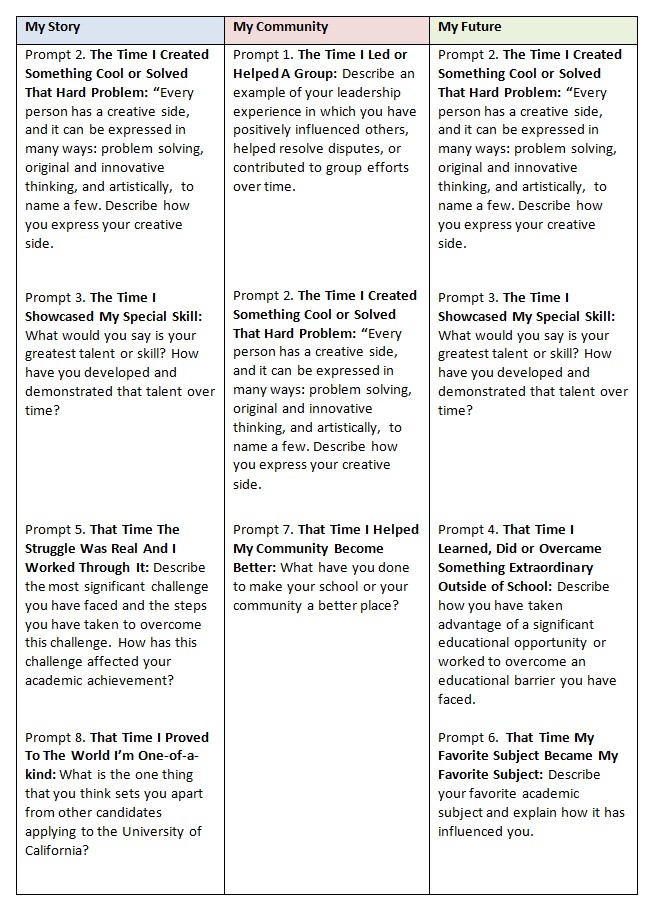
And there you have it—you have identified which prompts you want to answer (hopefully).
How To Start Drafting:

Once you got your prompts, you can start drafting. My students’ least favorite part, but with this tool, I hope it’ll be easier.
Follow this format. Copy and paste the following into a separate document and free write from there.
Prompt (copy and paste prompt here):
Memory (150-200 words): Ground us in what happened. Narrate dialogue, descriptions, and details.
Reflection (150-200 words): Reflect on what this memory says or shows about who you are and what your aspirations are. Answer the reflection questions listed below by the UC (and the ones in bolded are written by me). The UC Provided an additional worksheet here.
Reflection Questions
Prompt 1: Leadership
1. The Time I Led or Helped A Group: Describe an example of your leadership experience in which you have positively influenced others, helped resolve disputes, or contributed to group efforts over time.
Things to consider: A leadership role can mean more than just a title. It can mean being a mentor to others, acting as the person in charge of a specific task, or a taking lead role in organizing an event or project. Think about your accomplishments and what you learned from the experience. What were your responsibilities?
Did you lead a team? How did your experience change your perspective on leading others? Did you help to resolve an important dispute at your school, church in your community or an organization? And your leadership role doesn’t necessarily have to be limited to school activities. For example, do you help out or take care of your family?
My questions: How did you manage conflict or communicate clearly? How did you practice perspective taking and empathy? How did you foster kindness, harmony, forgiveness, unity and teamwork?
Prompt 2: Creativity
2. The Time I Created Something Cool or Solved That Hard Problem: “Every person has a creative side, and it can be expressed in many ways: problem solving, original and innovative thinking, and artistically, to name a few. Describe how you express your creative side.
Things to consider: What does creativity mean to you? Do you have a creative skill that is important to you? What have you been able to do with that skill? If you used creativity to solve a problem, what was your solution? What are the steps you took to solve the problem?
How does your creativity influence your decisions inside or outside the classroom? Does your creativity relate to your major or a future career?
My questions: What inspired you to create something new? How did you go about it? Was it successful-why or why not?
What problem did you identify? Why was this problem significant? What was your process to try and come up with a solution? Was the solution successful-why or why not? What does this process showcase about your passion, your intellect, and your heart?
Prompt 3: Talent or Skill
3. The Time I Showcased My Special Skill: What would you say is your greatest talent or skill? How have you developed and demonstrated that talent over time?
Things to consider: If there’s a talent or skill that you’re proud of, this is the time to share it. You don’t necessarily have to be recognized or have received awards for your talent (although if you did and you want to talk about, feel free to do so). Why is this talent or skill meaningful to you?
Does the talent come naturally or have you worked hard to develop this skill or talent? Does your talent or skill allow you opportunities in or outside the classroom? If so, what are they and how do they fit into your schedule?
My questions: What started your interest in this skill and why did you keep on doing it? How did this skill begin to shape and inform other areas of your life? What has this skill taught you? How has it changed your outlook on yourself, others, and the world?
Prompt 4: Educational Opportunity or Barrier
4. That Time I Learned or Did Something Extraordinary Outside of School: Describe how you have taken advantage of a significant educational opportunity or worked to overcome an educational barrier you have faced.
Things to consider: An educational opportunity can be anything that has added value to your educational experience and better prepared you for college. For example, participation in an honors or academic enrichment program, or enrollment in an academy that’s geared toward an occupation or a major, or taking advanced courses that interest you — just to name a few.
If you choose to write about educational barriers you’ve faced, how did you overcome or strived to overcome them? What personal characteristics or skills did you call on to overcome this challenge? How did overcoming this barrier help shape who are you today?
My questions: What was especially thought-provoking about this experience? How did it confirm one way or the other your career goals? How did you showcase your passion or interest in this certain area of study?
Prompt 5: Significant Challenge
5. That Time The Struggle Was Real And I Worked Through It: Describe the most significant challenge you have faced and the steps you have taken to overcome this challenge. How has this challenge affected your academic achievement?
Things to consider: A challenge could be personal, or something you have faced in your community or school. Why was the challenge significant to you? This is a good opportunity to talk about any obstacles you’ve faced and what you’ve learned from the experience. Did you have support from someone else or did you handle it alone?
If you’re currently working your way through a challenge, what are you doing now, and does that affect different aspects of your life? For example, ask yourself, “How has my life changed at home, at my school, with my friends, or with my family?
My notes: Reserve answering this question ONLY for truly significant life experiences. You can’t write about failing a test or getting a low grade in class. The topic here applies more to some truly traumatic life experience that few teenagers have to go through—to the point that it actually impeded on other areas of your life. Give this topic the gravitas and respect it deserves.
My questions: What were your beliefs about yourself and the world before this event happened? What was lost or gained because of this episode? How did you heal or work through this difficult life circumstance? Who are you now because of it and how does it inform your beliefs about others and the world? Because of this, what hopes do you have for yourself and others?
Prompt 6: Favorite Subject
6. That Time My Favorite Subject Became My Favorite Subject: Describe your favorite academic subject and explain how it has influenced you.
Things to consider: Discuss how your interest in the subject developed and describe any experience you have had inside and outside the classroom — such as volunteer work, summer programs, participation in student organizations and/or activities — and what you have gained from your involvement.
Has your interest in the subject influenced you in choosing a major and/or career? Have you been able to pursue coursework at a higher level in this subject (honors, AP, IB, college or university work)?
My questions: What was especially thought-provoking about this class? How did it confirm one way or the other your career goals? How did your part in the class showcase your passion or interest in this certain area of study?
Prompt 7: Community
7. That Time I Helped My Community Become Better: What have you done to make your school or your community a better place?
Things to consider: Think of community as a term that can encompass a group, team or a place – like your high school, hometown, or home. You can define community as you see fit, just make sure you talk about your role in that community. Was there a problem that you wanted to fix in your community?
Why were you inspired to act? What did you learn from your effort? How did your actions benefit others, the wider community or both? Did you work alone or with others to initiate change in your community?
My questions: What problem did you identify that this community was facing? What was your process to try and come up with a solution? Was the solution successful-why or why not? What does this process showcase about your passion, your intellect, and your heart?
How did you manage conflict or communicate clearly? How did you practice perspective taking and empathy? How did you foster kindness, harmony, forgiveness, unity and teamwork?
Prompt 8: Unique
8. That Time I Proved To The World I’m One-of-a-kind: What is the one thing that you think sets you apart from other candidates applying to the University of California?
Things to consider: Don’t be afraid to brag a little. Even if you don’t think you’re unique, you are — remember, there’s only one of you in the world. From your point of view, what do you feel makes you belong on one of UC’s campuses? When looking at your life, what does a stranger need to understand in order to know you?
What have you not shared with us that will highlight a skill, talent, challenge, or opportunity that you think will help us know you better? We’re not necessarily looking for what makes you unique compared to others, but what makes you, YOU.
My questions: What is an experience or quality that really sets you apart and why? What values does this event or quality showcase about you? Who are you now because of it and how does it inform your beliefs about others and the world? Because of this, what hopes do you have for yourself and others?
And there you have it! Hopefully you have at least some drafts and ideas to begin tackling the 2017 UC Personal Insight Questions! Writing is a process, and so give yourself plenty of time to revisit these steps and revisit your essays.
I know there’s still a lot of panicking going on, but hopefully after this Unofficial Guide to the 2017 UC Personal Statements, these new essays won’t be something you’re panicking about.
Update: If you wanted these brainstorming exercises in a word document so it's easier to work through--you can access the file here. Also in there is some insights on how to best structure a college essay as well. Enjoy!
- John and Lynn Chen
If you have more questions about the new UC application essays, or want to chat with an Ilumin Counselor about how to craft the perfect application please contact us here!